

What age 20 inch wheel bike
A 20-inch wheel bike is an XBikes starting point for children ages 7–12 and 48–60 inches (122–152 cm) tall. Age is only a guide: measure the rider and confirm stand-over clearance, reach, brake control and confidence on the actual bike before choosing it.
Start with height, not birthday
Have the child stand straight without shoes against a wall, with feet flat and together. Mark the top of the head and measure from the floor. Compare that result with the 20-inch starting range of 48–60 inches (122–152 cm).
A child inside that range may be ready for a 20-inch bike, but the number does not guarantee a fit. Children of the same age can have different leg lengths, arm reach and riding ability. A rider outside the range should be compared with the adjacent XBikes starting points rather than assigned a bike by age alone.
| Wheel size | Starting age | Rider height |
|---|---|---|
| 18 Inch | 5–9 | 43–52 in / 109–132 cm |
| 20 Inch | 7–12 | 48–60 in / 122–152 cm |
| 24 Inch | 10–14 | 54–64 in / 137–163 cm |
The overlapping ranges are intentional starting points. They show why a tall seven-year-old and a shorter ten-year-old may need different comparisons.
Measure inseam and check stand-over
Measure inseam by having the child stand in socks with feet slightly apart. Place a firm, thin book between the legs so its upper edge meets the crotch as a bicycle saddle would, then measure from the floor to that edge.
Next, have the child straddle the actual bicycle with both feet flat on the floor. There should be clear space between the child and the top tube, and mounting or stepping off should feel controlled. Exact frame geometry is not supplied here, so wheel diameter alone cannot tell you whether that clearance is adequate.
Test reach, brakes and confidence
With the bicycle supported by an adult, ask the child to sit in a normal riding position and hold the grips. The child should reach the handlebar without stretching, twisting forward or locking the elbows. Steering should feel manageable through a gentle turn in each direction.
Check that the rider can comfortably operate the bicycle’s fitted brakes while maintaining a secure grip. Do not assume that reaching the handlebar means the brake controls are also within reach. Then arrange a short, supervised try in a traffic-free area. Look for a controlled start, straight tracking, deliberate braking and a calm stop.
If the child appears tense, cannot stop predictably or struggles to put a foot down, reconsider the fit or setup. Do not buy an oversized bicycle solely to leave growing room; the child should be able to control it now.
How the supplied 20-inch options help
The catalog provides two relevant comparisons because each includes a 20 Inch SKU label: the cruiser listing offers color-and-size variants, while the training-wheel listing offers several wheel-size variants. These labels identify choices to inspect, but they do not replace the individual fit checks above.
 26-Inch XJD Beach Cruiser Bike for Girls – Purple, V-Brake
This cruiser listing includes Mint Green / 20 Inch and Pink / 20 Inch variants, making those exact SKUs relevant for a 20-inch comparison despite the product title beginning with 26-Inch.
 Light Pink XJD Girls' Bicycle with Basket & Training Wheels
This training-wheel bicycle listing includes a 20 Inch SKU, plus separate 12, 14 and 16 Inch choices. Use the exact 20-inch variant for comparison and still perform an individual fit check.
26-Inch XJD Beach Cruiser Bike for Girls – Purple, V-Brake
Despite the exact product title beginning with “26-Inch,” this listing includes Mint Green / 20 Inch and Pink / 20 Inch SKU labels, alongside 24- and 26-inch choices. Select the exact 20-inch variant when comparing it for this question; do not treat the Purple / 26 Inch option as equivalent.
Light Pink XJD Girls' Bicycle with Basket & Training Wheels
This listing includes 12 Inch, 14 Inch, 16 Inch and 20 Inch SKU labels. Its 20 Inch variant is relevant to the requested size, while the smaller labels are separate sizes. The title identifies a basket and training wheels, but the supplied catalog facts do not establish whether those features suit a particular rider’s ability.
Make the final decision
- Measure standing height and inseam.
- Use ages 7–12 and 48–60 inches (122–152 cm) only as the 20-inch starting point.
- Confirm stand-over space, comfortable handlebar reach and effective brake operation on the exact bicycle and variant.
- Observe a supervised test for controlled starting, steering, stopping and dismounting.
- Choose a properly fitting helmet that sits level and is secured using its straps according to the manufacturer’s instructions.
For assembly, maintenance, load limits, component compatibility or torque settings, follow the exact product manual or use a qualified bicycle mechanic; those details are not supplied here.
Choose the 20-inch bike only if the child fits and controls it today. If those checks fail, compare the measured rider with the adjacent 18- or 24-inch starting range and repeat the same hands-on fit test.
Bikes for your next adventure
-
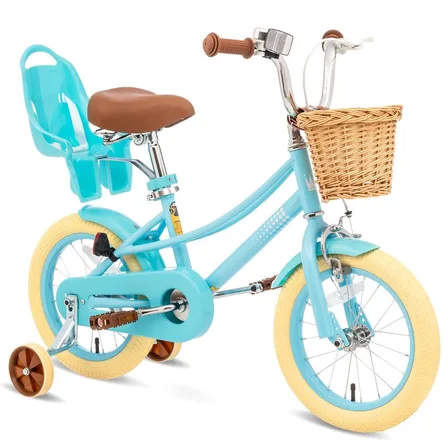
Girls' Training Wheel Bike by XJD, 12–20 Inch Wheels – Blue
This XJD girls' training wheel bike in Blue covers one of the widest fit ranges …$139
$159 -
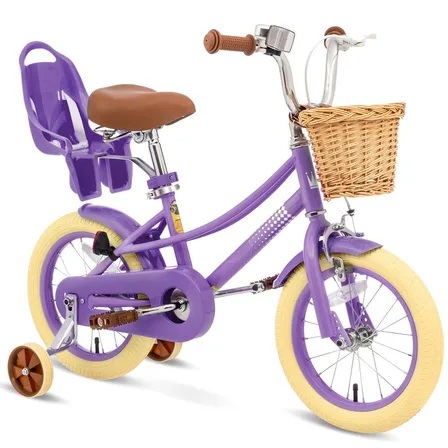
XJD Girls' Bike with Training Wheels, 12/14/16/20 Inch – Purple
The XJD girls' bike with training wheels in Purple is built to grow with your ri…$139
$159 -
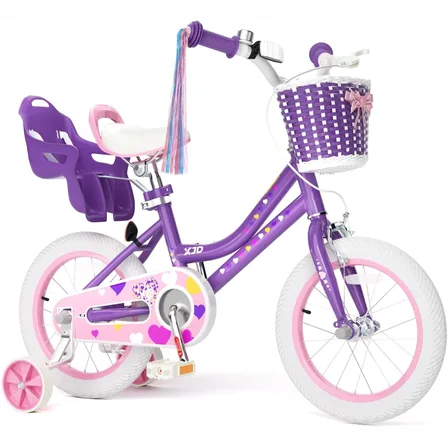
XJD Light Purple Girls Bike with Basket, Training Wheels, 12/14/16/20 Inch
The XJD Girls Bike with Basket in Light Purple is a single-speed training-wheel …$99.99
$119.99