

What age 12 inch bike
A 12-inch bike is an XBikes starting point for ages 3–4 and heights 34–40 in (86–102 cm), but your child’s measurements and control determine the fit.
What age is a 12-inch bike for?
The short answer is ages 3–4. That age range is only a starting point: children of the same age can differ substantially in height, leg length, reach and confidence. Measure the rider instead of choosing from a birthday alone.
Under the XBikes standard, a 12-inch wheel size corresponds to a rider height of 34–40 in (86–102 cm). If your child falls outside that range, compare the adjacent wheel sizes, but do not assume that a larger bike will work simply because the child will eventually grow into it.
Measure before choosing
Measure your child’s standing height without shoes, with their back straight against a wall. Then measure the inseam from the floor to the crotch while the child stands naturally. Height identifies a useful wheel-size starting point; inseam helps you judge stand-over clearance and whether the child can get on, stop and put their feet down comfortably.
Record both measurements and bring them to the fit check. A wheel-size label does not provide the frame dimensions, saddle range or reach of every bicycle, so it cannot establish fit on its own.
Compare the nearest wheel sizes
| Wheel size | Starting age | Rider height |
|---|---|---|
| 12 Inch | 3–4 | 34–40 in / 86–102 cm |
| 14 Inch | 3–6 | 37–45 in / 94–114 cm |
| 16 Inch | 4–7 | 40–48 in / 102–122 cm |
The ranges overlap because age and height do not produce one automatic answer. A child near 40 in (102 cm), for example, reaches the upper starting point for a 12-inch bike and the lower starting point for a 16-inch bike. Compare actual fit and control rather than selecting the larger label by default. A 14-inch option may also deserve comparison within its stated range, but it is not equivalent to either neighboring size.
How to perform the fit check
Have the child try the exact bicycle whenever possible. The American Academy of Pediatrics advises against buying an oversized bike for future growth. During the trial, look for the following:
- Stand-over: The child should be able to straddle the bicycle with appropriate clearance rather than being pressed against the frame.
- Starting and stopping: They should be able to mount, begin moving, stop and stabilize without the bicycle overwhelming them.
- Reach: Their hands should reach the controls while their posture remains comfortable and controlled.
- Brake control: The child must be able to reach and operate the bicycle’s braking controls confidently.
- Confidence: Watch for tension, difficulty steering or reluctance caused by the bicycle feeling too large.
If height suggests one size but the child cannot control that bicycle, prioritize the fit trial. Do not compensate for poor reach or stand-over by assuming practice will solve an oversized fit.
How the supplied catalog option helps
The Girls 12/14/16 Inch Kids Bike by XJD with Training Wheels – Peach is relevant because its supplied SKU labels include 12 Inch, 14 Inch and 16 Inch. Those options let you compare the requested 12-inch size with adjacent starting points while keeping each size distinct. Its training wheels are also explicit in the catalog title and category, but they do not replace checking height, inseam, reach, brake operation and confidence.
These catalog options help answer “what age 12 inch bike” by presenting the requested 12 Inch SKU alongside 14 Inch and 16 Inch alternatives for children whose measurements or fit trial point away from 12 inches.
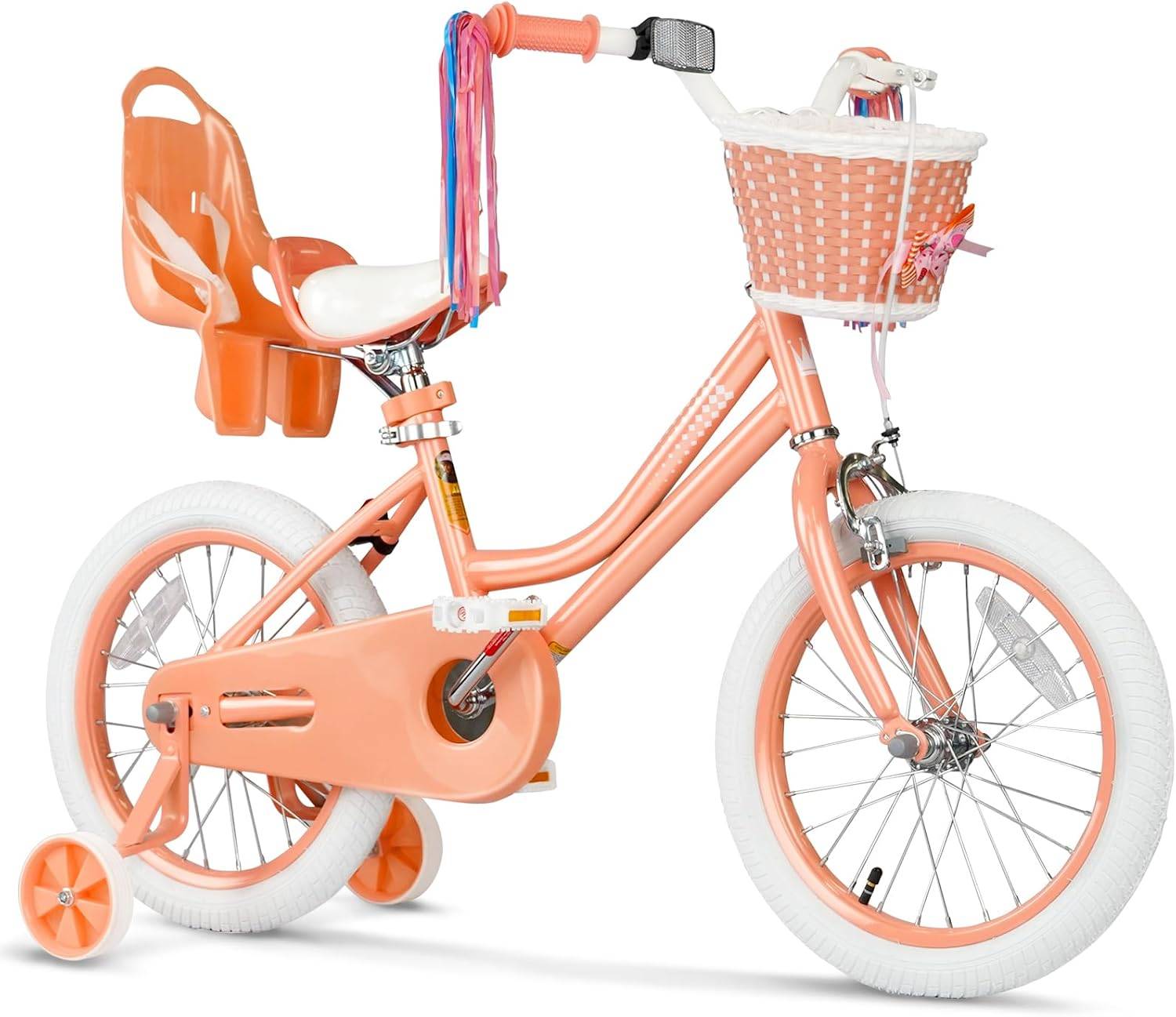
Use only the exact SKU label when comparing sizes. Do not infer frame dimensions, brake type, materials, weight, load limit or other specifications from the title. For assembly, adjustment, maintenance, compatibility and torque requirements, follow the exact product manual or ask a qualified bicycle mechanic.
Helmet and final decision
A properly fitting bicycle helmet is required for the ride. Following U.S. Consumer Product Safety Commission guidance, position it level and adjust its straps according to the helmet manufacturer’s instructions. A helmet cannot correct a bicycle that is too large or difficult for the child to control.
Choose the 12-inch option only when the child is near the 34–40 in (86–102 cm) starting range and the individual trial confirms suitable stand-over, reach, brake control and confidence. If the trial does not confirm those points, measure again and compare the 14-inch or 16-inch starting ranges—without treating either as an automatic upgrade or buying extra size merely for growth.
Bikes for your next adventure
-
Girls 12/14/16 Inch Kids Bike by XJD with Training Wheels – Peach
The XJD Girls Bike in Peach is a training-wheel bike built for girls roughly 3 t…$149
$169 -

Pink Girls' 12/14/16" Bike by XJD – Basket & Doll Seat
The XJD Pink Girls' Bike with Basket & Doll Seat is made for riders 71–122 cm ta…$75.99
$99.99 -
Pink 12/14/16/20" XJD Girls Bike with Training Wheels & Basket
The Pink XJD Girls Bike with Training Wheels & Basket is a first-bike pick f…$65.99
$75.99