

Is a 20 inch bike good for what height
A 20-inch bike is a starting match for a child 48–60 inches (122–152 cm) tall, typically ages 7–12. Measure the rider and check the actual bike before deciding.
Who usually fits a 20-inch bike?
Under the XBikes wheel-size starting points, a 20-inch bicycle corresponds to a rider height of 48–60 inches (122–152 cm). The age range of 7–12 is only a secondary guide because children of the same age can have different leg lengths, arm lengths, coordination and confidence.
If the rider is below 48 inches, compare smaller wheel sizes rather than buying a 20-inch bike for future growth. If the rider is above 60 inches, begin comparing larger sizes. At either boundary, an individual fit check matters more than the range alone.
| Wheel size | XBikes rider-height starting point | Typical age |
|---|---|---|
| 16 Inch | 40–48 in / 102–122 cm | 4–7 |
| 18 Inch | 43–52 in / 109–132 cm | 5–9 |
| 20 Inch | 48–60 in / 122–152 cm | 7–12 |
| 24 Inch | 54–64 in / 137–163 cm | 10–14 |
Measure height and inseam first
Measure standing height without shoes, with the child upright against a wall. Then measure inseam: have the child stand with feet slightly apart and measure from the floor to the crotch. Record both measurements in inches or centimetres.
Compare standing height with the 20-inch range, but do not turn inseam into a wheel-size answer by itself. Frame shapes and stand-over heights vary, so the recorded inseam must be compared with the exact bicycle and its product manual. If the manual does not provide enough information, ask a qualified bicycle mechanic to assess the fit.
Check the child on the actual bicycle
A height-range match does not prove that a particular frame fits. Have the child try the bicycle, following the American Academy of Pediatrics guidance not to choose an oversized bike merely so the child can grow into it.
- Stand-over: The child should be able to straddle the frame with appropriate clearance and without leaning the bicycle sharply.
- Reach: Seated in a normal riding position, the child should reach the handlebar without stretching, locking the elbows or losing balance.
- Brake control: The child should reach and operate the provided brakes confidently while keeping control of the handlebar.
- Starting and stopping: In a traffic-free area with close adult supervision, confirm that the rider can start, steer, stop and dismount without struggling against the bike’s size.
If any of these checks fail, do not assume an adjustment will solve the problem. Follow the exact product manual for permitted adjustments, assembly and compatibility, or use a qualified bicycle mechanic.
How the catalog options help with the comparison
These catalog choices include 20-inch bicycles or 20-inch SKU labels, so they provide relevant models to compare after measuring the rider. Their different categories also make it important to judge the exact configuration and individual fit rather than treating every 20-inch bicycle as interchangeable.
 Blue XJD Freestyle BMX Bike, 20-Inch – No Pegs
A 20-inch Kids' BMX Bikes option with a Default SKU label. Compare its actual stand-over, reach and brake control with the measured rider before choosing it.
 Pink 12/14/16/20" XJD Girls Bike with Training Wheels & Basket
This Training Wheel Bikes model offers distinct 12, 14, 16 and 20 Inch SKU labels. The 20 Inch configuration is relevant here; verify that exact selection and perform an individual fit check.
 26-Inch XJD Beach Cruiser Bike for Girls – Purple, V-Brake
Although its title begins with 26-Inch, this Beach Cruiser Bikes listing includes Mint Green / 20 Inch and Pink / 20 Inch SKU labels. Confirm the selected size because its 20-, 24- and 26-inch configurations are not equivalent.
The Blue XJD Freestyle BMX Bike, 20-Inch – No Pegs is a 20-inch option in Kids' BMX Bikes, with a Default SKU label. Its listed wheel size makes it relevant when the rider falls near the 20-inch height starting point, but the catalog facts do not establish stand-over clearance, reach or brake fit.
The Pink 12/14/16/20" XJD Girls Bike with Training Wheels & Basket is in Training Wheel Bikes and has separate 12 Inch, 14 Inch, 16 Inch and 20 Inch SKU labels. Select and evaluate the 20 Inch label for this question; the smaller labels are distinct sizes, not equivalent alternatives.
The 26-Inch XJD Beach Cruiser Bike for Girls – Purple, V-Brake is in Beach Cruiser Bikes. Despite the exact title beginning with “26-Inch,” its supplied SKU labels include Mint Green / 20 Inch and Pink / 20 Inch, as well as 24- and 26-inch choices. Verify the selected label carefully. Do not infer that its differently sized configurations fit the same rider.
Make the final decision safely
A properly fitting bicycle helmet is necessary whenever the child rides. The U.S. Consumer Product Safety Commission advises that the helmet fit properly, sit level and have its straps used according to the manufacturer’s instructions.
Choose a 20-inch bike only when the child’s measured height is consistent with the 48–60-inch starting range and the actual-bike check confirms comfortable stand-over, manageable reach, effective brake control and confident handling. If those checks do not agree, compare the adjacent size indicated by the rider’s height instead of buying extra room for growth.
Bikes for your next adventure
-

Light Pink XJD Girls' Bicycle with Basket & Training Wheels
The Light Pink XJD Girls' Bicycle with Basket & Training Wheels is a retro-style…$109.99
$129.99 -

Kids Bike Helmet by XJD for Girls – Pink
The XJD Kids Bike Helmet in Pink is a lightweight multi-sport helmet for girls r…$59.99
$99 -
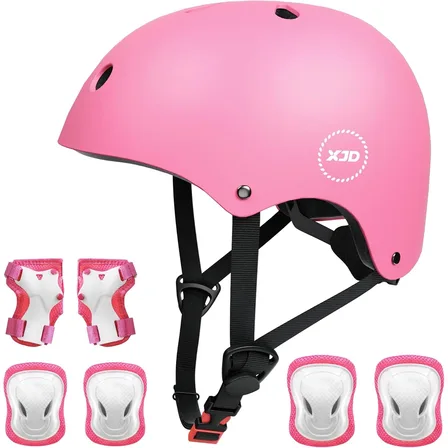
XJD Kids Helmet & Protective Gear Set for Girls, Pink
The XJD Kids Helmet & Protective Gear Set in Pink is a complete safety kit for g…$24.64