

What age are 20 inch bikes for
A 20-inch bike is a starting point for children ages 7–12 who are 48–60 inches (122–152 cm) tall, but measured fit and control matter more than age.
Is a 20-inch bike the right size?
Age gives you a quick place to begin, not a final answer. Children of the same age can differ substantially in height, leg length, reach and riding confidence. Measure the child and have them try the bicycle before deciding.
Do not choose an oversized bike simply to leave room for growth. A child needs to control the bike comfortably now. If the rider falls outside the 20-inch starting range—or cannot manage the bike during a fit check—compare the neighboring wheel sizes instead.
| Wheel size | Starting age | Rider height |
|---|---|---|
| 16 Inch | 4–7 | 40–48 in / 102–122 cm |
| 18 Inch | 5–9 | 43–52 in / 109–132 cm |
| 20 Inch | 7–12 | 48–60 in / 122–152 cm |
| 24 Inch | 10–14 | 54–64 in / 137–163 cm |
The overlapping ranges are intentional: wheel size cannot be selected reliably from a birthday alone.
What to measure before shopping
- Standing height: Have the child stand straight without shoes against a wall. Measure from the floor to the top of the head, then compare the result with the 48–60-inch (122–152 cm) starting range.
- Inseam: Measure from the floor to the crotch while the child stands in socks with feet slightly apart. Use this measurement when checking the bicycle’s stand-over clearance; wheel diameter alone does not determine frame clearance.
- Reach: On the actual bike, check whether the rider can hold the handlebars without stretching, locking the elbows or leaning awkwardly.
Frame shapes and adjustment ranges can differ even when two bicycles share 20-inch wheels. Follow the exact product manual for permitted adjustments, assembly and compatibility. If anything is unclear, use a qualified bicycle mechanic.
Perform a hands-on fit check
Have the child straddle the bicycle with both feet flat on the ground. There should be usable clearance between the child and the frame rather than contact with the top tube. Next, seat the rider and check that starting, stopping and steering feel controlled.
The child should be able to reach and operate the brakes comfortably, where applicable, without shifting the hands into an unstable position. Ask for a few controlled starts, turns and stops in a traffic-free area. Hesitation caused by unfamiliarity can improve with practice; an inability to reach the controls or handle the bicycle is a fit problem.
Current confidence also matters. A rider who is technically within the height range may still find a particular 20-inch bike difficult to manage. Conversely, an older child below the height range should not move to 20-inch wheels based on age alone.
How the supplied 20-inch options are relevant
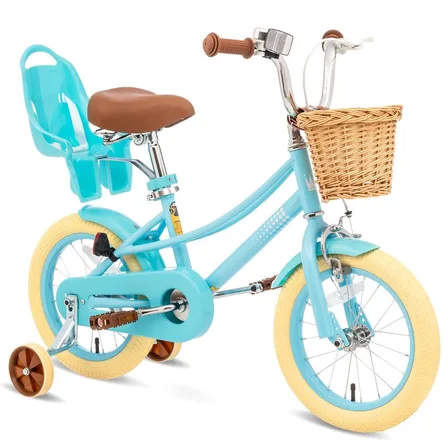
Both supplied catalog bicycles offer a labeled 20 Inch version, so they are directly relevant to this question. The Girls' Training Wheel Bike by XJD, 12–20 Inch Wheels – Blue is listed in 12, 14, 16 and 20 Inch options. The XJD Girls' Bike with Training Wheels, 12/14/16/20 Inch – Purple has the same supplied size labels. Their catalog category is Training Wheel Bikes; their exact fit still requires the measurements and hands-on checks above.
 Girls' Training Wheel Bike by XJD, 12–20 Inch Wheels – Blue
This training-wheel bicycle listing includes a 20 Inch SKU, alongside 12, 14 and 16 Inch labels. Its relevance depends on the child passing an individual height, stand-over, reach and control check.
 XJD Girls' Bike with Training Wheels, 12/14/16/20 Inch – Purple
This training-wheel bicycle is offered with a labeled 20 Inch option as well as 12, 14 and 16 Inch options. Use the 20 Inch size only after checking the individual rider’s measurements and control.
These products are useful when a family specifically wants to compare training-wheel bicycle listings that include a 20 Inch SKU. Their supplied facts do not establish frame dimensions, brake type, adjustment range, load limit, assembly procedure or suitability for an individual child. Confirm those details in the exact product manual or with a qualified bicycle mechanic.
When a different wheel size may fit better
If the child measures below 48 inches (122 cm), do not assume the 20-inch option will work. The XBikes starting points place 18-inch bikes at ages 5–9 and heights of 43–52 inches (109–132 cm), while 16-inch bikes begin at ages 4–7 and 40–48 inches (102–122 cm). Test the actual bicycle rather than treating the overlap as automatic interchangeability.
If the rider is above 60 inches (152 cm), compare larger options. A 24-inch bike starts at ages 10–14 and heights of 54–64 inches (137–163 cm); 26-inch bicycles are a starting point for youth and adults over 60 inches (153 cm). These ranges guide comparison but do not override reach, stand-over, brake control or confidence.
Make the final 20-inch decision
Choose a 20-inch bike only when the child’s measured height supports it and the actual bicycle passes the stand-over, reach, steering and brake-control checks. Finish by fitting a bicycle helmet so it sits level and its straps are used according to the helmet manufacturer’s instructions. If the child cannot control the bike comfortably today, compare another wheel size instead of buying 20-inch wheels for future growth.
Bikes for your next adventure
-

XJD Kids Bike for Girls – Pink, 12/14/16/20 Inch with Training Wheels
The XJD Kids Bike for Girls in Pink is a training-wheel bike built to carry your…$139
$159 -
Girls' Training Wheel Bike by XJD, 12–20 Inch Wheels – Blue
This XJD girls' training wheel bike in Blue covers one of the widest fit ranges …$139
$159 -

26-Inch XJD Beach Cruiser Bike for Girls – Purple, V-Brake
This XJD 26-inch purple beach cruiser is sized for big kids and teens — suggeste…$218.49
$229.99