

What age can a baby go in a bike carrier
A baby can go in a bike carrier only after meeting that carrier’s minimum age and size rules, sitting upright unsupported, and wearing a properly fitted helmet. Age alone is not enough.
What decides whether your baby is ready?
There is no single age that applies to every bike-mounted child seat, trailer or other carrier. Designs differ, so begin with the exact carrier manual. Check its minimum and maximum age, weight and height requirements, along with any instructions about helmet clearance, seating position and harness use. If those details are missing, do not guess; contact the manufacturer or ask a qualified bicycle mechanic.
Your child also needs enough head, neck and trunk control to remain stable while the bicycle starts, stops, turns and travels over uneven surfaces. A baby who slumps, cannot sit unsupported for the journey, or cannot hold their head steadily is not ready, even if they have reached a stated minimum age.
Measure and compare before the first ride
Measure your child’s current height and weight, then compare both with the carrier manual. Do not rely on clothing size or a measurement taken several months ago. Confirm that the harness can be adjusted as instructed, that the child’s helmet does not force their head forward, and that feet, hands and clothing remain inside the carrier’s protected spaces.
- Measure: current height and weight.
- Observe: unsupported sitting and steady head control.
- Compare: every result with the exact carrier’s manual.
- Check: harness position, helmet clearance and protected placement of hands and feet.
- Stop: if your child slumps, appears uncomfortable or no longer fits within any stated limit.
Check the bicycle and carrier together
A child may be developmentally ready while the equipment combination is unsuitable. Verify that the carrier is explicitly compatible with the bicycle, mounting location and any rack or frame attachment involved. Follow the product manuals for assembly, maintenance, load limits and fastener torque. None of those details should be inferred from appearance.
Before carrying a child, inspect the installation and make a short, unloaded handling check in a traffic-free area. A carrier changes balance, steering and stopping. If mounting instructions are unclear, parts do not align correctly or the bicycle feels difficult to control, have a qualified bicycle mechanic examine the setup.
Helmet fit is a separate requirement
The U.S. Consumer Product Safety Commission advises that a bicycle helmet must fit properly, sit level and have its straps used according to the helmet manufacturer’s instructions. Check the fit on the child, not over bulky headwear. The carrier must also provide enough space for the helmet without pushing it forward or tilting it.
A carrier’s harness does not replace a helmet, and a helmet does not make a child developmentally ready. Both equipment fit and physical readiness must be satisfied.
When the supplied bikes become relevant
The supplied XBikes products are not baby carriers. They become relevant later, when a child is ready to ride a bicycle independently or with training wheels. Their available wheel sizes provide useful comparison points for that later transition, but they do not answer carrier compatibility or replace a carrier.
 XJD Kids Bike for Girls – Pink, 12/14/16/20 Inch with Training Wheels
A later-stage riding option offered in 12, 14, 16 and 20 Inch sizes with training wheels; it is a bicycle, not a baby carrier.
 XJD Pink Girls' Bike – Kids 12/14/16 Inch Training Wheel Bicycle
A training-wheel bicycle offered in 12, 14 and 16 Inch sizes for comparison when a child progresses to independent riding; it is not a carrier.
XJD Kids Bike for Girls – Pink, 12/14/16/20 Inch with Training Wheels is listed in 12, 14, 16 and 20 Inch options. XJD Pink Girls' Bike – Kids 12/14/16 Inch Training Wheel Bicycle is listed in 12, 14 and 16 Inch options. The first therefore extends to a 20 Inch catalog choice, while the second stops at 16 Inch. No other product differences are established by the supplied facts.
How to size a later first bicycle
For a future bicycle purchase, XBikes uses these starting points: 12 Inch for ages 3–4 and heights 34–40 in / 86–102 cm; 14 Inch for ages 3–6 and 37–45 in / 94–114 cm; 16 Inch for ages 4–7 and 40–48 in / 102–122 cm; and 20 Inch for ages 7–12 and 48–60 in / 122–152 cm.
These ranges are screening guides, not proof of fit. Measure the rider’s height and inseam, then have the child try the bicycle. Check stand-over clearance, reach, brake control and current confidence. Consistent with HealthyChildren guidance, do not buy an oversized bicycle merely to allow room for growth. Any age wording in a product title is a catalog label rather than individual fit evidence.
Your next decision
Find the exact carrier manual now and compare its limits with fresh measurements and your baby’s unsupported sitting and head control. Proceed only when every requirement is met, the helmet fits correctly and the bicycle-carrier combination is confirmed compatible. Otherwise, wait and recheck later; consider the supplied training-wheel bicycles only when your child reaches the independent-riding stage and passes an individual bike fit check.
Bikes for your next adventure
-

XJD Pink Beach Cruiser for Girls – Rear Rack & V-Brake
The XJD Pink Beach Cruiser for girls is the step-up bike for riders who've outgr…$179.99
$209.99 -
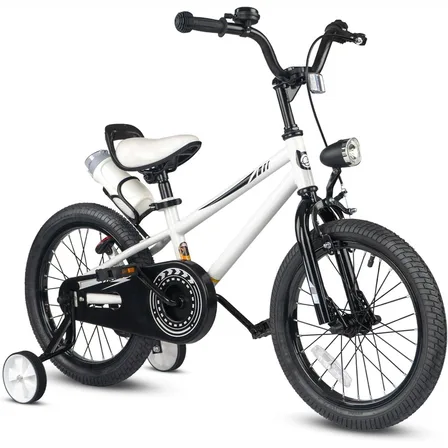
XJD Kids' Training Wheel Bike for Boys & Girls, 12/14/16 Inch – White
The XJD kids' training wheel bike in White is made for riders ages 3–8 (roughly …$169
$199 -

Kids Bike Helmet by XJD for Boys & Girls – Black, Blue, Green, Pink, Purple
The XJD Kids Bike Helmet covers a wide 2-to-8-year age range thanks to two head-…$59.99