

What age bike trailer baby
There is no single age at which every baby can ride in a bike trailer. Use the trailer manufacturer’s minimum age and readiness rules, confirm the child fits its restraint system, and ask the child’s pediatrician if readiness is uncertain.
Decide by readiness, not a birthday alone
A baby must satisfy every requirement in the exact trailer manual. Look for its minimum passenger age, required developmental abilities, permitted seating position, and any rules concerning helmets or infant accessories. A child who has reached an age printed in general advice is not automatically ready for a particular trailer.
Before riding, confirm that the baby can maintain the head and body position required by the manual throughout a moving journey. Consider whether the child can remain properly positioned when the trailer turns, stops, or travels over uneven ground. If the baby slumps, cannot be secured as directed, or does not meet even one stated condition, wait.
Prematurity, low muscle tone, medical conditions, and differences in development can make an age-based estimate especially unreliable. Discuss the intended setup with the child’s pediatrician when any developmental or medical question remains.
What to measure and compare
Check the baby’s current measurements against the trailer’s stated passenger limits. The relevant dimensions may include height and weight, but use only the limits and measuring method in that model’s manual. Do not estimate from clothing size or assume that an accessory changes the permitted range.
- Passenger fit: The restraint must lie and fasten exactly as its instructions show, without routing around bulky clothing or an unapproved insert.
- Head clearance: Confirm the required clearance with the child seated in the specified position and wearing any equipment required by the manual.
- Body position: Check that the baby remains supported and does not slide, slump, or lean outside the protected seating area.
- Towing compatibility: Compare the trailer coupling requirements with the towing bicycle. Never assume that an axle, frame, or adapter is compatible.
For an uncertain measurement, accessory, load limit, attachment, assembly step, or torque setting, consult the exact product manual or a qualified bicycle mechanic. Do not improvise a connection or substitute an accessory merely because it appears to fit.
Check the complete setup before the first trip
The adult towing bicycle must be correctly sized and fully controllable by its rider. Attach and inspect the trailer precisely as its manufacturer directs, including every hitch, secondary retention device, restraint, closure, wheel, and visibility component specified in the instructions.
Load the child only after the trailer is attached and stable. Secure the passenger according to the manual, then make a stationary check of clearances and restraint position. Begin with a short, calm route away from traffic and avoid conditions prohibited by either manual. A trailer changes the bicycle’s width, turning path, acceleration, and stopping behavior, so the towing adult should practice with the approved setup before carrying the baby.
Helmet and local-rule questions
Helmet directions can depend on the trailer design, manufacturer instructions, and applicable law. Follow all three rather than applying a rule from a different trailer. When a bicycle helmet is required, it must be the correct size, sit level, and have its straps adjusted according to the helmet manufacturer’s instructions. A poorly positioned helmet is not corrected by tightening unrelated trailer restraints.
If the trailer manual, helmet instructions, and local requirements appear to conflict, do not ride until the trailer manufacturer or another qualified source resolves the conflict. Never remove padding, alter a restraint, or modify the trailer to create space.
Why the supplied bicycle is only a later-stage comparison
The supplied catalog item is not a baby trailer. The XJD Girls' Bike with Training Wheels, 12/14/16/20 Inch – Purple is a training-wheel bicycle offered in 12 Inch, 14 Inch, 16 Inch, and 20 Inch labels. It therefore does not establish when a baby may ride as a trailer passenger. It becomes relevant only when comparing a later transition to a child’s own bicycle and checking that bicycle individually.

As XBikes starting points, 12 Inch corresponds to ages 3–4 and heights 34–40 in (86–102 cm); 14 Inch to ages 3–6 and 37–45 in (94–114 cm); 16 Inch to ages 4–7 and 40–48 in (102–122 cm); and 20 Inch to ages 7–12 and 48–60 in (122–152 cm). These ranges are not trailer-passenger guidance.
For any child’s bicycle, measure current height and inseam, then check stand-over clearance, reach, brake control, and confidence on the actual bicycle. Have the child try it, and do not select an oversized size merely to allow room for growth. Age is only a starting point.
Your next decision
Find the exact trailer manual now and compare its passenger requirements with the baby’s present measurements, developmental control, and restraint fit. If every condition is met, verify bicycle compatibility and complete the prescribed setup checks. If a condition is missing, unclear, or unmet, postpone the trailer ride and contact the manufacturer, a qualified bicycle mechanic, or the child’s pediatrician as appropriate.
Bikes for your next adventure
-

Blue XJD Kids Bike Helmet for Boys & Girls
The Blue XJD Kids Bike Helmet is a lightweight, adjustable multi-sport helmet fo…$59.99
$99 -

Kids Bike Helmet by XJD for Girls – Pink
The XJD Kids Bike Helmet in Pink is a lightweight multi-sport helmet for girls r…$59.99
$99 -
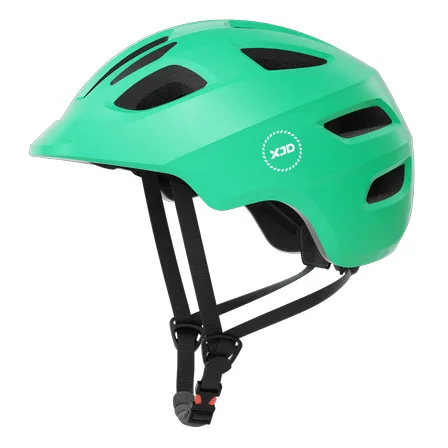
Green XJD Kids Bike Helmet for Boys & Girls
The Green XJD Kids Bike Helmet is a lightweight multi-sport helmet for toddlers …$59.99
$99