

What age baby bike trailer
There is no single safe age for every baby bike trailer. Wait until your child can sit steadily without support, control their head while wearing a properly fitted helmet, and meet every age, height and weight rule in the trailer manual.
Readiness matters more than a birthday
A calendar age alone cannot show whether a baby can tolerate the movement and upright position involved in trailer travel. Before riding, confirm that the child has reliable head and neck control, remains stable in the trailer’s seating system and can wear the required helmet without the helmet pushing the head forward.
Ask your child’s pediatrician if there is any uncertainty, especially after premature birth or when development, muscle tone, breathing or neck control is a concern. The trailer manufacturer’s minimum age and other passenger restrictions are firm limits, not targets to work around.
What to measure and compare
Check the exact trailer manual before putting a child inside. Measure the child as the manual directs, then compare those measurements with its passenger limits. Do not estimate or rely on another trailer’s specifications.
- Current height and weight: Both must remain within the stated passenger limits.
- Seated space: Confirm adequate room for the child and helmet without contact that changes head position.
- Harness fit: Use the supplied restraint system exactly as its manufacturer describes.
- Helmet fit: The helmet should sit level and use its straps according to the helmet manufacturer’s instructions.
- Trailer and bicycle compatibility: Verify the hitch, bicycle and trailer combination in the relevant manuals.
If a limit, component or instruction is missing, contact the manufacturer or use a qualified bicycle mechanic. Do not invent a load limit, substitute hardware or guess at assembly and torque.
A practical first-ride check
- Assemble and inspect the trailer according to its exact manual.
- Fit the child’s helmet and harness before attaching the trailer.
- Check that the child can maintain a comfortable, controlled head position while seated.
- Confirm the tow bicycle’s brakes, tires and hitch are ready for use.
- Begin with a brief ride in a controlled area and stop if the child slumps, becomes distressed or cannot maintain position.
Repeat the fit check as the child grows. Also recheck the manual before adding another passenger, luggage or accessories, because permitted configurations and load limits are product-specific.
When the supplied kids’ bikes become relevant
The three catalog products below are not baby bike trailers and should not be used as trailer substitutes. They become relevant later, when a child is ready to ride a separate bicycle. Their 12, 14, 16 and 20 Inch options provide comparison points for that transition, but wheel labels alone never establish fit.
 Girls' Training Wheel Bike by XJD, 12–20 Inch Wheels – Blue
A training-wheel bicycle offered in 12, 14, 16 and 20 Inch sizes. It is relevant only as a later independent-riding comparison, not as a baby trailer or trailer substitute.
 XJD Girls' Bike with Training Wheels, 12/14/16/20 Inch – Purple
This purple training-wheel bike has 12, 14, 16 and 20 Inch options. Compare the appropriate label with measured rider fit only after the child is ready to ride separately.
 XJD Kids Bike for Girls – Pink, 12/14/16/20 Inch with Training Wheels
This pink kids’ training-wheel bike is available in 12, 14, 16 and 20 Inch sizes. Its catalog facts do not establish baby use or bike-trailer compatibility.
Girls' Training Wheel Bike by XJD, 12–20 Inch Wheels – Blue, XJD Girls' Bike with Training Wheels, 12/14/16/20 Inch – Purple and XJD Kids Bike for Girls – Pink, 12/14/16/20 Inch with Training Wheels are all cataloged as training-wheel bikes. Each is offered with 12, 14, 16 and 20 Inch wheel labels; the supplied facts do not establish trailer compatibility, passenger use or suitability for a baby.
How to size a later first bicycle
When the child has moved beyond passenger travel, use these XBikes wheel-size starting points. They are screening ranges, not a replacement for trying the bicycle.
| Wheel size | Starting age | Rider height |
|---|---|---|
| 12 Inch | 3–4 | 34–40 in / 86–102 cm |
| 14 Inch | 3–6 | 37–45 in / 94–114 cm |
| 16 Inch | 4–7 | 40–48 in / 102–122 cm |
| 18 Inch | 5–9 | 43–52 in / 109–132 cm |
| 20 Inch | 7–12 | 48–60 in / 122–152 cm |
| 24 Inch | 10–14 | 54–64 in / 137–163 cm |
| 26 Inch | Youth and adults | Over 60 in / 153 cm |
Prioritize measured height, inseam, reach, brake control and present confidence over age. Have the child try the bicycle: check stand-over clearance, steering control and whether the brake controls are comfortably reachable. Do not buy an oversized bicycle merely to allow room for growth.
Make the decision
Use the trailer only when your child meets its complete manual requirements, can sit unsupported with dependable head control and can maintain a proper helmet position. If any one of those checks fails, wait and reassess later. Consider the supplied training-wheel bikes only after the child is ready for an individually fitted bicycle, starting with measured height and an in-person control check.
Bikes for your next adventure
-

Blue XJD Kids Bike Helmet for Boys & Girls
The Blue XJD Kids Bike Helmet is a lightweight, adjustable multi-sport helmet fo…$59.99
$99 -

Kids Bike Helmet by XJD for Girls – Pink
The XJD Kids Bike Helmet in Pink is a lightweight multi-sport helmet for girls r…$59.99
$99 -
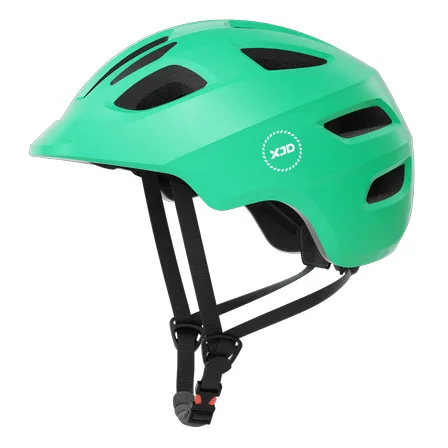
Green XJD Kids Bike Helmet for Boys & Girls
The Green XJD Kids Bike Helmet is a lightweight multi-sport helmet for toddlers …$59.99
$99