

What age can a child use a bike seat
There is no single age when every child can use a bike seat. First identify whether you mean a passenger seat or the saddle on the child’s own bicycle, then check the child and equipment for an individual fit.
If you mean a child passenger seat
Use the passenger-seat manufacturer’s stated minimum requirements, permitted child size or load limits, mounting compatibility and instructions. Age alone cannot confirm that a child is ready, and those limits must not be guessed from appearance or replaced with bicycle wheel-size guidance.
The child must meet every developmental and fit requirement in the exact seat manual. The seat must also be approved by its manufacturer for the specific bicycle and mounting position. If the manual is missing, the limits are unclear or the bicycle is not listed as compatible, do not carry the child until the manufacturer or a qualified bicycle mechanic confirms the setup.
Before each ride, check that the child is secured exactly as instructed, cannot reach moving parts and wears a properly fitting bicycle helmet. The helmet should sit level, with its straps adjusted according to its manufacturer’s directions. Follow the product manual for attachment checks, maintenance and torque; no general article can safely supply model-specific values.
If you mean the seat on the child’s own bike
For a child riding independently, start with measured standing height rather than choosing by birthday. Compare that measurement with the XBikes wheel-size starting points below, then have the child try the bicycle. The age bands overlap because children of the same age can differ substantially in proportions, coordination and confidence.
| Wheel size | Starting age | Rider height |
|---|---|---|
| 12 Inch | 3–4 | 34–40 in / 86–102 cm |
| 14 Inch | 3–6 | 37–45 in / 94–114 cm |
| 16 Inch | 4–7 | 40–48 in / 102–122 cm |
| 18 Inch | 5–9 | 43–52 in / 109–132 cm |
| 20 Inch | 7–12 | 48–60 in / 122–152 cm |
| 24 Inch | 10–14 | 54–64 in / 137–163 cm |
| 26 Inch | Youth and adults | Over 60 in / 153 cm |
These figures narrow the search; they do not establish fit. Do not buy an oversized bicycle merely to leave growing room. A bike that is too large can make starting, stopping, steering and reaching the controls harder.
What to measure and test
Measure the child’s height without shoes against a wall. Measure inseam from the floor to the crotch while the child stands naturally. Then compare both measurements with the actual bicycle geometry and adjustment range rather than assuming that wheel diameter determines everything.
During a supervised fit check, confirm that the child can:
- stand over the bicycle with appropriate clearance rather than being forced against the frame;
- sit in a stable position and reach the handlebar without an awkward stretch;
- turn the handlebar while remaining balanced and in control;
- reach and operate the available brake controls reliably;
- start, stop and put a foot down without panic or loss of control.
Current confidence matters too. A size that falls within a height band may still be unsuitable if reach, inseam or control is wrong. If adjustments or assembly are needed, follow the exact bicycle manual or ask a qualified bicycle mechanic.
How the supplied bicycles are relevant
The supplied XBikes options are complete children’s bicycles with training wheels, so they help only when “bike seat” means the saddle of the child’s own bike. They are not child passenger seats and should not be used as evidence that a child is ready to ride on an adult’s bicycle.
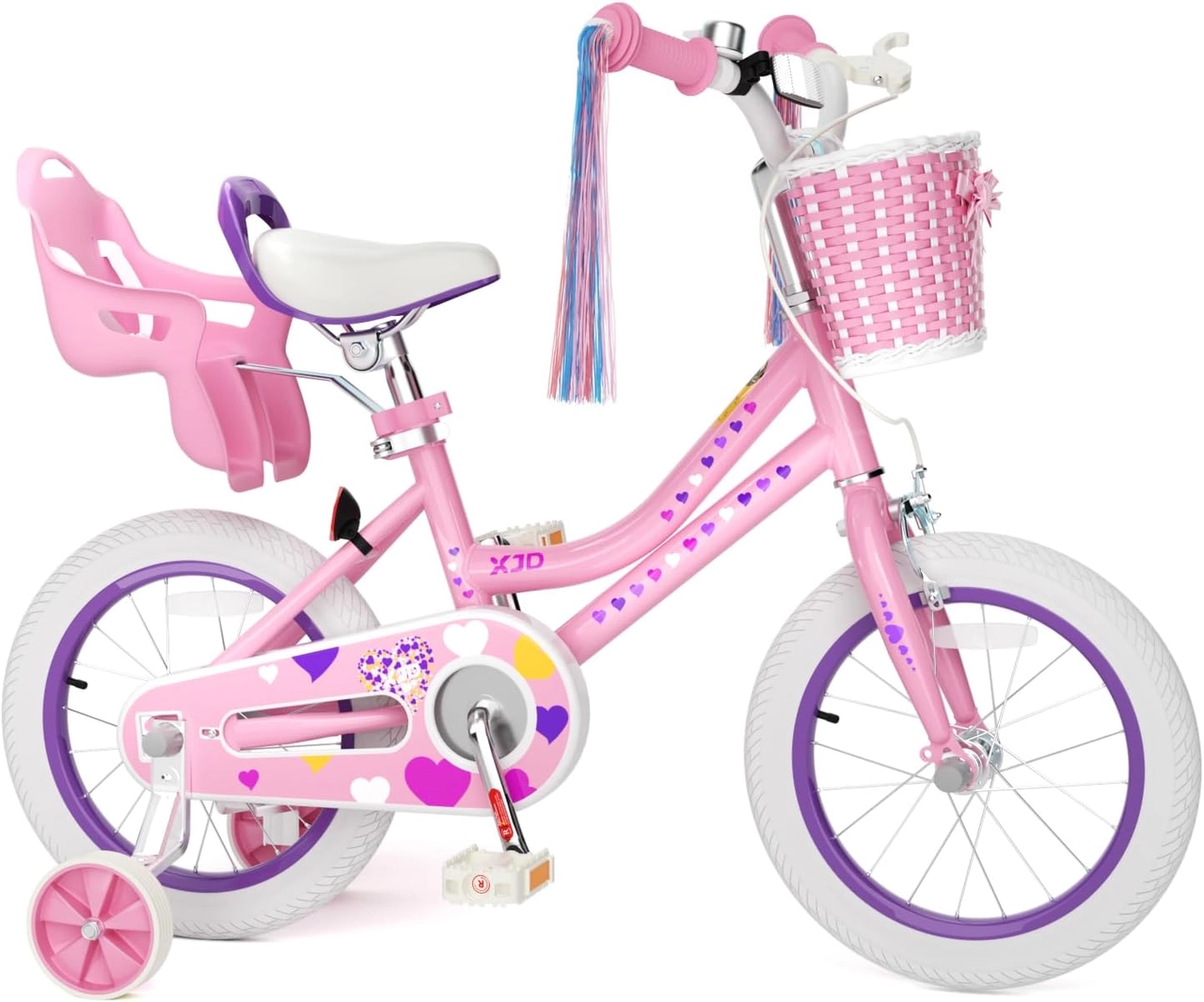 Pink Girls' 12/14/16" Bike by XJD – Basket & Doll Seat
A training-wheel bicycle offered in 12 Inch, 14 Inch and 16 Inch labels. Its catalog Doll Seat wording does not make it a child passenger seat; use it only as an own-bike size comparison.
 Light Pink XJD Girls' Bicycle with Basket & Training Wheels
A training-wheel bicycle offered in 12 Inch, 14 Inch, 16 Inch and 20 Inch labels, providing several own-bike size comparison points that still require height, inseam, reach and control checks.
 Blue XJD Girls Bike with Training Wheels – 12/14/16 Inch
A training-wheel bicycle available in 12 Inch, 14 Inch and 16 Inch labels. It is relevant when choosing a child’s own bike, not when selecting a passenger seat.
Pink Girls' 12/14/16" Bike by XJD – Basket & Doll Seat is offered in 12 Inch, 14 Inch and 16 Inch labels. Its “Doll Seat” wording refers to the exact catalog title; it does not identify a passenger seat for carrying a child.
Light Pink XJD Girls' Bicycle with Basket & Training Wheels offers the broadest supplied size comparison: 12 Inch, 14 Inch, 16 Inch and 20 Inch. Compare only a size matching the child’s measured range, then complete the individual fit checks.
Blue XJD Girls Bike with Training Wheels – 12/14/16 Inch is available in 12 Inch, 14 Inch and 16 Inch. As with the other options, its training-wheel category does not replace checks for stand-over clearance, reach, brake control and confidence.
Make the decision
If you mean a passenger seat, proceed only when the child and bicycle meet every requirement in that seat’s manual. If you mean the child’s own bicycle, measure height and inseam now, shortlist the matching wheel-size starting points, and let the child try the bike before choosing.
Bikes for your next adventure
-

Black XJD Kids Bike for Boys – 12, 14 & 16 Inch Sizes
For a son between roughly 3 and 8 years old, the XJD Kids Bike in Black covers t…$169
$199 -

Blue XJD Girls Bike with Training Wheels – 12/14/16 Inch
If you're shopping for a first pedal bike for a daughter roughly 3 to 8 years ol…$149
$169 -
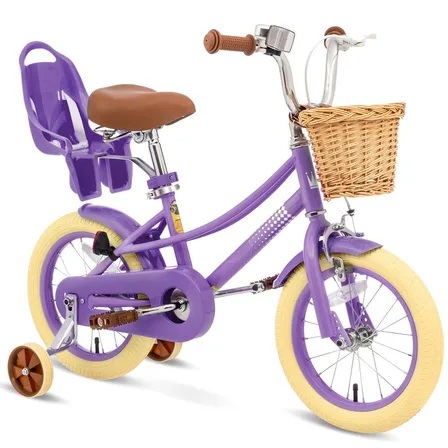
XJD Girls' Bike with Training Wheels, 12/14/16/20 Inch – Purple
The XJD girls' bike with training wheels in Purple is built to grow with your ri…$139
$159