

What age can a toddler ride a bike
A toddler can usually start a pedal bike at about age 3, but only if a 12-inch bike fits and the child can control it confidently. Measure height and inseam, then check stand-over, reach, steering and brake use on the actual bicycle.
Use age only as a starting point
XBikes lists a 12-inch wheel bike as the first pedal-bike starting point: ages 3–4 and rider height 34–40 inches (86–102 cm). That does not mean every 3-year-old is ready, or that a younger or older child should be placed on that size automatically.
Height narrows the search, while an individual fit check decides whether the bike is appropriate. Current confidence matters too. A child who freezes, cannot steer predictably or cannot stop on request needs more practice before riding independently, even if the height range appears suitable.
Measure before comparing bikes
- Measure standing height: Have the child stand straight without shoes against a wall. Compare the result with the XBikes height range rather than relying on age alone.
- Measure inseam: With the child standing naturally, measure from the floor to the crotch. Use this measurement when checking whether the child can stand over the actual bicycle comfortably.
- Try the bicycle: Confirm that the child can get on and off without struggling, maintain a controlled position and reach the handlebars without stretching.
- Check brake control: The child must be able to reach and operate the fitted brakes as intended. Consult the exact product manual or a qualified bicycle mechanic for adjustments or procedures not provided here.
Do not choose an oversized bicycle merely to leave room for growth. A bike that is too large can make mounting, steering and stopping harder at the moment those skills are still developing.
Compare the relevant XBikes sizes
| Wheel size | XBikes age starting point | Rider height starting point | Relevance to a toddler |
|---|---|---|---|
| 12 Inch | Ages 3–4 | 34–40 in / 86–102 cm | The principal size to try when the child meets the measurements and readiness checks. |
| 14 Inch | Ages 3–6 | 37–45 in / 94–114 cm | Worth comparing for a taller toddler, but only when stand-over, reach and control work on the actual bike. |
| 16 Inch | Ages 4–7 | 40–48 in / 102–122 cm | Generally beyond the toddler starting point; consider it only if the rider's measurements and trial fit support it. |
| 20 Inch | Ages 7–12 | 48–60 in / 122–152 cm | Not relevant for a typical toddler and should never be selected simply for future growth. |
These ranges can overlap, especially between 12- and 14-inch wheels. When they do, compare the actual bicycles rather than assuming the larger wheel is preferable. Favor the option on which the child shows better stand-over, natural reach, dependable brake operation and calm control.
When the supplied products are relevant
Girls' Training Wheel Bike by XJD, 12–20 Inch Wheels – Blue and XJD Girls' Bike with Training Wheels, 12/14/16/20 Inch – Purple are relevant because both are training-wheel bikes offered in 12-, 14-, 16- and 20-inch labels. Their 12- and possibly 14-inch options give parents sizes to compare against the toddler starting points above; the larger labels do not establish toddler fit.
 Girls' Training Wheel Bike by XJD, 12–20 Inch Wheels – Blue
A training-wheel bike offered in 12-, 14-, 16- and 20-inch labels. Its 12-inch option matches XBikes' earliest age and height starting point, subject to an individual fit and control check.
 XJD Girls' Bike with Training Wheels, 12/14/16/20 Inch – Purple
This training-wheel bike has 12-, 14-, 16- and 20-inch size labels. For a toddler, compare only measurements-supported options—usually 12 inch, or possibly 14 inch for a taller rider—and verify fit in person.
Based on the supplied catalog facts, the two products have the same listed size choices and category. Their exact titles identify blue and purple versions, but no supplied fact establishes differences in components, weight, braking system or performance. Select between them only after confirming the chosen size and the individual child's fit; consult each exact product manual for assembly, maintenance, load limits, compatibility and torque information.
Readiness matters as much as dimensions
A correctly sized bike is not automatically a ready-to-ride bike. Before starting, look for a child who willingly sits on the bicycle, looks ahead, keeps hands on the controls, steers around a simple path and responds to instructions to slow or stop. Training wheels can support an early pedal-bike setup, but their presence does not replace supervision, brake control or a correct fit.
Practice in a flat area away from traffic and obstacles, with close adult supervision. Use a bicycle helmet that fits properly, sits level and has straps secured according to the helmet manufacturer's instructions. Recheck fit as the child grows and whenever control becomes awkward.
Make the decision now
If the child is around age 3, first measure height and inseam. Try a 12-inch bicycle when height is 34–40 inches (86–102 cm), comparing a 14-inch option only if the child is at least 37 inches (94 cm) tall and controls it better during an actual fit check. If stand-over, reach, braking or confidence is not yet satisfactory, wait and try again rather than buying a larger bike for later.
Bikes for your next adventure
-

Black XJD Toddler Bike Helmet, Adjustable – Kids' Protective Helmet
The XJD Toddler Bike Helmet in black is an adjustable protective helmet for kids…$20.39
-

Kids Bike Helmet by XJD for Girls – Pink
The XJD Kids Bike Helmet in Pink is a lightweight multi-sport helmet for girls r…$59.99
$99 -
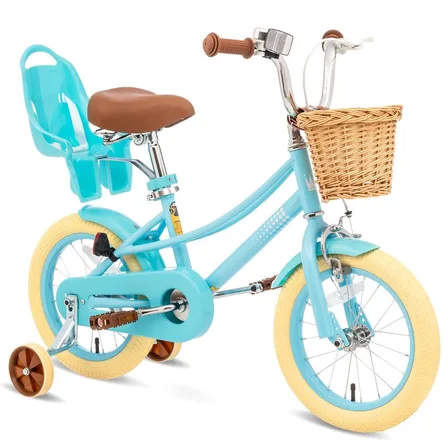
Girls' Training Wheel Bike by XJD, 12–20 Inch Wheels – Blue
This XJD girls' training wheel bike in Blue covers one of the widest fit ranges …$139
$159