

What age can kids go in bike trailer
There is no single age when every child can go in a bike trailer. Use the trailer manual’s minimum age and limits, then check head control, posture and helmet fit.
Age alone does not decide readiness
A child must meet every requirement stated by the trailer manufacturer. That may include a minimum age, developmental conditions, seating rules and load limits. If the manual is missing or unclear, do not guess: obtain the exact manual from the manufacturer before riding.
Also consider the child’s ability to maintain the position required by that trailer. They should not slump, tip sideways or lose head control while seated as instructed. A premature birth, developmental delay, medical condition or uncertainty about neck control is a reason to ask the child’s pediatric clinician before using a trailer.
A child who is old enough according to a calendar may still be too small or insufficiently stable for a particular model. Conversely, developmental readiness does not override the manufacturer’s stated minimum age or other restrictions.
What to measure and compare
Before the first ride, write down the child’s current weight and seated size, then compare them with the exact trailer manual. Confirm all of the following rather than relying on an advertised age label:
- The child meets the stated minimum age and developmental requirements.
- The child is within every passenger-size and load limit, including any rule for combined passengers or cargo.
- The seating and restraint system can be adjusted exactly as the manual describes.
- The child has adequate headroom while wearing a properly fitted bicycle helmet, if the manual or local rules require one.
- The towing bicycle and hitch are explicitly compatible with the trailer.
Do not invent a workaround for an incompatible axle, hitch, restraint or seating position. Follow the manuals for assembly, maintenance and load limits. Ask a qualified bicycle mechanic to verify the bicycle–hitch connection if compatibility or installation is uncertain.
Make a stationary fit check
Place the trailer on level ground and set it up according to its manual. Seat and secure the child without moving the trailer. Check that the restraint lies in the intended positions, the child remains upright, and the helmet or head does not press against the enclosure or force the chin downward.
A bicycle helmet must fit properly, sit level and have its straps adjusted according to the helmet manufacturer’s instructions. Replace assumptions such as “close enough” with a fresh fit check whenever the child grows, clothing changes substantially or another child uses the trailer.
Next, inspect the hitch, wheels, tires, retention devices and enclosure using the trailer’s pre-ride procedure. No maintenance intervals, fastener torque or replacement limits can be generalized safely; use the exact product manual or a qualified mechanic.
What to do on the first outings
Begin with the trailer empty so the towing adult can learn how the bicycle starts, turns, brakes and clears obstacles with the added width and length. Then choose a short, low-speed ride in a controlled area away from traffic and difficult terrain, provided the child and equipment pass every check.
Stop immediately if the child slumps, appears distressed, cannot maintain the required position or if the trailer behaves unexpectedly. Recheck the setup rather than treating discomfort or instability as something the child will simply get used to.
How the supplied kids’ bikes relate
The supplied products are training-wheel bicycles, not bike trailers, so they cannot establish when a child is ready to ride as a trailer passenger. They become relevant later when comparing a child’s measured height and individual bicycle fit with possible first-bike sizes.
Girls' Training Wheel Bike by XJD with Basket – Purple is offered in 14 Inch, 16 Inch and 20 Inch labels. Flower Pink XJD Girls Bike with Doll Seat & Basket is offered in 12 Inch, 14 Inch and 16 Inch labels. These options help show the range of bicycle sizes that may be considered after measuring the rider; they are not trailer products or substitutes for a trailer readiness check.
 Girls' Training Wheel Bike by XJD with Basket – Purple
A training-wheel bicycle offered in 14 Inch, 16 Inch and 20 Inch labels. It is relevant only to a later move from trailer passenger to rider, subject to measured height and an individual fit check.
 Flower Pink XJD Girls Bike with Doll Seat & Basket
A training-wheel bicycle offered in 12 Inch, 14 Inch and 16 Inch labels. It provides possible first-bike size comparison points but does not determine a child’s readiness for a bike trailer.
When a child moves from passenger to rider
For that later decision, XBikes uses these starting points: 12 Inch for ages 3–4 and heights 34–40 in (86–102 cm); 14 Inch for ages 3–6 and 37–45 in (94–114 cm); 16 Inch for ages 4–7 and 40–48 in (102–122 cm); and 20 Inch for ages 7–12 and 48–60 in (122–152 cm).
Those ranges are screening guides, not proof of fit. Have the child try the bicycle. Prioritize measured height, inseam, stand-over clearance, reach, brake control and current confidence, and never choose an oversized bicycle merely for future growth.
For a trailer ride now, proceed only when the child meets the exact trailer manual’s age, developmental, fit and load requirements and the complete stationary check succeeds; otherwise wait and reassess.
Bikes for your next adventure
-

Kids Bike Helmet by XJD for Girls – Pink
The XJD Kids Bike Helmet in Pink is a lightweight multi-sport helmet for girls r…$59.99
$99 -

Blue XJD Kids Bike Helmet for Boys & Girls
The Blue XJD Kids Bike Helmet is a lightweight, adjustable multi-sport helmet fo…$59.99
$99 -
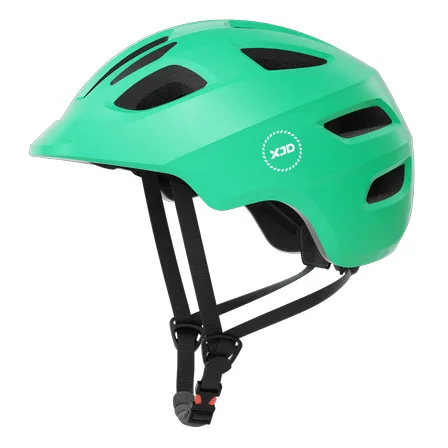
Green XJD Kids Bike Helmet for Boys & Girls
The Green XJD Kids Bike Helmet is a lightweight multi-sport helmet for toddlers …$59.99
$99