

What age child can ride a 20 inch bike
A 20-inch bike is a starting point for children ages 7–12 who are 48–60 inches (122–152 cm) tall. Measure height first, then confirm fit and control on the actual bike.
Use height before age
Age answers the question only approximately because children of the same age can differ greatly in size, proportions and riding ability. Under the XBikes sizing starting points, a 20-inch wheel suits a rider height of 48–60 inches (122–152 cm). A child outside that range should be compared with another wheel size rather than placed on a 20-inch bike because of age alone.
| Wheel size | Starting age | Rider height |
|---|---|---|
| 16 Inch | 4–7 | 40–48 in / 102–122 cm |
| 20 Inch | 7–12 | 48–60 in / 122–152 cm |
| 24 Inch | 10–14 | 54–64 in / 137–163 cm |
The overlap between sizes is intentional: the child’s individual fit determines the answer. Do not move up merely to leave growing room.
Measure the child accurately
- Height: Have the child stand without shoes, heels against a wall, looking straight ahead. Mark the top of the head and measure from the floor.
- Inseam: With feet slightly apart, measure from the floor to the crotch. Use this to compare the child with the stand-over clearance and saddle adjustment of the exact bicycle.
- Current ability: Note whether the child starts, stops, steers and balances confidently. A less-confident rider may need a more manageable fit even when height suggests two possible sizes.
There is no supplied universal inseam number for a 20-inch bike, because frame shapes differ. Compare the measurement with the specific bicycle and follow its manual.
Perform an actual fit check
Have the child try the assembled bicycle. When standing over the frame, the child should have comfortable clearance rather than being pressed against it. Seated, the rider should be able to reach the handlebar without stretching, turn it under control and maintain a stable position.
Ask the child to operate each brake while holding the grips normally. The controls must be within easy reach, and the child must have enough hand control to use them reliably. Also watch a start, a straight ride, a controlled turn and a stop in a traffic-free area with close adult supervision. If the rider cannot do these without strain or fear, the nominal age range does not make the bike a suitable fit.
How the supplied bikes clarify the choice
The catalog provides one currently listed 20-inch option and one smaller-size comparison. This makes it possible to compare the requested wheel size with nearby choices, while the final decision still depends on the child’s measurements and an in-person control check.
 XJD Light Purple Girls Bike with Basket, Training Wheels, 12/14/16/20 Inch
Its supplied available SKU labels stop at 16 Inch, despite the exact title mentioning 20 Inch. Use this training-wheel model only as a smaller-size comparison, not as a 20-inch substitute.
 XJD Kids Beach Cruiser Bicycle, Rear Rack & V-Brakes, Mint Green
The supplied SKU labels include 20 Inch, making this beach cruiser relevant for a child in the stated height range. Confirm stand-over, reach, V-brake control and confidence on the actual bicycle.
XJD Kids Beach Cruiser Bicycle, Rear Rack & V-Brakes, Mint Green has supplied SKU labels of 20 Inch, 24 Inch and 26 Inch. Its 20 Inch SKU is relevant to this question. The listed V-brakes make brake reach and operation an especially important part of the child’s hands-on fit check.
XJD Light Purple Girls Bike with Basket, Training Wheels, 12/14/16/20 Inch is categorized as a Training Wheel Bike, but its supplied available SKU labels are only 12 Inch, 14 Inch and 16 Inch. Although “20 Inch” appears in the exact catalog title, the supplied availability data does not list a 20-inch SKU. Treat its 16-inch option as a smaller comparison, not as an equivalent or substitute for a 20-inch bike.
Know when 20 inches is the wrong answer
- Consider the 16-inch starting point when the rider measures 40–48 inches (102–122 cm), especially if a 20-inch bicycle is difficult to stand over, steer or stop.
- Consider the 24-inch starting point when the rider is ages 10–14 and measures 54–64 inches (137–163 cm), but only if the actual bicycle offers comfortable clearance, reach and control.
- Reject any size that forces stretching, prevents reliable braking or makes the child visibly unstable, even when age and height fall within its starting range.
Make the final decision
Choose a 20-inch bike only when the child measures within the 48–60-inch (122–152 cm) starting range and passes the stand-over, reach, steering, braking and confidence checks. Follow the exact product manual or use a qualified bicycle mechanic for assembly, adjustment, maintenance and any specifications not supplied here. Before riding, fit a bicycle helmet so it sits level and secure its straps according to the helmet manufacturer’s instructions.
If those checks fail, do not buy the 20-inch bike for future growth: compare the child’s measured height with the adjacent size and repeat the hands-on fit test.
Bikes for your next adventure
-
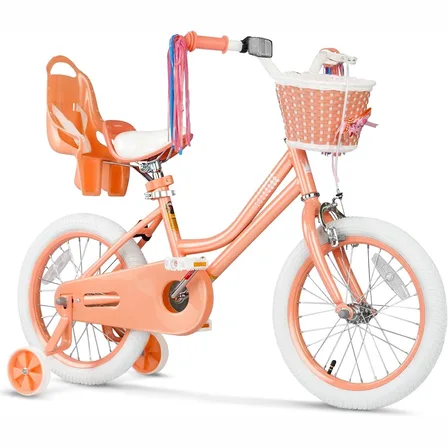
Girls 12/14/16 Inch Kids Bike by XJD with Training Wheels – Peach
The XJD Girls Bike in Peach is a training-wheel bike built for girls roughly 3 t…$149
$169 -
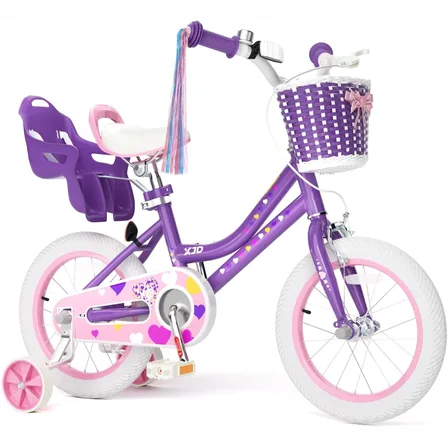
XJD Light Purple Girls Bike with Basket, Training Wheels, 12/14/16/20 Inch
The XJD Girls Bike with Basket in Light Purple is a single-speed training-wheel …$99.99
$119.99 -
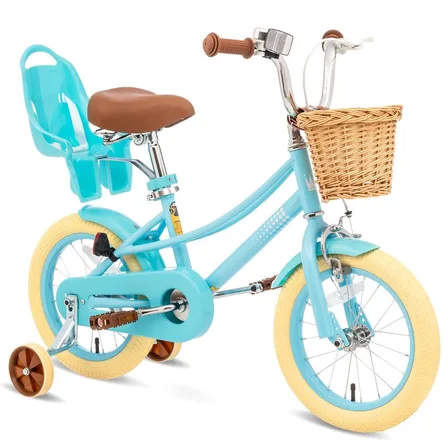
Girls' Training Wheel Bike by XJD, 12–20 Inch Wheels – Blue
This XJD girls' training wheel bike in Blue covers one of the widest fit ranges …$139
$159