

What age child rides a 16 inch bike
A 16-inch bike generally suits a child aged 4–7 who is 40–48 inches (102–122 cm) tall, but measured fit and control matter more than age.
Start with height, not the birthday
Age is only a starting point because children of the same age can differ considerably in size, coordination and confidence. Measure the child’s height without shoes, standing straight against a wall. If the result is within 40–48 inches (102–122 cm), a 16-inch bike is a reasonable size to try.
A child outside that height range should be compared with the adjacent XBikes starting points: 14-inch bikes cover 37–45 inches (94–114 cm) and ages 3–6, while 18-inch bikes cover 43–52 inches (109–132 cm) and ages 5–9. These ranges overlap because the final choice depends on the individual bike and rider.
Measure inseam and check stand-over clearance
Measure inseam with the child wearing the shoes they will normally use for riding. Have them stand with feet slightly apart and measure from the floor to the crotch. Do not convert that measurement into a wheel size using an unrelated chart; instead, take it to the actual bike and check whether the child can stand over it comfortably.
When straddling the bike, the child should not be forced onto tiptoes or pressed against the frame. They should also be able to get on and off without struggling. Because frame shapes and seat adjustment ranges are not supplied here, confirm these points on the exact bicycle rather than assuming every 16-inch model fits identically.
Test reach, brakes and confidence
Have the child sit in a normal riding position while an adult securely steadies the bicycle. Check that they can reach the handlebar without stretching, turn it in both directions and keep comfortable control of their body position. They must be able to reach and operate the bicycle’s brakes confidently. Brake type and adjustment can vary, so follow the exact product manual or ask a qualified bicycle mechanic for help.
Next, let the child try the bike in a clear, traffic-free area with close adult supervision. Look for controlled starting, steering, stopping and dismounting. A 16-inch bike is too large right now if the child cannot control it, even when their age or height falls inside the starting range. Do not buy an oversized bicycle merely to leave room for growth.
How the available 16-inch options compare
Two supplied XBikes catalog options include a 16 Inch SKU, making them relevant bikes to inspect for this question. Purple XJD Girls' Bike with Doll Seat & Basket is categorized as a Training Wheel Bike, while Black XJD Kids' BMX Bicycle with Training Wheels is categorized as a Kids' BMX Bike. Both also have 12 Inch and 14 Inch SKU labels, but those sizes are not equivalent to 16 Inch and should be evaluated against their own fit ranges.
 Purple XJD Girls' Bike with Doll Seat & Basket
Available in a 16 Inch SKU relevant to this fit question. This Training Wheel Bike also has 12 Inch and 14 Inch labels, so confirm the exact selected size and the child’s individual fit.
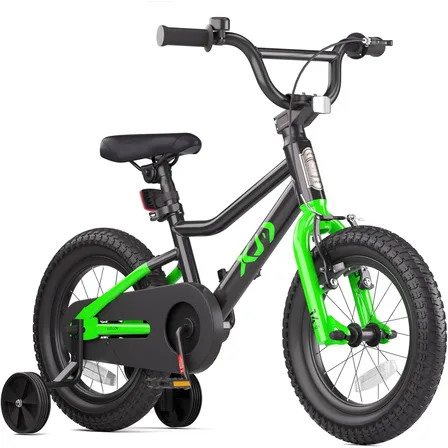
 Black XJD Kids' BMX Bicycle with Training Wheels
This Kids' BMX Bike includes a 16 Inch SKU, plus 12 Inch and 14 Inch options. Select the intended wheel-size label and verify height, stand-over, reach, brake control and confidence on the actual bicycle.
Choose the exact 16 Inch SKU if you intend to assess a 16-inch bicycle. The catalog categories and titles help distinguish the two options, but they do not prove that either will fit a particular child. No product-specific frame measurements, brake details, load limits, assembly instructions or other fit dimensions were supplied, so verify those details in the exact product manual or with a qualified bicycle mechanic.
Use this fit decision at the bike
| Check | Proceed when | Pause when |
|---|---|---|
| Starting range | Height is 40–48 in (102–122 cm) | Height points more clearly to an adjacent size |
| Stand-over | The child straddles and dismounts comfortably | The frame restricts standing or dismounting |
| Reach | Steering is comfortable without stretching | The child strains or loses body control |
| Brakes | The child can reach and operate them confidently | Controls are unreachable or difficult to use |
| Ride check | Starting, turning and stopping stay controlled | The child looks overwhelmed or unstable |
If any critical check fails, compare a correctly sized alternative instead of expecting the child to adapt to an oversized bike. If the child sits near an overlapping height boundary, trying both relevant sizes is more useful than deciding from age alone.
Before the first ride
Use a bicycle helmet that fits properly, sits level and has its straps positioned according to the helmet manufacturer’s instructions. Check the bicycle’s assembly and required maintenance using its exact manual; where instructions or specifications are unclear, use a qualified bicycle mechanic.
For a child asking whether a 16-inch bike is the right next step, measure height and inseam today, then arrange an actual fit and control check. Choose it only if the child comfortably passes the stand-over, reach, brake and riding-confidence checks.
Bikes for your next adventure
-

XJD Pink Beach Cruiser for Girls – Rear Rack & V-Brake
The XJD Pink Beach Cruiser for girls is the step-up bike for riders who've outgr…$179.99
$209.99 -

Flower Pink XJD Girls Bike with Doll Seat & Basket
The XJD Flower Pink girls' bike is made for riders 71–122 cm tall (roughly ages …$69.99
-
Black XJD Kids' BMX Bicycle with Training Wheels
The XJD Kids' BMX Bicycle with Training Wheels is built for children roughly 3 t…$99.99
$119.99