

What age do kids learn how to ride a bike
Most kids learn to ride a bike between ages 3 and 8, but there is no single correct age. Readiness, measured fit, control and confidence matter more.
When is a child ready to learn?
A child may be ready when they want to try, can follow simple directions and can coordinate steering, pedalling and stopping. Some children begin balancing at three or four; others learn comfortably several years later. Neither timetable signals failure.
Look for practical readiness rather than comparing siblings or classmates. The child should be able to sit securely, hold the handlebar without stretching, turn their head while continuing straight and operate the brakes they will use. Hesitation is useful information: reduce the challenge instead of forcing progress.
Measure before choosing a wheel size
Measure the child's standing height without shoes. Also measure inseam from the floor to the crotch, because two children of equal height can have different leg lengths. Then have the child try the actual bicycle. Check that they can stand over it, reach the handlebar comfortably, steer without overextending and operate the brakes with control.
| Wheel size | XBikes age starting point | Rider height starting point |
|---|---|---|
| 12 Inch | Ages 3–4 | 34–40 in / 86–102 cm |
| 14 Inch | Ages 3–6 | 37–45 in / 94–114 cm |
| 16 Inch | Ages 4–7 | 40–48 in / 102–122 cm |
| 18 Inch | Ages 5–9 | 43–52 in / 109–132 cm |
| 20 Inch | Ages 7–12 | 48–60 in / 122–152 cm |
| 24 Inch | Ages 10–14 | 54–64 in / 137–163 cm |
| 26 Inch | Youth and adults | Over 60 in / 153 cm |
These ranges are starting points, not promises of fit. If age and measured height suggest different rows, prioritize measured height and the individual fit check. The American Academy of Pediatrics advises having the child try the bicycle and avoiding an oversized bike bought for future growth.
How the supplied bikes relate to learning age
The two catalog options help parents compare 12-, 14- and 16-inch starting points for children within the corresponding height ranges. Both are Kids' BMX Bikes supplied with training wheels, so they may be relevant when a child is beginning with supported practice. Training wheels do not remove the need to verify stand-over clearance, reach, brake control and confidence.
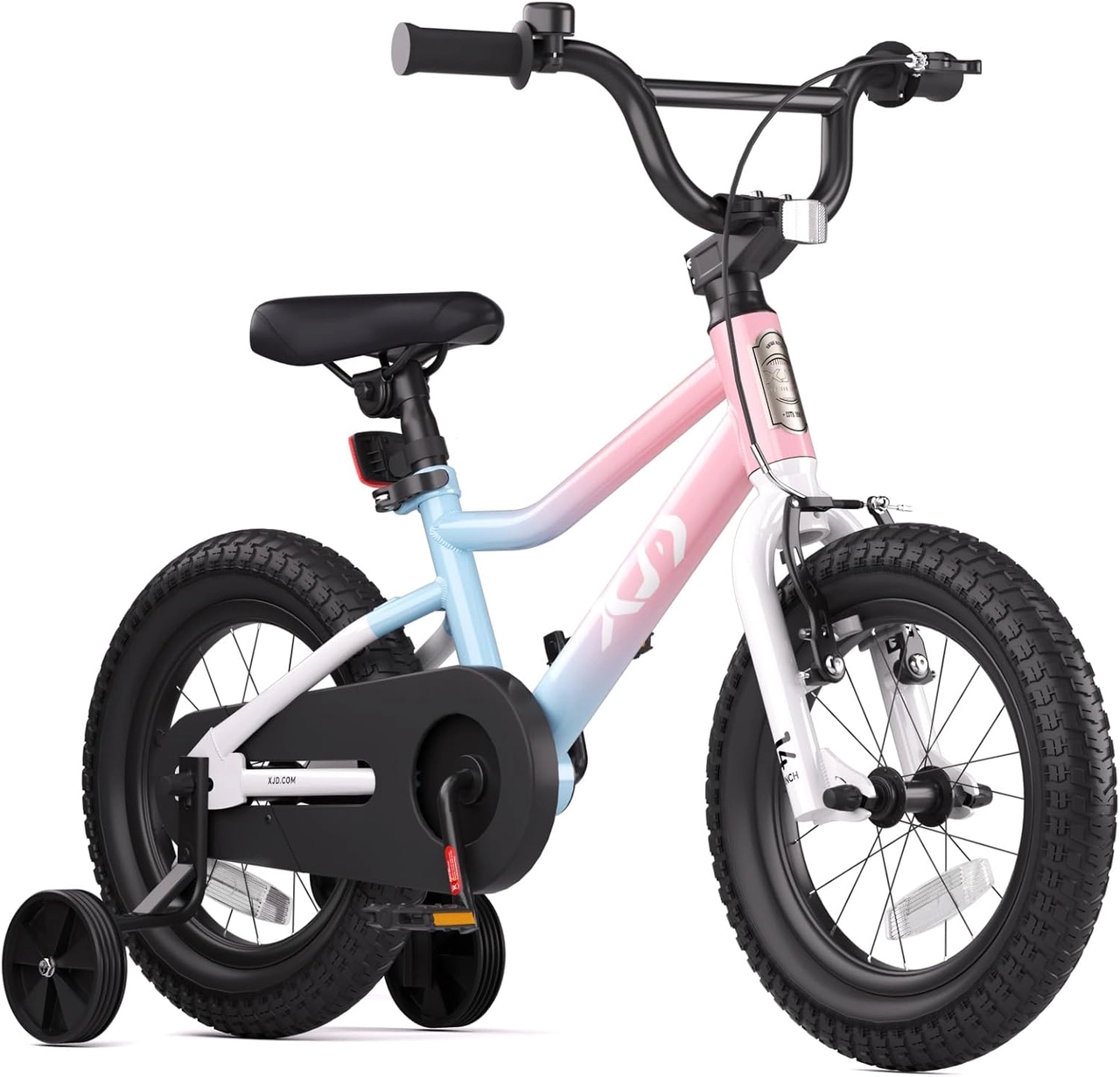 XJD Girls BMX Bike 12/14/16 Inch with Training Wheels – Pink Blue
A Kids' BMX Bike with training wheels and 12-, 14- and 16-inch size labels, relevant for comparison when the rider's measured height and individual fit support one of those sizes.
 XJD Boys & Girls BMX Bike with Training Wheels, 12/14/16" – Blue
This Kids' BMX Bike includes training wheels and offers 12-, 14- and 16-inch labels. Use it only when measured height, inseam, reach, brake control and confidence confirm an appropriate fit.
The XJD Girls BMX Bike 12/14/16 Inch with Training Wheels – Pink Blue is offered in 12 Inch, 14 Inch and 16 Inch labels. The XJD Boys & Girls BMX Bike with Training Wheels, 12/14/16" – Blue is offered in the same three wheel-size labels. Based on the supplied facts, the meaningful comparison here is title, colour wording and available size label; no further performance or component difference can be inferred.
These options are relevant only if the child's measurements and trial fit support a 12-, 14- or 16-inch bicycle. For a child who fits the 18-, 20-, 24- or 26-inch starting point, they are smaller-size comparison points, not substitutes. Confirm assembly, adjustment, maintenance, load limits and torque in the exact product manual or with a qualified bicycle mechanic.
A simple first-riding progression
- Choose a flat, open practice area away from traffic and obstacles.
- Let the child become comfortable sitting, looking ahead, steering and stopping before adding speed.
- Practise short starts and controlled stops. Stay close enough to assist without pulling the handlebar.
- Keep sessions brief and finish before frustration replaces concentration.
- Increase distance and independence only when the child repeatedly shows control.
If training wheels are used, treat them as a temporary support rather than proof that a bicycle fits. Follow the product manual for their installation and adjustment. A qualified bicycle mechanic should handle any uncertainty.
Helmet fit is part of readiness
A bicycle helmet must fit properly, sit level and use its straps according to the manufacturer's instructions, as advised by the U.S. Consumer Product Safety Commission. Recheck the fit each ride. A loose, tilted or incorrectly strapped helmet should be corrected before practice begins.
Choose a low-risk riding environment and supervise according to the child's judgment and control. Learning to pedal does not yet mean a child can predict traffic, manage steep slopes or respond reliably to unexpected hazards.
What to do next
Measure height and inseam, identify the table's starting wheel size, and arrange an individual fit check. Buy only when the child can stand over the bike, reach comfortably, steer and brake with confidence. The right age to learn is therefore the age when your child is willing, physically ready and correctly fitted—not the birthday printed on a calendar.
Bikes for your next adventure
-

Blue XJD Girls Bike with Training Wheels – 12/14/16 Inch
If you're shopping for a first pedal bike for a daughter roughly 3 to 8 years ol…$149
$169 -
XJD Girls BMX Bike 12/14/16 Inch with Training Wheels – Pink Blue
The XJD Girls BMX Bike in Pink/Blue is built as a first pedal bike for kids roug…$99.99
$119.99 -

26-Inch XJD Beach Cruiser Bike for Girls – Purple, V-Brake
This XJD 26-inch purple beach cruiser is sized for big kids and teens — suggeste…$218.49
$229.99