

What age for 26 inch bike
A 26-inch bike is generally for youth and adults over 60 inches (153 cm) tall—not for one fixed age. Measure the rider and require an individual fit check before choosing it.
Age is only the starting question
XBikes does not assign a specific age range to 26-inch bikes. Its wheel-size starting point is “youth and adults over 60 inches / 153 cm.” Children grow at different rates, so two riders of the same age may need different wheel sizes.
Use the rider’s measured height first, then check inseam clearance, reach, brake control and current riding confidence on the actual bicycle. A 26-inch wheel label alone cannot confirm that a particular frame fits.
Measure before comparing sizes
- Measure standing height: Have the rider stand without shoes, upright against a wall. Measure from the floor to the top of the head.
- Measure inseam: With feet naturally spaced, measure from the floor to the crotch. This helps assess clearance over the bicycle rather than relying on total height alone.
- Note current control: Consider whether the rider starts, stops, turns and balances confidently on the present bike.
- Bring the measurements to the fit check: Compare them with the actual bicycle and the sizing information in its exact product manual.
If the rider is not over 60 inches (153 cm), do not assume a 26-inch bike will become suitable after a quick adjustment. Compare the smaller XBikes starting points and test the fit instead.
Compare the nearest wheel-size starting points
| Wheel size | XBikes age starting point | XBikes height starting point |
|---|---|---|
| 20 Inch | Ages 7–12 | 48–60 in / 122–152 cm |
| 24 Inch | Ages 10–14 | 54–64 in / 137–163 cm |
| 26 Inch | Youth and adults | Over 60 in / 153 cm |
The ranges overlap because height is a screening tool, not a final verdict. A rider near a boundary should compare the relevant bicycles in person. Do not move up merely because the child has reached the upper end of an age range, and do not buy an oversized bicycle for future growth.
What a successful 26-inch fit looks like
Ask the rider to straddle the bicycle and check that there is appropriate stand-over clearance for that bicycle. Then have the rider sit in a normal riding position. The handlebars should be reachable without an uncomfortable stretch or loss of steering control.
The rider must also be able to operate the brakes reliably from the normal hand position. Check whether the controls are comfortably within reach and whether the child can stop while remaining composed and balanced. If the rider has to strain, slide forward excessively or sacrifice steering control, the bike is not a suitable fit even when the height guideline appears to match.
A short supervised try is more informative than an age printed on a shopping list. The American Academy of Pediatrics guidance supports having the child try the bicycle, checking stand-over and control, confirming brake reach, and avoiding an oversized bike bought for growth.
How the supplied 26-inch products help
Both supplied catalog options include an exact 26-inch SKU, so they are relevant bicycles to compare during a fit check. Their other listed wheel sizes also let a rider near the threshold compare a smaller option without treating wheel sizes as interchangeable.
 Pink XJD Beach Cruiser Bike, 24"/26", U-Brake
Available in both 24 Inch and 26 Inch versions, this beach cruiser provides a direct size comparison for a rider near the 26-inch threshold. Its title specifies a U-brake.
 XJD Kids Beach Cruiser Bicycle, Rear Rack & V-Brakes, Mint Green
Available in 20 Inch, 24 Inch and 26 Inch versions, this beach cruiser offers three wheel-size comparison points. Its supplied title identifies a rear rack and V-brakes.
The Pink XJD Beach Cruiser Bike, 24"/26", U-Brake is listed in 24 Inch and 26 Inch versions. Its title identifies a U-brake. Compare the two wheel-size versions against the rider’s measurements, reach and control; the catalog facts do not establish an age range for this model.
The XJD Kids Beach Cruiser Bicycle, Rear Rack & V-Brakes, Mint Green is listed in 20 Inch, 24 Inch and 26 Inch versions. Its title identifies a rear rack and V-brakes. The word “Kids” is a catalog label, not proof that its 26-inch version fits every child.
These listings confirm size choices, not frame dimensions, component adjustment ranges, assembly procedures, load limits or compatibility. For those details, follow the manual for the exact product and SKU or ask a qualified bicycle mechanic.
Make the final decision
Choose the 26-inch option only when the rider is over 60 inches (153 cm) and the actual bicycle passes the stand-over, reach, brake-control and confidence checks. If any check fails, compare a smaller size rather than expecting the rider to grow into an oversized bike.
Finish by fitting a bicycle helmet properly: it should sit level, fit securely and use its straps according to the helmet manufacturer’s instructions. For the title question, the practical answer is therefore height first, hands-on fit second, and age only as background context.
Bikes for your next adventure
-

26-Inch XJD Beach Cruiser Bike for Girls – Purple, V-Brake
This XJD 26-inch purple beach cruiser is sized for big kids and teens — suggeste…$218.49
$229.99 -
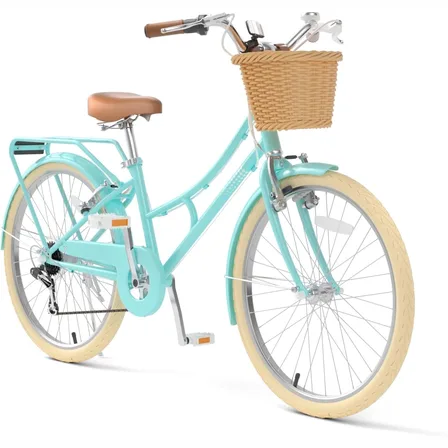
XJD Kids Beach Cruiser Bicycle, Rear Rack & V-Brakes, Mint Green
The XJD Beach Cruiser in Mint Green is a geared, multi-speed cruiser bike for ol…$179.99
$209.99 -

XJD Pink Beach Cruiser for Girls – Rear Rack & V-Brake
The XJD Pink Beach Cruiser for girls is the step-up bike for riders who've outgr…$179.99
$209.99