

What age for a 20 inch bike
A 20-inch bike is usually a starting point for children ages 7–12 and 48–60 inches (122–152 cm) tall. Measure the rider and check the actual bike before deciding.
Age answers the question only partly
The XBikes sizing starting point places a 20-inch wheel bike in the ages 7–12 range. That range is useful for narrowing the search, but it is not a guarantee of fit. Children of the same age can differ considerably in height, leg length, reach and riding confidence.
Prioritize the child’s measured height, inseam, ability to reach the controls and confidence on the bike. Do not move up to a larger wheel merely because the child is close to a birthday or because you want extra growing room. An oversized bicycle can be difficult to mount, stop and steer.
Measure before comparing bikes
- Measure height: Have the child stand straight without shoes against a wall. A height of 48–60 inches (122–152 cm) places them within the XBikes 20-inch starting range.
- Measure inseam: With shoes off and feet slightly apart, measure from the floor to the top of the inside leg. Use this measurement when checking the stand-over space on the exact bicycle.
- Note current ability: Record whether the rider starts, balances, turns and stops confidently. A hesitant rider may need a more manageable fit even when height and age fall within the range.
Wheel diameter is not the same as seat height or frame size. Two bicycles with 20-inch wheels can have different geometry, so measurements must be compared with the specifications or manual for the particular model.
Use the XBikes sizes as boundaries
| Wheel size | Starting age | Starting rider height |
|---|---|---|
| 18 Inch | 5–9 | 43–52 in / 109–132 cm |
| 20 Inch | 7–12 | 48–60 in / 122–152 cm |
| 24 Inch | 10–14 | 54–64 in / 137–163 cm |
The overlapping ranges are intentional starting points, not proof that adjacent sizes are interchangeable. For example, a child who is 50 inches tall appears in both the 18-inch and 20-inch height ranges. Their inseam, reach, control and confidence should settle the choice through an individual fit check.
What to check on the actual 20-inch bike
Have the child try the fully assembled bicycle under close adult supervision. Check that they can stand over it comfortably rather than being pressed against the frame. They should be able to get on and off without struggling and maintain control while seated.
- Reach: The rider should hold the handlebar without stretching excessively, locking the elbows or leaning awkwardly.
- Brake control: The child must be able to reach and operate the supplied braking controls reliably. A brake label alone does not establish that the controls fit a particular hand.
- Starting and stopping: Ask the rider to demonstrate a controlled start and stop in a suitable traffic-free area.
- Steering: Confirm that normal turns do not force the child to shift into an unstable position.
- Confidence: Watch for hesitation caused by the bike feeling tall, long or difficult to control.
If assembly, adjustment, compatibility, maintenance or torque information is needed, follow the exact product manual or consult a qualified bicycle mechanic. Do not guess at an adjustment.
How the supplied 20-inch options are relevant
Both supplied catalog products include a 20 Inch option, so they can be useful candidates for an individual fit comparison. Their titles and variant labels identify choices, but they do not replace measurements or prove that either frame will suit a particular child.
 26-Inch XJD Beach Cruiser Bike for Girls – Purple, V-Brake
Although its title identifies a 26-inch Purple configuration, the catalog also lists Mint Green and Pink 20 Inch variants. Verify the exact selected configuration and perform an individual fit check.
 Light Pink XJD Girls' Bicycle with Basket & Training Wheels
This bicycle includes a 20 Inch option as well as 12, 14 and 16 Inch choices. Compare the specifically selected 20 Inch version with the rider’s measurements and control.
Light Pink XJD Girls' Bicycle with Basket & Training Wheels is listed with 12 Inch, 14 Inch, 16 Inch and 20 Inch options. Compare the specifically selected 20 Inch version—not one of its smaller variants—with the child’s height, inseam, reach and present riding ability.
26-Inch XJD Beach Cruiser Bike for Girls – Purple, V-Brake has Mint Green and Pink catalog variants labeled 20 Inch, alongside 24 Inch and 26 Inch choices; Purple is supplied only as a 26 Inch label. The title describes the 26-inch Purple configuration, so do not assume every feature named there applies to a 20-inch variant. Confirm the exact selected configuration and its manual.
Helmet and final decision
A bicycle helmet must fit properly, sit level and have its straps used according to the helmet manufacturer’s instructions. A correctly sized bike does not compensate for a poorly fitted helmet.
Choose a 20-inch bike when the child is near the 48–60 inch starting range and can demonstrate comfortable stand-over space, natural reach, dependable brake operation and confident control on that exact bicycle. If any check fails, pause the purchase and compare a different fit rather than buying extra size for growth.
Bikes for your next adventure
-
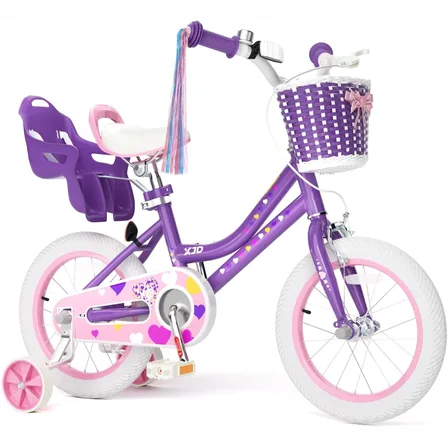
XJD Light Purple Girls Bike with Basket, Training Wheels, 12/14/16/20 Inch
The XJD Girls Bike with Basket in Light Purple is a single-speed training-wheel …$99.99
$119.99 -
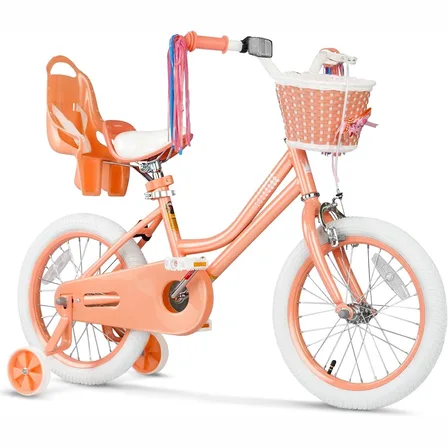
Girls 12/14/16 Inch Kids Bike by XJD with Training Wheels – Peach
The XJD Girls Bike in Peach is a training-wheel bike built for girls roughly 3 t…$149
$169 -

26-Inch XJD Beach Cruiser Bike for Girls – Purple, V-Brake
This XJD 26-inch purple beach cruiser is sized for big kids and teens — suggeste…$218.49
$229.99