

What age is 20 inch bike for
A 20-inch bike is a starting point for children ages 7–12 who are 48–60 inches (122–152 cm) tall. Measure and test the fit before buying.
Use height before age
Age gives you a quick place to start, but children of the same age can differ greatly in height, leg length, reach and confidence. For a 20-inch wheel bike, first compare the rider’s measured height with the XBikes range of 48–60 inches (122–152 cm).
A child outside that range should be compared with another wheel-size starting point rather than placed on a 20-inch bike simply because of age. The nearby XBikes ranges are 18-inch bikes for ages 5–9 and heights of 43–52 inches (109–132 cm), and 24-inch bikes for ages 10–14 and heights of 54–64 inches (137–163 cm). Overlap is intentional: the final choice depends on the individual bike and rider.
What to measure at home
- Height: Have the child stand without shoes against a wall, looking straight ahead. Measure from the floor to the top of the head.
- Inseam: With feet slightly apart, place a firm, thin book between the legs and raise it gently to mimic a bicycle saddle. Measure from the floor to the top edge of the book.
- Current-bike clues: Note whether the child feels stretched toward the controls, cramped while pedalling, or unable to start and stop confidently.
Use the height result to choose a likely wheel-size range. Keep the inseam measurement available when checking the specific bicycle’s stand-over space and saddle adjustment. Wheel diameter alone does not determine frame dimensions, so two 20-inch bikes may fit differently.
How to check a 20-inch bike in person
Have the child try the exact bicycle. While straddling the frame, the child should be able to stand securely rather than being forced onto tiptoes or against the frame. Seated, the rider should reach the handlebars and steering controls without an uncomfortable stretch.
Ask the child to demonstrate that they can steer, start and stop while remaining in control. Check that their hands can comfortably reach and operate the brakes fitted to that particular bike. Confidence matters: a measurement that falls within the chart does not override difficulty balancing, steering or braking.
Do not buy an oversized bicycle merely to leave growing room. This follows the fit approach described by the American Academy of Pediatrics: the child should try the bike, with stand-over position, control and brake reach checked before purchase.
How the supplied 20-inch options compare
All three catalog options are training-wheel bikes offered with a 20 Inch SKU, so they are relevant when a child fits the 20-inch range and a training-wheel configuration suits the rider’s current needs. Their supplied differences are the exact product title and color wording; fit must still be checked on the selected model.
 Light Pink XJD Girls' Bicycle with Basket & Training Wheels
A training-wheel bicycle offered in a 20 Inch SKU, as well as 12, 14 and 16 Inch labels. Its title identifies a light pink finish and basket; individual fit still requires measurement and a riding check.
 Girls' Training Wheel Bike by XJD, 12–20 Inch Wheels – Blue
This blue XJD training-wheel bike includes a 20 Inch SKU among its supplied 12, 14, 16 and 20 Inch labels. It is relevant only after confirming the rider fits and controls the exact bicycle.
 XJD Girls' Bike with Training Wheels, 12/14/16/20 Inch – Purple
This purple XJD training-wheel bike is offered with 12, 14, 16 and 20 Inch SKU labels. Its 20 Inch option is a catalog match, but height, stand-over, reach, brake control and confidence determine suitability.
- Light Pink XJD Girls' Bicycle with Basket & Training Wheels is listed in 12 Inch, 14 Inch, 16 Inch and 20 Inch sizes. Its title also identifies a basket and training wheels.
- Girls' Training Wheel Bike by XJD, 12–20 Inch Wheels – Blue is likewise offered in 12 Inch, 14 Inch, 16 Inch and 20 Inch SKU labels, with blue identified in its title.
- XJD Girls' Bike with Training Wheels, 12/14/16/20 Inch – Purple provides the same four supplied size labels, with purple identified in its title.
These listings establish that a 20 Inch selection exists; they do not establish that every child aged 7–12 will fit. Confirm the chosen SKU label and have the rider try the exact bike. For assembly, adjustments, compatibility, load limits, maintenance or torque requirements, follow that product’s manual or use a qualified bicycle mechanic.
When a 20-inch bike is not the right choice
Reconsider the size if the child is below or above the 48–60 inch height starting range, cannot stand over the bike securely, must stretch to steer or reach the brakes, or cannot control starts and stops. Compare an overlapping size rather than assuming a birthday automatically means moving up.
Training wheels are also a separate decision from wheel size. The supplied products are relevant only when both a 20-inch fit and a training-wheel bike match the child’s present confidence and riding needs. Their availability in smaller labeled sizes does not make those sizes equivalent to a 20-inch bike.
Make the final decision
Measure height and inseam, use ages 7–12 and 48–60 inches (122–152 cm) only as the 20-inch starting point, then test stand-over, reach, braking and control on the exact bicycle. Complete the setup with a properly fitting bicycle helmet that sits level and has its straps used according to the helmet manufacturer’s instructions. Choose 20 inches only if all of those checks work for this rider now.
Bikes for your next adventure
-

26-Inch XJD Beach Cruiser Bike for Girls – Purple, V-Brake
This XJD 26-inch purple beach cruiser is sized for big kids and teens — suggeste…$218.49
$229.99 -
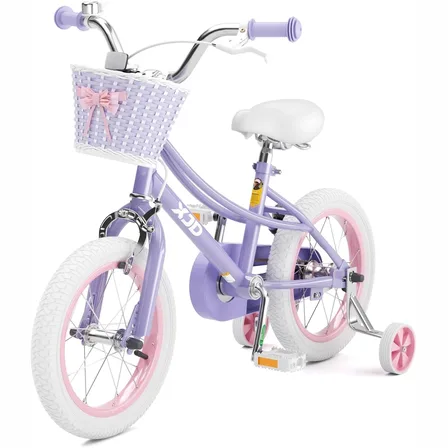
Girls' Training Wheel Bike by XJD with Basket – Purple
If you're shopping for a first bike for a girl roughly 3 to 12 years old (91–152…$75.99
-

Blue XJD Freestyle BMX Bike, 20-Inch – No Pegs
The XJD 20-Inch Blue Freestyle BMX is an entry-level BMX bike for boys and girls…$189.99