

What age is a 12 inch bike suitable for
A 12 inch bike is usually suitable for a child aged 3–4 who is 34–40 inches (86–102 cm) tall. Age is only a starting point: measure the child and confirm that they can stand over, reach, steer and brake on the actual bicycle.
Start with height, not the birthday
Measure the child without shoes, standing straight against a wall. Compare that height with the XBikes starting range for a 12 inch wheel: 34–40 inches (86–102 cm). A three- or four-year-old outside that range may need a different wheel size.
Next, measure inseam from the floor to the crotch while the child stands naturally. Inseam does not select a wheel size by itself because frame shapes and saddle adjustment differ, but it helps you assess stand-over clearance and whether the child can put their feet down confidently.
Do not choose an oversized bicycle solely to leave room for growth. A child who cannot comfortably control the bike now is not correctly fitted, even if their age appears in a suggested range.
Compare the nearby wheel sizes
| Wheel size | Starting age | Rider height |
|---|---|---|
| 12 Inch | 3–4 | 34–40 in / 86–102 cm |
| 14 Inch | 3–6 | 37–45 in / 94–114 cm |
| 16 Inch | 4–7 | 40–48 in / 102–122 cm |
The ranges overlap because children of the same age vary in proportions, reach and confidence. If a measured height falls in an overlap, do not assume the larger wheel is automatically preferable. Compare the actual bicycles and choose the one the child can control comfortably now.
What to check during a real fit test
Have the child try the bicycle while wearing the shoes they normally use for riding. A suitable 12 inch bike should let the child:
- stand over the frame with comfortable clearance;
- sit in a stable position and place their feet down confidently;
- reach the handlebar without stretching or locking their arms;
- turn the handlebar while remaining balanced;
- reach and operate the brakes, where fitted, with reliable control; and
- start, stop and steer at a pace appropriate to their current confidence.
A measured height inside the range does not override a failed fit check. Body proportions and bicycle geometry can change the result. The American Academy of Pediatrics advises having the child try the bicycle, checking stand-over and controls, and avoiding an oversized purchase for future growth.
How the supplied XBikes options are relevant
All three catalog options offer 12 Inch, 14 Inch and 16 Inch SKU labels, so they allow you to compare the requested 12 inch option with the two nearest larger sizes. They are training wheel bicycles; that can make them relevant when a family specifically wants that category, but wheel size and training wheels do not replace an individual fit and control check.
 XJD Pink Girls' Bike – Kids 12/14/16 Inch Training Wheel Bicycle
A training wheel bicycle offered with 12 Inch, 14 Inch and 16 Inch SKU labels, making its 12 Inch option relevant for an individual fit check and its larger labels useful for comparison.
 XJD Girls Bike for Kids Ages 3-8, 12/14/16 Inch with Training Wheels – Purple
Offers 12 Inch, 14 Inch and 16 Inch training wheel options. The “Ages 3-8” wording in its title is a catalog label; select size using measured height and a hands-on fit check.
 Girls 12/14/16 Inch Kids Bike by XJD with Training Wheels – Peach
A training wheel bicycle with supplied 12 Inch, 14 Inch and 16 Inch SKU labels. Its requested 12 Inch option is relevant only when the rider meets the height and control checks.
The supplied choices are XJD Pink Girls' Bike – Kids 12/14/16 Inch Training Wheel Bicycle, XJD Girls Bike for Kids Ages 3-8, 12/14/16 Inch with Training Wheels – Purple, and Girls 12/14/16 Inch Kids Bike by XJD with Training Wheels – Peach. Each has the same supplied wheel-size labels, so the catalog facts do not establish a fit advantage for one over another.
The words “Ages 3-8” in the second product’s exact catalog title are a label, not evidence that every child in that span fits every listed size. Use the XBikes size ranges above, followed by an actual fit check.
When these products are not the right comparison
These products are not relevant if the child does not fit any of their 12, 14 or 16 inch options, if the family does not want a training wheel bike, or if the child cannot comfortably reach and control the selected bicycle. For context, XBikes starts 18 Inch at ages 5–9 and 43–52 inches (109–132 cm), but none of the supplied products lists an 18 Inch SKU.
Do not infer brake type, weight, material, load limit, assembly details or compatibility from the titles. Follow the exact product manual for setup and maintenance, and use a qualified bicycle mechanic when the instructions are unclear or the bicycle cannot be adjusted to fit.
Make the final 12 inch decision
Choose a 12 inch bike only when the child is near the 34–40 inch (86–102 cm) starting range and passes the hands-on checks for stand-over, reach, braking and control. If those checks fail, compare the child’s measured height with the next size range instead of relying on age or buying large for growth.
Before riding, add a properly fitted bicycle helmet. U.S. Consumer Product Safety Commission guidance says it should sit level and its straps should be used according to the helmet manufacturer’s instructions. Your next step is simple: record height and inseam, try the 12 inch bicycle, and accept it only if the child can control it comfortably today.
Bikes for your next adventure
-
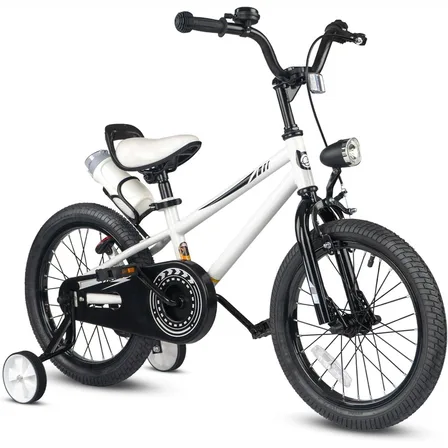
XJD Kids' Training Wheel Bike for Boys & Girls, 12/14/16 Inch – White
The XJD kids' training wheel bike in White is made for riders ages 3–8 (roughly …$169
$199 -

XJD Boys 12/14/16" Training Wheel Bike – Blue
The XJD Boys Bike in Blue is a training wheel bike for riders 71–122 cm tall—rou…$169
$199 -

XJD Boys & Girls BMX Bike with Training Wheels, 12/14/16" – Blue
The XJD Boys & Girls BMX Bike in Blue is a first pedal bike for kids roughly age…$99.99
$119.99