

What age is a 16 inch bike
A 16-inch bike is generally for children ages 4–7 who are 40–48 inches (102–122 cm) tall, but measured fit and control matter more than age.
Start with height, not the birthday
The age range is a useful starting point, not a guarantee. Two children of the same age can have different leg lengths, arm reach, coordination and confidence. Measure the child’s current standing height without shoes, then compare it with the XBikes 16-inch starting range of 40–48 inches (102–122 cm).
If the child falls outside that height range, do not assume a 16-inch bicycle will fit. A shorter rider may need a 14-inch option, while a taller rider may be ready to compare a 20-inch option. The final decision still requires an in-person fit check because frame shapes and riding positions can differ.
What to measure and check
Record the child’s height and inseam before shopping. To measure inseam, have the child stand straight in socks with their feet slightly apart, then measure from the floor to the crotch. Compare that measurement with the bicycle’s stand-over clearance and saddle adjustment information in the exact product documentation; no single inseam number applies to every 16-inch frame.
When the child tries the bike, check the complete riding position:
- Stand-over: The child should be able to straddle the bicycle without the frame preventing a comfortable, controlled stance.
- Starting and stopping: The rider should be able to get on, start, stop and put a foot down without struggling.
- Reach: The handlebars should be reachable without excessive stretching, locked elbows or loss of steering control.
- Brake control: The child must be able to reach and operate the fitted braking controls confidently.
- Confidence: Watch for controlled turns and stops rather than judging fit only while the bicycle is stationary.
This follows the practical principle in American Academy of Pediatrics guidance: let the child try the bicycle, verify stand-over and control, and do not buy an oversized bike solely for future growth.
How 16 inches compares with nearby sizes
| Wheel size | Starting age | Rider height | When to compare it |
|---|---|---|---|
| 14 Inch | 3–6 | 37–45 in / 94–114 cm | When the rider is below or near the lower end of the 16-inch range |
| 16 Inch | 4–7 | 40–48 in / 102–122 cm | When height falls in range and the individual fit check succeeds |
| 20 Inch | 7–12 | 48–60 in / 122–152 cm | When the rider is at or above the upper edge of the 16-inch range |
The overlap is intentional: age and height bands do not select a bicycle by themselves. If a child is 45 inches tall, for example, both the 14-inch and 16-inch starting ranges include that height. Trying each relevant size reveals which one permits better reach, stand-over, braking and control. A 20-inch bike is not equivalent to a 16-inch bike, even when a child is close to the boundary.
A relevant XBikes catalog comparison
The Light Pink XJD Girls' Bicycle with Basket & Training Wheels is relevant because its available SKU labels include 12 Inch, 14 Inch, 16 Inch and 20 Inch. Those catalog options allow families to compare the requested 16-inch label with adjacent listed sizes, but the labels do not replace measurement or an individual fit check.

Its placement in the Training Wheel Bikes category may also make it pertinent when a family is specifically considering that product type. However, neither the category nor the wording of the exact product title establishes that a particular child fits it. Consult the exact product page and manual for dimensions, setup, compatibility, load limits and maintenance information not supplied here. Assembly or adjustment questions should be handled according to that manual or by a qualified bicycle mechanic.
Do not size up just for growth
An oversized bicycle can make mounting, steering, braking and putting a foot down more difficult. If a child cannot comfortably control a 16-inch bike today, future growth is not a reason to accept the poor present fit. Choose the size the child can manage now, then reassess after a growth spurt or a meaningful change in riding ability.
The reverse matters too. A child within the stated age range may already be too tall or cramped for a particular 16-inch model. Look for natural posture and usable adjustment room documented for that bicycle, rather than forcing the choice because the age label appears correct.
Before the first ride
Confirm that the bicycle is assembled and adjusted according to its exact manual, and ask a qualified bicycle mechanic for help when the instructions or condition are uncertain. Check that the riding area suits the child’s current skill and supervise as appropriate.
A bicycle helmet is essential, but merely owning one is not enough. U.S. Consumer Product Safety Commission guidance says it should fit properly, sit level on the head and have its straps used according to the helmet manufacturer’s instructions.
Decision: consider a 16-inch bike when the child is 40–48 inches tall and roughly age 4–7, then buy it only if the child can straddle, reach, steer, brake, start and stop with control during an individual fit check.
Bikes for your next adventure
-
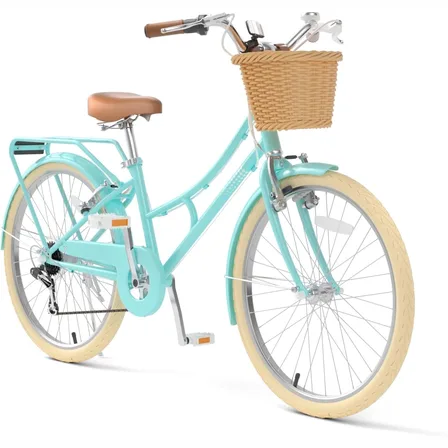
XJD Kids Beach Cruiser Bicycle, Rear Rack & V-Brakes, Mint Green
The XJD Beach Cruiser in Mint Green is a geared, multi-speed cruiser bike for ol…$179.99
$209.99 -
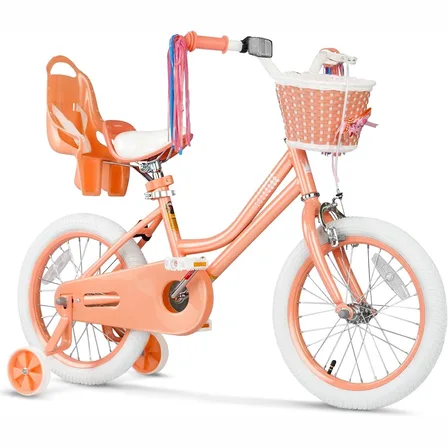
Girls 12/14/16 Inch Kids Bike by XJD with Training Wheels – Peach
The XJD Girls Bike in Peach is a training-wheel bike built for girls roughly 3 t…$149
$169 -
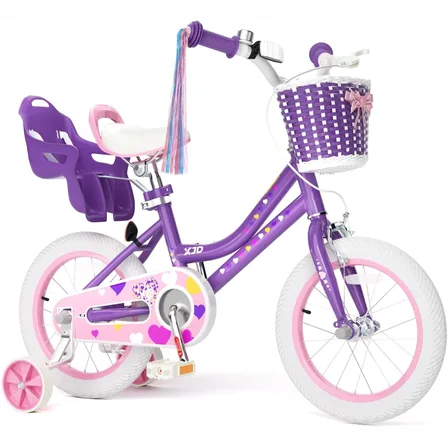
XJD Light Purple Girls Bike with Basket, Training Wheels, 12/14/16/20 Inch
The XJD Girls Bike with Basket in Light Purple is a single-speed training-wheel …$99.99
$119.99