

What age is a 16 inch bike frame for
A 16 inch kids’ bike is an XBikes starting point for ages 4–7 and riders 40–48 in (102–122 cm) tall. Measure the child and check the actual fit before choosing.
Does “16 inch” mean the frame or the wheels?
On children’s bikes, a “16 inch bike” usually describes the wheel size, not the frame measurement. That distinction matters because an actual 16 inch frame can refer to a substantially different bicycle. When comparing a listing, confirm that “16 Inch” is the wheel-size option rather than assuming it describes the frame.
For a 16 inch wheel bike, age 4–7 is only an initial guide. Height places the rider in the more useful XBikes starting range of 40–48 in (102–122 cm), but two children of equal height can have different inseams, arm lengths and confidence levels.
What to measure before ordering
Measure the child while they are wearing the shoes they normally use for riding. Record their full standing height, then measure the inseam from the floor to the crotch. Use the height to identify a likely wheel size and the inseam to assess stand-over clearance on the exact bicycle.
- Height: Compare the measured result with the 40–48 in (102–122 cm) starting range for a 16 inch wheel bike.
- Inseam and stand-over: The child should be able to straddle the bicycle comfortably. Check this on the assembled bike rather than relying on age or wheel size alone.
- Reach: With the child seated in a normal riding position, make sure they can reach and steer the handlebar without stretching or losing balance.
- Brake control: Confirm that the child can reach and operate the fitted controls confidently. Follow the exact product manual for adjustment instructions.
Compare the nearby XBikes size ranges
| Wheel size | Starting age | Rider height |
|---|---|---|
| 14 Inch | 3–6 | 37–45 in / 94–114 cm |
| 16 Inch | 4–7 | 40–48 in / 102–122 cm |
| 18 Inch | 5–9 | 43–52 in / 109–132 cm |
| 20 Inch | 7–12 | 48–60 in / 122–152 cm |
The overlapping ranges are intentional starting points, not proof that two sizes fit equally well. If the child falls near a boundary, compare the relevant bicycles in person. Do not move up simply to leave growing room: an oversized bike can make mounting, steering, stopping and balance harder.
How the supplied bikes relate to a 16 inch choice
Both supplied catalog options are training-wheel bikes offered with a “16 Inch” SKU label. The Pink 12/14/16/20" XJD Girls Bike with Training Wheels & Basket and the Light Pink XJD Girls' Bicycle with Basket & Training Wheels also have 12 Inch, 14 Inch and 20 Inch labels. This makes their labeled options useful for comparing the requested size with adjacent catalog choices, but the labels do not replace an individual fit check.
These particular options help answer the question because each includes the exact 16 Inch catalog choice and is categorized as a training-wheel bike. Select the size explicitly; the product title alone covers several sizes and does not identify which one will be supplied.
 Pink 12/14/16/20" XJD Girls Bike with Training Wheels & Basket
Offered in a 16 Inch SKU as well as 12, 14 and 20 Inch choices. This training-wheel bike is relevant for comparing labeled sizes, but the rider still needs an individual fit check.
 Light Pink XJD Girls' Bicycle with Basket & Training Wheels
This training-wheel bicycle includes a 16 Inch SKU label alongside 12, 14 and 20 Inch options. Its requested-size option is relevant, although height, inseam, reach and control must still be checked.
The supplied facts do not specify dimensions such as stand-over height, saddle range or handlebar reach. Check those details in the exact product information or manual, and have the child try the assembled bicycle whenever possible. For assembly, adjustments, compatibility, load limits and maintenance procedures not stated in the catalog facts, follow that bicycle’s manual or ask a qualified bicycle mechanic.
Run a practical fit check
The American Academy of Pediatrics advises having a child try the bicycle, avoiding an oversized bike bought for growth, and checking stand-over, control and brake reach. With the bicycle properly assembled, supervise this check in a clear, traffic-free area.
- The child can get on and off without struggling.
- They can straddle the bike comfortably rather than being forced onto tiptoes by an oversized bicycle.
- They can turn the handlebar while remaining balanced and in control.
- They can reach and use the brakes or other fitted stopping controls reliably.
- The riding position does not require an obvious stretch to the handlebar.
Current confidence matters too. A rider within the height range may still need the easier handling of a smaller correctly fitted bicycle, while another child may be ready for the 16 inch option. Training wheels do not correct poor frame clearance, excessive reach or inaccessible controls.
Make the final 16 inch decision
Choose a 16 inch wheel bike when the child is around ages 4–7, measures 40–48 in (102–122 cm), and passes the stand-over, reach, steering and brake-control checks on that specific bicycle. If any check fails, compare another correctly sized option instead of assuming the child will grow into it.
Before riding, add a properly fitting bicycle helmet. It should sit level and its straps should be used according to the helmet manufacturer’s instructions. The useful next step is simple: measure height and inseam today, confirm that the listing means 16 inch wheels, then arrange an individual fit check before committing to that size.
Bikes for your next adventure
-
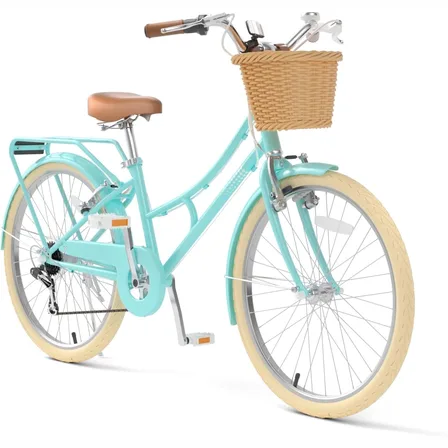
XJD Kids Beach Cruiser Bicycle, Rear Rack & V-Brakes, Mint Green
The XJD Beach Cruiser in Mint Green is a geared, multi-speed cruiser bike for ol…$179.99
$209.99 -
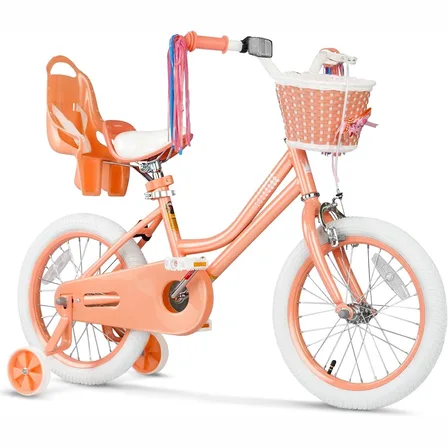
Girls 12/14/16 Inch Kids Bike by XJD with Training Wheels – Peach
The XJD Girls Bike in Peach is a training-wheel bike built for girls roughly 3 t…$149
$169 -
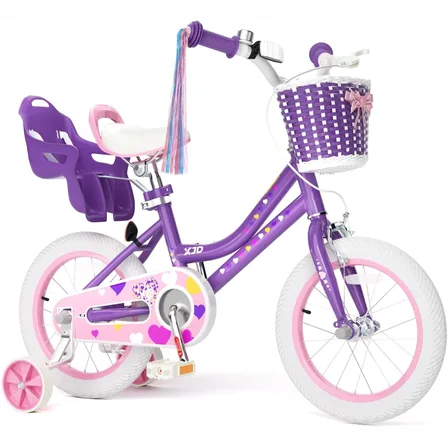
XJD Light Purple Girls Bike with Basket, Training Wheels, 12/14/16/20 Inch
The XJD Girls Bike with Basket in Light Purple is a single-speed training-wheel …$99.99
$119.99