

What age kid rides a 16 inch bike
Most children who ride a 16 inch bike are ages 4–7 and 40–48 inches (102–122 cm) tall. Height and an individual fit check matter more than age.
Is a 16 inch bike the right starting point?
Use the XBikes range of ages 4–7 and rider heights of 40–48 inches (102–122 cm) as an initial screening guide. A child outside either end of that height range should also be compared with the adjacent wheel sizes rather than being assigned a 16 inch bike from age alone.
For context, a 14 inch bike starts at ages 3–6 and 37–45 inches (94–114 cm), while an 18 inch bike starts at ages 5–9 and 43–52 inches (109–132 cm). These ranges overlap because children of the same age can have different leg length, reach, coordination and confidence. Wheel-size labels are comparison points, not proof of fit.
Measure before choosing
Measure the child's height without shoes, standing straight against a wall. Then measure inseam from the floor to the crotch while the child stands naturally. There is no supplied numerical inseam cutoff for a 16 inch bike, so use that measurement when checking the actual bicycle rather than trying to convert it into a wheel size.
Have the child try the assembled bike in the footwear they will normally wear. Check that they can:
- Stand over the bicycle without the frame pressing into them.
- Get on and off without being lifted or twisting awkwardly.
- Reach the handlebar while keeping comfortable control of steering.
- Reach and operate the brakes confidently, if the chosen model has hand controls.
- Start, stop and turn without the bicycle feeling too large or difficult to manage.
Follow the exact product manual for setup and adjustment. If assembly, adjustment or brake operation is uncertain, use a qualified bicycle mechanic.
Why age alone can give the wrong answer
A tall four-year-old and a shorter seven-year-old may need different sizes even though both fall within the 16 inch age starting point. Current ability matters too: a confident rider may handle steering and stopping differently from a child who is still learning balance.
Do not buy an oversized bicycle solely for future growth. The child needs to control it now. If they cannot stand over it, reach its controls or stop reliably, the fact that they may grow into it later does not correct the present mismatch.
How the supplied 16 inch options compare
All three supplied products include a 16 Inch SKU label and sit in the Training Wheel Bikes category, so they are relevant options to inspect after the child's measurements place them near the 16 inch starting range. Their other listed sizes also make the adjacent comparisons visible, but each actual size still requires its own fit check.
These particular catalog options help answer the title because each offers the requested 16 Inch label, while their listed size choices show which nearby options can be compared when a child is between ranges.
 Black XJD Kids Bike for Boys – 12, 14 & 16 Inch Sizes
A Training Wheel Bikes listing with 12 Inch, 14 Inch and 16 Inch SKU labels. Its 16 Inch option is relevant for hands-on comparison after measuring the child.
 XJD Kids' Training Wheel Bike for Boys & Girls, 12/14/16 Inch – White
This Training Wheel Bikes product offers 12 Inch, 14 Inch and 16 Inch SKU labels, including the requested size for an individual stand-over, reach and control check.
 Girls' Training Wheel Bike by XJD, 12–20 Inch Wheels – Blue
This Training Wheel Bikes listing includes 12 Inch, 14 Inch, 16 Inch and 20 Inch SKU labels. The 16 Inch option is relevant; other sizes are distinct comparison points.
Black XJD Kids Bike for Boys – 12, 14 & 16 Inch Sizes
This Training Wheel Bikes listing has 12 Inch, 14 Inch and 16 Inch SKU labels. Its 16 Inch option is the relevant one for a child who measures within the 40–48 inch starting range, subject to the hands-on checks above. The smaller labels provide comparison choices when 16 Inch feels too large.
XJD Kids' Training Wheel Bike for Boys & Girls, 12/14/16 Inch – White
This is also a Training Wheel Bikes listing with 12 Inch, 14 Inch and 16 Inch SKU labels. Compare its 16 Inch option by stand-over, reach, brake access and control; the wording in the title is a catalog description, not separate evidence that it fits a particular child.
Girls' Training Wheel Bike by XJD, 12–20 Inch Wheels – Blue
This Training Wheel Bikes listing supplies 12 Inch, 14 Inch, 16 Inch and 20 Inch SKU labels. It includes the requested 16 Inch choice and a broader listed size span. A 20 inch bike is not equivalent: its XBikes starting point is ages 7–12 and 48–60 inches (122–152 cm).
Make the final decision during a real fit check
- Confirm the child's measured height against the 40–48 inch (102–122 cm) 16 inch starting range.
- Bring the height and inseam measurements to the fitting.
- Have the child mount, stand over, steer and stop the actual bicycle.
- Compare 14 Inch if the 16 Inch bike is hard to control; compare 18 Inch only when the child's measurements and hands-on control support it.
- Recheck fit after any permitted seat or handlebar adjustment described in the exact manual.
Do not finish the fit without a helmet
Choose a bicycle helmet that fits the child properly. It should sit level, and its straps should be positioned and secured according to the helmet manufacturer's instructions. A helmet does not make an oversized or poorly controlled bicycle suitable, so complete both checks separately.
The practical answer is therefore: consider a 16 inch bike at ages 4–7 and 40–48 inches tall, then buy it only if this child can stand over, reach, steer and stop the actual bicycle confidently today.
Bikes for your next adventure
-

Blue XJD Girls Bike with Training Wheels – 12/14/16 Inch
If you're shopping for a first pedal bike for a daughter roughly 3 to 8 years ol…$149
$169 -
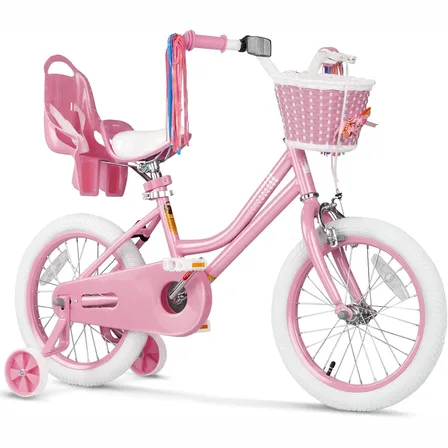
XJD Pink Girls' Bike – Kids 12/14/16 Inch Training Wheel Bicycle
The XJD Pink Girls' Bike is a training-wheel bicycle for girls ages 3 to 8 (ride…$149
$169 -

XJD Kids Bike for Girls – Pink, 12/14/16/20 Inch with Training Wheels
The XJD Kids Bike for Girls in Pink is a training-wheel bike built to carry your…$139
$159