

What age should ride a 16 inch bike
A 16-inch bike generally suits ages 4–7 and heights 40–48 in (102–122 cm), but the child’s measured fit and control decide.
Age is only the starting point
The XBikes starting range answers the age question, but birthdays do not show whether a particular bicycle fits. Children of the same age can have different leg length, arm reach and riding confidence. Measure the rider and have them try the exact bike rather than choosing from age alone.
Do not buy a larger bicycle simply to leave room for growth. An oversized bike can make mounting, stopping and steering harder now. The appropriate size is one the child can control comfortably today.
What to measure before choosing
- Height: Have the child stand upright without shoes against a wall. Measure from the floor to the top of the head. A 16-inch bike is the relevant starting point at 40–48 in (102–122 cm).
- Inseam: With feet slightly apart, measure from the floor to the crotch. Compare that measurement with the stand-over space and usable seat-height range on the exact bicycle. No universal inseam number should replace an actual fit check.
- Reach: While seated in a normal riding position, the child should reach the handlebar without stretching, locking the elbows or leaning excessively.
Wheel size does not determine every frame dimension. Two bicycles with 16-inch wheels may fit differently, so the measured height range narrows the search but does not complete it.
Compare the nearby wheel sizes
| Wheel size | XBikes age starting point | Rider height starting point |
|---|---|---|
| 14 Inch | Ages 3–6 | 37–45 in / 94–114 cm |
| 16 Inch | Ages 4–7 | 40–48 in / 102–122 cm |
| 18 Inch | Ages 5–9 | 43–52 in / 109–132 cm |
The overlapping ranges are intentional starting points, not proof that the sizes are interchangeable. For example, a 44-inch child falls within all three height ranges. That child still needs to try each relevant bicycle and demonstrate comfortable stand-over clearance, reach, balance, steering and stopping control.
If the rider is near 40 inches, compare 14- and 16-inch bikes rather than automatically sizing up. Near 48 inches, compare 16 and 18 inches. Choose according to present control and confidence, not the largest wheel the child can technically use.
How to perform the fit check
- Have the child straddle the bicycle and confirm that they can stand over it without the frame obstructing them.
- Check that mounting and getting off are controlled, not awkward or dependent on an adult holding the bicycle.
- Ask the child to sit normally and turn the handlebar both ways. Their reach should remain relaxed and steering should feel manageable.
- Confirm that the child can operate the bicycle’s braking system reliably. If it has hand-brake levers, verify that the child can reach and use them without shifting into an unstable position.
- Observe a start, straight ride, turn and stop in a traffic-free area under close adult supervision. Hesitation caused by unfamiliarity is different from being physically unable to control the bike.
If any essential action requires stretching, tiptoeing, twisting or adult assistance, try another size or configuration. A qualified bicycle mechanic can help with setup questions; follow the exact product manual for assembly, adjustment, maintenance, compatibility, load limits and torque.
Where the supplied catalog option fits
XJD Kids' Training Wheel Bike for Boys & Girls, 12/14/16 Inch – White is directly relevant because its supplied options include 12 Inch, 14 Inch and the requested 16 Inch size. The 16 Inch option is the one to evaluate against the 40–48 in (102–122 cm) starting range. Its 14 Inch option can provide a nearby comparison for a smaller rider, while 12 Inch is a distinct smaller size—not an equivalent substitute.
These catalog options help answer the title by allowing a parent to focus on the exact 16 Inch option and compare it with smaller wheel choices from the same listing when the child is near the lower boundary. The product title and training-wheel classification do not prove individual fit; the child must still complete the checks above.

No 18 Inch option is supplied for this product. If the child is near or above the upper end of the 16-inch range, use the XBikes 18-inch starting point—ages 5–9 and 43–52 in (109–132 cm)—to decide whether an in-person comparison with a separate 18-inch bicycle is warranted.
Helmet and final decision
Use a bicycle helmet that fits the child properly. It should sit level, with its straps adjusted according to the helmet manufacturer’s instructions. A helmet does not correct a poor bicycle fit, so check both separately.
Choose a 16-inch bike when the rider is generally 4–7 years old, measures 40–48 in (102–122 cm), and can comfortably stand over, reach, steer and brake on the exact bicycle. If those control checks fail, compare the adjacent appropriate size instead of waiting for the child to grow into an oversized bike.
Bikes for your next adventure
-

XJD Pink Beach Cruiser for Girls – Rear Rack & V-Brake
The XJD Pink Beach Cruiser for girls is the step-up bike for riders who've outgr…$179.99
$209.99 -
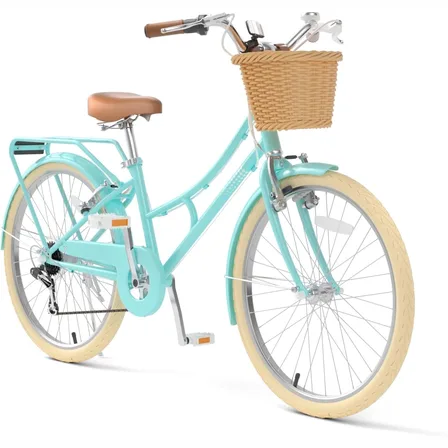
XJD Kids Beach Cruiser Bicycle, Rear Rack & V-Brakes, Mint Green
The XJD Beach Cruiser in Mint Green is a geared, multi-speed cruiser bike for ol…$179.99
$209.99 -

Flower Pink XJD Girls Bike with Doll Seat & Basket
The XJD Flower Pink girls' bike is made for riders 71–122 cm tall (roughly ages …$69.99