

What age should a child have a bike
Most children are ready for a bike around age 3, but age alone cannot determine fit. Measure height and inseam, then check control on the actual bike.
Use age only as a starting point
A child should have a bike when they show enough confidence and coordination to steer, stop and follow simple safety instructions. For sizing, begin with measured rider height rather than a birthday. Children of the same age can differ substantially in leg length, reach and riding ability.
The XBikes ranges below are starting points, not guarantees. If age and height suggest different wheel sizes, prioritize measured height and an in-person fit check. Never choose an oversized bicycle simply to leave room for growth; a bike that is too large can make starting, stopping and steering harder.
| Wheel size | Starting age | Rider height |
|---|---|---|
| 12 Inch | 3–4 | 34–40 in / 86–102 cm |
| 14 Inch | 3–6 | 37–45 in / 94–114 cm |
| 16 Inch | 4–7 | 40–48 in / 102–122 cm |
| 18 Inch | 5–9 | 43–52 in / 109–132 cm |
| 20 Inch | 7–12 | 48–60 in / 122–152 cm |
| 24 Inch | 10–14 | 54–64 in / 137–163 cm |
| 26 Inch | Youth and adults | Over 60 in / 153 cm |
Measure before comparing bikes
Measure the child without shoes, standing straight against a wall. Record total height. For inseam, have the child stand with feet slightly apart and measure from the floor to the crotch. Keep both measurements available when checking the bicycle and its manual.
Wheel size narrows the search, but it does not establish stand-over clearance or reach. The child should try the bicycle whenever possible. Check whether they can stand over it comfortably, reach the handlebars without stretching, turn them without losing balance, and operate the brakes with dependable control. Their current confidence matters too: a hesitant beginner may need a more manageable fit than an experienced rider of identical height.
What to check during the test ride
- Mounting and standing: Ask the child to get on and off without being lifted into position. Confirm comfortable stand-over space.
- Posture and reach: Look for relaxed arms and easy steering, rather than a forward stretch or cramped position.
- Starting and stopping: Have the child demonstrate controlled starts and stops in a traffic-free area under adult supervision.
- Brake access: Confirm that the child can reach and operate the bicycle’s braking controls. Do not assume a brake is usable merely because it is present.
- Confidence: Watch for controlled decisions rather than speed. Persistent fear, wobbling or difficulty stopping means the fit or readiness should be reconsidered.
How the supplied XBikes options fit the decision
These catalog options cover several wheel-size starting points, making them useful for comparing a measured child with an appropriate size band. Their labels still require the same individual checks for inseam, reach, braking and confidence.
 XJD Boys & Girls BMX Bike with Training Wheels, 12/14/16" – Blue
Available in 12 Inch, 14 Inch and 16 Inch labels, this model is relevant to younger riders whose measured height matches those XBikes starting ranges, subject to an individual fit and control check.
 XJD Pink Beach Cruiser for Girls – Rear Rack & V-Brake
Its 20 Inch, 24 Inch and 26 Inch choices make this model relevant to taller children and youth. Compare measured height first, then verify stand-over, reach and brake control on the actual bicycle.
 Girls' Training Wheel Bike by XJD with Basket – Purple
Offered in 14 Inch, 16 Inch and 20 Inch labels, this product spans several XBikes height starting points. The jump to 20 Inch should follow a fresh measurement and complete fit check.
The XJD Boys & Girls BMX Bike with Training Wheels, 12/14/16" – Blue has 12 Inch, 14 Inch and 16 Inch options. Those sizes span the XBikes starting ranges from ages 3–4 at 34–40 inches through ages 4–7 at 40–48 inches, with overlap at 14 Inch. Choose among them by height and actual fit, not by selecting the largest option.
The Girls' Training Wheel Bike by XJD with Basket – Purple is offered in 14 Inch, 16 Inch and 20 Inch labels. Its 20 Inch option begins at the 48–60 inch, ages 7–12 starting point, so it is not automatically the next fit for a shorter child who has outgrown a 16 Inch bike. Measure again and test control.
The XJD Pink Beach Cruiser for Girls – Rear Rack & V-Brake has 20 Inch, 24 Inch and 26 Inch options. These labels are relevant to taller children and youth: 20 Inch starts at 48 inches, 24 Inch at 54 inches, and 26 Inch is for youth and adults over 60 inches. The brake wording in the title does not replace checking whether the rider can comfortably reach and control it.
When these products are not relevant
None of the supplied options is an 18 Inch bike. If the child measures within the 18 Inch starting range of 43–52 inches and does not fit a nearby offered size comfortably, do not force the choice; compare an 18 Inch alternative elsewhere. Likewise, these products are not appropriate merely because the child falls within an age band. Poor stand-over clearance, excessive reach, weak brake control or low confidence overrides the age estimate.
For assembly, adjustments, compatibility, load limits, maintenance and torque requirements, follow the exact product manual or use a qualified bicycle mechanic. Do not improvise specifications.
Make the final decision
Before riding, provide a properly fitting bicycle helmet. It should sit level, fit securely and use its straps according to the helmet manufacturer’s instructions.
Next step: measure the child’s height and inseam today, identify the matching wheel-size starting point, and have them try that size. Buy only when they can stand over, steer, reach the controls and brake confidently—never because age alone or future growth suggests it.
Bikes for your next adventure
-
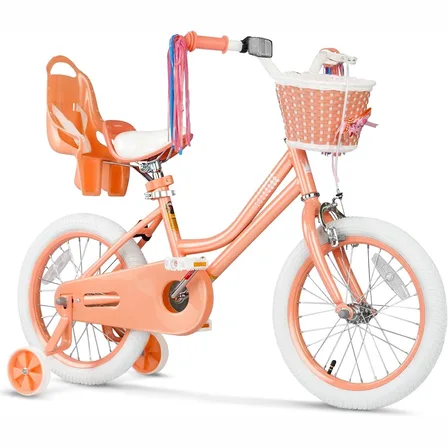
Girls 12/14/16 Inch Kids Bike by XJD with Training Wheels – Peach
The XJD Girls Bike in Peach is a training-wheel bike built for girls roughly 3 t…$149
$169 -
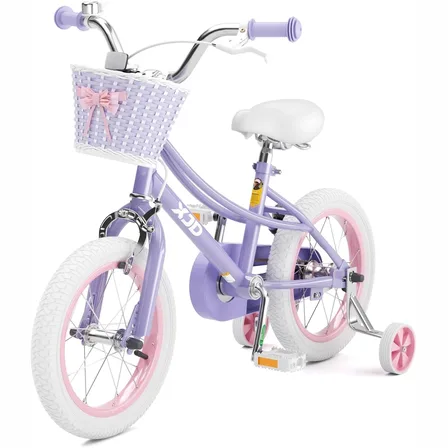
Girls' Training Wheel Bike by XJD with Basket – Purple
If you're shopping for a first bike for a girl roughly 3 to 12 years old (91–152…$75.99
-
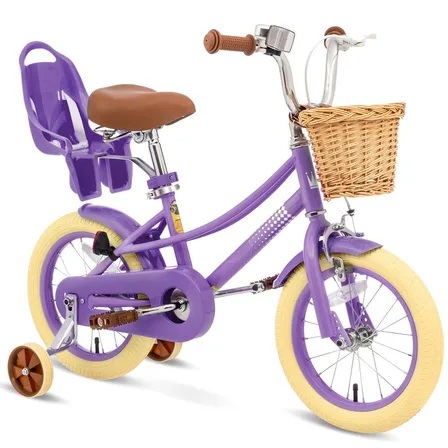
XJD Girls' Bike with Training Wheels, 12/14/16/20 Inch – Purple
The XJD girls' bike with training wheels in Purple is built to grow with your ri…$139
$159