

What age should a child start riding a bike
Most children can start riding a bike around age 3, but readiness and fit matter more than a birthday. Measure height and inseam, then check control on the actual bike.
Start with readiness, not age alone
A child is ready to begin when they are interested, can follow simple directions and can stay engaged while practicing. They should be able to hold the handlebar, look ahead, place their feet securely where needed and respond when asked to stop.
Confidence matters too. A hesitant child may need more time or shorter practice sessions, even when a size chart suggests that a bicycle could fit. An eager child still needs a correctly sized bike; enthusiasm does not make an oversized frame easier to control.
Measure before choosing a wheel size
Measure the child without shoes, standing straight against a wall, to find current height. For inseam, measure from the floor to the crotch while the child stands with feet slightly apart. Record both measurements rather than relying on clothing size or age.
Use height to identify likely wheel sizes in the XBikes starting points below. Inseam then helps you judge stand-over clearance and whether the child can place their feet down confidently. Bicycle geometry can vary even when two bikes share a wheel size, so the child must still try the actual model.
| Wheel size | Starting age | Rider height |
|---|---|---|
| 12 Inch | 3–4 | 34–40 in / 86–102 cm |
| 14 Inch | 3–6 | 37–45 in / 94–114 cm |
| 16 Inch | 4–7 | 40–48 in / 102–122 cm |
| 18 Inch | 5–9 | 43–52 in / 109–132 cm |
| 20 Inch | 7–12 | 48–60 in / 122–152 cm |
| 24 Inch | 10–14 | 54–64 in / 137–163 cm |
| 26 Inch | Youth and adults | Over 60 in / 153 cm |
Overlapping ranges are intentional starting points, not proof that either adjacent size fits. When measurements fall in an overlap, compare the actual bikes and choose according to stand-over room, reach, control and confidence rather than choosing the larger option for longer use.
Check the bike with the child on it
Have the child try the bicycle. The American Academy of Pediatrics advises against buying an oversized bike simply for growth. A useful fit check covers the whole riding position:
- Stand-over: The child should be able to straddle the bike without the frame preventing a stable stance.
- Reach: They should hold the handlebar without stretching, locking their elbows or leaning so far forward that steering becomes awkward.
- Brake control: If the bicycle has hand controls, the child must be able to reach and operate them while maintaining a secure grip.
- Current confidence: They should be able to start, steer and stop at their present skill level, with close adult supervision.
If any check fails, compare a different model or size. Do not assume that lowering an adjustable part will correct every reach or stand-over problem.
Where the supplied bike is relevant
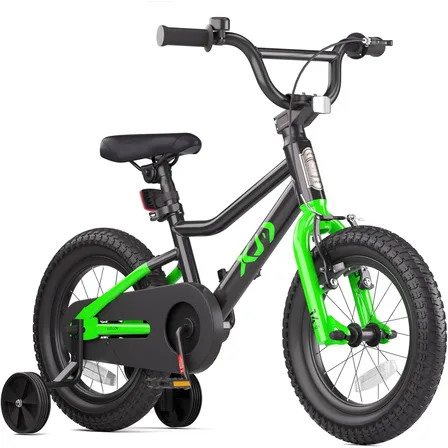
The Black XJD Kids Bike for Boys – 12, 14 & 16 Inch Sizes is listed in the Training Wheel Bikes category and offers 12 Inch, 14 Inch and 16 Inch SKU labels. Those three catalog options provide relevant comparison points for children whose measured heights fall within the corresponding XBikes ranges, while still requiring an individual fit check.

Compare its listed sizes against the measurement, not merely the broad age bands. A child measuring 38 inches, for example, falls within both the 12 Inch and 14 Inch starting ranges, so the deciding evidence must come from trying each relevant size and checking stand-over, reach, brake control and confidence.
This product is not a direct catalog option for a child whose appropriate comparison begins at 18, 20, 24 or 26 inches. Its available 12, 14 and 16 Inch sizes are nearest-size comparison points only when useful for understanding the transition; they are not substitutes for the required larger size.
Prepare for the first ride
Choose a flat practice area away from traffic, obstacles and steep slopes. Keep early sessions short enough that the child remains attentive, and supervise closely. Progress should be based on consistent starting, steering and stopping rather than pressure to ride by a particular birthday.
A bicycle helmet is required equipment for practice. Following U.S. Consumer Product Safety Commission guidance, use a properly fitting helmet that sits level and fasten its straps according to the helmet manufacturer's instructions. Recheck the fit whenever the helmet is adjusted or passed through a growth period.
For assembly, maintenance, load limits, compatibility and torque requirements, follow the exact bicycle manual. If the instructions are unavailable or the setup is uncertain, use a qualified bicycle mechanic rather than guessing.
Make the decision
Measure the child's height and inseam today, shortlist the matching wheel-size range, and arrange an actual fit check. Start riding only when the child can straddle the bike, reach and operate its controls, and demonstrate enough confidence to practice under supervision; otherwise, wait or compare another size.
Bikes for your next adventure
-

XJD Kids Bike for Girls – Pink, 12/14/16/20 Inch with Training Wheels
The XJD Kids Bike for Girls in Pink is a training-wheel bike built to carry your…$139
$159 -
Black XJD Kids' BMX Bicycle with Training Wheels
The XJD Kids' BMX Bicycle with Training Wheels is built for children roughly 3 t…$99.99
$119.99 -

XJD Girls Bike for Kids Ages 3-8, 12/14/16 Inch with Training Wheels – Purple
The XJD Girls Bike in Purple is a training-wheel bicycle for kids ages 3 to 8, f…$149
$169