

What age should a kid start riding a bike
Most children can start riding a bike around age 3, but readiness and fit matter more than a birthday. Measure height and inseam, then check reach, balance and brake control on the actual bike.
Start with readiness, not age alone
A child is ready to begin when they can follow simple directions, walk or run steadily, and stay interested long enough to practise. They should also be able to hold the handlebar, look ahead and stop when asked. Hesitation is not failure; waiting and trying again later can be the right decision.
Age is only a starting point because children of the same age can differ greatly in height, coordination and confidence. XBikes lists 12-inch wheels as a starting point for ages 3–4 and heights of 34–40 in (86–102 cm), but the child must still try the bike.
Measure before comparing wheel sizes
Measure the child’s standing height without shoes. For inseam, have them stand straight with feet slightly apart and measure from the floor to the crotch. Keep both measurements available while checking the bicycle; wheel size alone does not reveal saddle height, stand-over clearance or reach.
| Wheel size | Starting age | Rider height |
|---|---|---|
| 12 Inch | 3–4 | 34–40 in / 86–102 cm |
| 14 Inch | 3–6 | 37–45 in / 94–114 cm |
| 16 Inch | 4–7 | 40–48 in / 102–122 cm |
| 18 Inch | 5–9 | 43–52 in / 109–132 cm |
| 20 Inch | 7–12 | 48–60 in / 122–152 cm |
| 24 Inch | 10–14 | 54–64 in / 137–163 cm |
| 26 Inch | Youth and adults | Over 60 in / 153 cm |
Where ranges overlap, do not automatically choose the larger wheel. Compare both on the child and favour the bike they can control confidently. Never buy an oversized bicycle solely for the child to grow into.
Perform the fit check on the actual bike
- Check stand-over: Have the child straddle the bicycle with both feet on the ground. They should be able to stand securely rather than being supported by the frame.
- Check seated reach: Their hands should reach the handlebar without an extreme stretch, locked elbows or a sharply bent posture.
- Check starting and stopping: Ask them to mount, push away and stop in a controlled way in a traffic-free area.
- Check brake control: If the bicycle has hand controls, confirm that the child can reach and operate them reliably. Do not assume suitability from wheel size.
- Check confidence: The child should look ahead and steer without appearing overwhelmed by the bicycle’s size.
If adjustment, assembly, compatibility, load limits or maintenance affects the fit, follow the exact product manual or ask a qualified bicycle mechanic. Do not improvise specifications.
When training-wheel models are relevant
Training-wheel bikes are relevant when a child fits the bicycle and needs support while developing pedalling and steering confidence. They are not a reason to move a child onto an oversized frame, and their presence does not replace checks for stand-over, reach or stopping control.
The two supplied catalog options make it possible to compare training-wheel bicycles across relevant starting sizes. The XJD Kids' Training Wheel Bike for Boys & Girls, 12/14/16 Inch – White offers 12 Inch, 14 Inch and 16 Inch labels. The Girls' Training Wheel Bike by XJD, 12–20 Inch Wheels – Blue offers those labels plus 20 Inch, so each must be matched to the child rather than selected by title alone.
 XJD Kids' Training Wheel Bike for Boys & Girls, 12/14/16 Inch – White
Available in 12 Inch, 14 Inch and 16 Inch labels, this training-wheel model is relevant for comparing several early wheel-size starting points after measuring the child and completing an individual fit check.
 Girls' Training Wheel Bike by XJD, 12–20 Inch Wheels – Blue
This training-wheel model has 12 Inch, 14 Inch, 16 Inch and 20 Inch labels. Its broader listed size range supports comparison, but height, inseam, reach, brake control and confidence must determine suitability.
How the two catalog options compare
For a child near the usual starting stage, both products include 12 Inch, 14 Inch and 16 Inch choices. Use the measured-height ranges in the table to identify candidates, then compare the actual bicycles for inseam clearance, reach, brake operation and confidence.
The 20 Inch label appears only for the Girls' Training Wheel Bike by XJD, 12–20 Inch Wheels – Blue. The XBikes starting point for 20-inch wheels is ages 7–12 and 48–60 in (122–152 cm), not the typical first-bike stage for a smaller three- or four-year-old. Neither supplied product lists 18 Inch, 24 Inch or 26 Inch; for a rider requiring one of those sizes, these products are comparison points only, not equal-size substitutes.
Words such as “Kids,” “Boys & Girls” or “Girls” in a catalog title do not prove fit. Select according to the individual child’s measurements and control.
Prepare for the first ride
Choose a flat, open area away from traffic and obstacles. Keep early sessions short, calm and focused on looking forward, steering and stopping. An adult should supervise and reassess the fit if the child repeatedly struggles to reach the ground or controls.
Use a bicycle helmet that fits properly, sits level and has straps adjusted according to the helmet manufacturer’s instructions. A helmet cannot correct a bicycle that is too large.
The next step is simple: record height and inseam, use the age range only to narrow the wheel-size choices, and let the child try the candidate bike. Start now only if they can stand over it, reach it, control it and stop confidently.
Bikes for your next adventure
-

XJD Kids Bike for Girls – Pink, 12/14/16/20 Inch with Training Wheels
The XJD Kids Bike for Girls in Pink is a training-wheel bike built to carry your…$139
$159 -

Blue XJD Girls Bike with Training Wheels – 12/14/16 Inch
If you're shopping for a first pedal bike for a daughter roughly 3 to 8 years ol…$149
$169 -
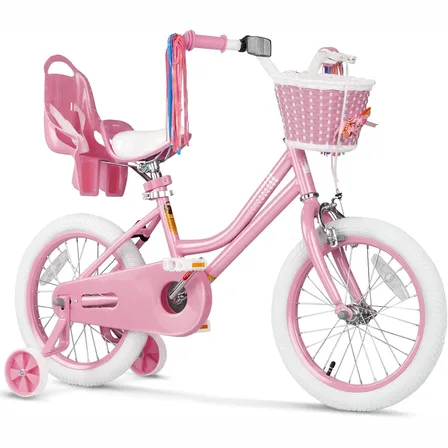
XJD Pink Girls' Bike – Kids 12/14/16 Inch Training Wheel Bicycle
The XJD Pink Girls' Bike is a training-wheel bicycle for girls ages 3 to 8 (ride…$149
$169