

What age should child be able to ride a bike
There is no single age when a child should be able to ride a bike. Start when the child can follow directions, control the bike and wants to learn—then choose by measured fit, not birthday.
Readiness matters more than a deadline
A child is ready to practise when they can stay engaged, understand simple stopping instructions and move the handlebars and brakes with control. Confidence also matters: reluctance is a reason to slow down, not evidence that the child is behind.
The XBikes starting ranges show why age cannot settle the question. Both 12-inch and 14-inch bikes can be starting points at age three, while the 14-inch range extends through age six. Children of the same age can therefore need different sizes or different amounts of support.
Measure before choosing a wheel size
Measure the child’s height without shoes, standing straight against a wall. Measure inseam from the floor to the crotch using a firm book held level between the legs. Height helps narrow the wheel-size range; inseam must then be compared with the actual bicycle’s stand-over clearance and saddle adjustment.
| Wheel size | Age starting point | Rider height |
|---|---|---|
| 12 Inch | 3–4 | 34–40 in / 86–102 cm |
| 14 Inch | 3–6 | 37–45 in / 94–114 cm |
| 16 Inch | 4–7 | 40–48 in / 102–122 cm |
| 18 Inch | 5–9 | 43–52 in / 109–132 cm |
| 20 Inch | 7–12 | 48–60 in / 122–152 cm |
| 24 Inch | 10–14 | 54–64 in / 137–163 cm |
| 26 Inch | Youth and adults | Over 60 in / 153 cm |
These ranges are starting points, not a substitute for trying the bicycle. Where ranges overlap, use the child’s inseam, reach, brake control and present confidence to decide. Do not move up merely because a birthday falls into another row.
Perform the fit and control check
The American Academy of Pediatrics advises having the child try the bicycle and avoiding an oversized bike bought for future growth. During the trial, check the following:
- Stand-over: the child can straddle the bicycle securely rather than being forced onto tiptoes or into an unstable position.
- Reach: the child can hold and turn the handlebars without stretching, locking the elbows or leaning excessively.
- Brake control: the child can reach and operate the bicycle’s brakes as intended while maintaining steering control.
- Confidence: the child can start, steer, stop and put a foot down without panic.
If any check fails, do not assume practice will compensate for poor fit. Compare another size or model. For setup, adjustments, torque, compatibility and maintenance procedures, follow the exact product manual or ask a qualified bicycle mechanic.
How the supplied training-wheel bike is relevant
The XJD Girls' Bike with Training Wheels, 12/14/16/20 Inch – Purple is relevant when a child is learning with training wheels and their measured fit points toward one of its supplied 12-, 14-, 16- or 20-inch size labels. Those four options let a parent compare several XBikes height starting points, but the title and size label alone do not prove fit.

This product is not an 18-, 24- or 26-inch option. If measurement points toward one of those sizes, treat its listed sizes only as comparison points, not equal substitutes. Availability of a matching label also does not replace checking stand-over, reach, brake access and control on the actual bicycle.
Make early practice controlled and low-pressure
Choose a level area away from traffic and obstacles. Begin with short sessions focused on starting, looking ahead, steering and stopping on request. Stay close enough to help without pulling the handlebars. End before fatigue turns repeated attempts into frustration.
Training wheels may suit a child who benefits from lateral support, but their presence does not establish the correct age or size. Whether they are fitted, adjusted or later removed should follow the product manual; use a qualified bicycle mechanic if the instructions or setup are unclear.
Protect the rider and decide what to do next
The U.S. Consumer Product Safety Commission says a bicycle helmet should fit properly, sit level and have its straps used according to the manufacturer’s instructions. Check the helmet before every practice session and replace or adjust it as directed by its manufacturer.
Your next decision is straightforward: measure height and inseam, identify the matching wheel-size starting range, and have the child try that size. Choose it only if the child can stand over, reach, brake and steer confidently. If those checks fail—or the child does not want to practise—change the fit or wait rather than treating age as a deadline.
Bikes for your next adventure
-

XJD Girls Bike for Kids Ages 3-8, 12/14/16 Inch with Training Wheels – Purple
The XJD Girls Bike in Purple is a training-wheel bicycle for kids ages 3 to 8, f…$149
$169 -
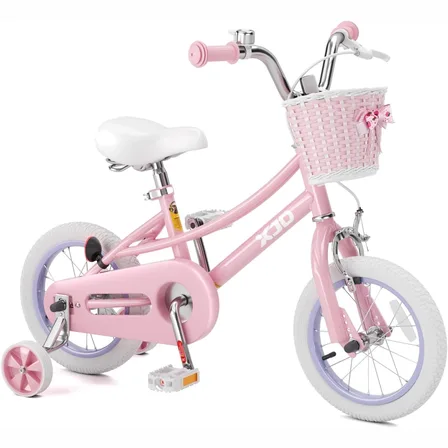
Pink 12/14/16/20" XJD Girls Bike with Training Wheels & Basket
The Pink XJD Girls Bike with Training Wheels & Basket is a first-bike pick f…$65.99
$75.99 -

XJD Kids Bike for Girls – Pink, 12/14/16/20 Inch with Training Wheels
The XJD Kids Bike for Girls in Pink is a training-wheel bike built to carry your…$139
$159