

What age should child learn to ride bike
Most children can start learning to ride a bike around ages 3–6, but readiness matters more than a birthday. Measure height and inseam, then check balance, reach, braking and confidence on the actual bike.
How to tell whether your child is ready
Age is only a starting point. A child is ready to learn when they want to try, can follow simple directions and can stay engaged without becoming overwhelmed. They should also be able to hold the handlebar, steer deliberately and put their feet down when they lose balance.
Do not treat hesitation as failure. A cautious child may benefit from short sessions and more time developing balance, while an eager child may progress quickly. Stop when frustration or fatigue begins; another calm attempt is more useful than forcing a long lesson.
Measure before choosing a bike
Measure the child's height without shoes. For inseam, have them stand upright with their feet slightly apart and measure from the floor to the crotch. Compare those measurements with the intended bicycle, not merely with an age printed in a listing.
Have the child try the bike whenever possible. They need comfortable stand-over clearance, an easy reach to the handlebar and access to the brake controls without stretching or losing their grip. They should be able to start, stop and support the bike with control. Never buy an oversized bicycle simply so the child can grow into it.
Use wheel size as a starting point
| Wheel size | Starting age | Rider height |
|---|---|---|
| 12 Inch | 3–4 | 34–40 in / 86–102 cm |
| 14 Inch | 3–6 | 37–45 in / 94–114 cm |
| 16 Inch | 4–7 | 40–48 in / 102–122 cm |
| 18 Inch | 5–9 | 43–52 in / 109–132 cm |
| 20 Inch | 7–12 | 48–60 in / 122–152 cm |
| 24 Inch | 10–14 | 54–64 in / 137–163 cm |
| 26 Inch | Youth and adults | Over 60 in / 153 cm |
Overlapping ranges are normal. Start with measured height, then use inseam, reach, brake control and current confidence to decide between sizes. Wheel diameter alone cannot confirm fit.
When training-wheel models are relevant
Training-wheel bikes can be relevant when a child is learning pedaling and steering but is not yet confident balancing independently. The two catalog options below provide several wheel sizes for comparison, so a parent can begin with the measured-height range and then conduct an individual fit check.
 XJD Kids Bike for Girls – Pink, 12/14/16/20 Inch with Training Wheels
A training-wheel model offered in 12, 14, 16 and 20 Inch sizes, making it relevant for comparison after measuring the child's height and checking individual fit and control.
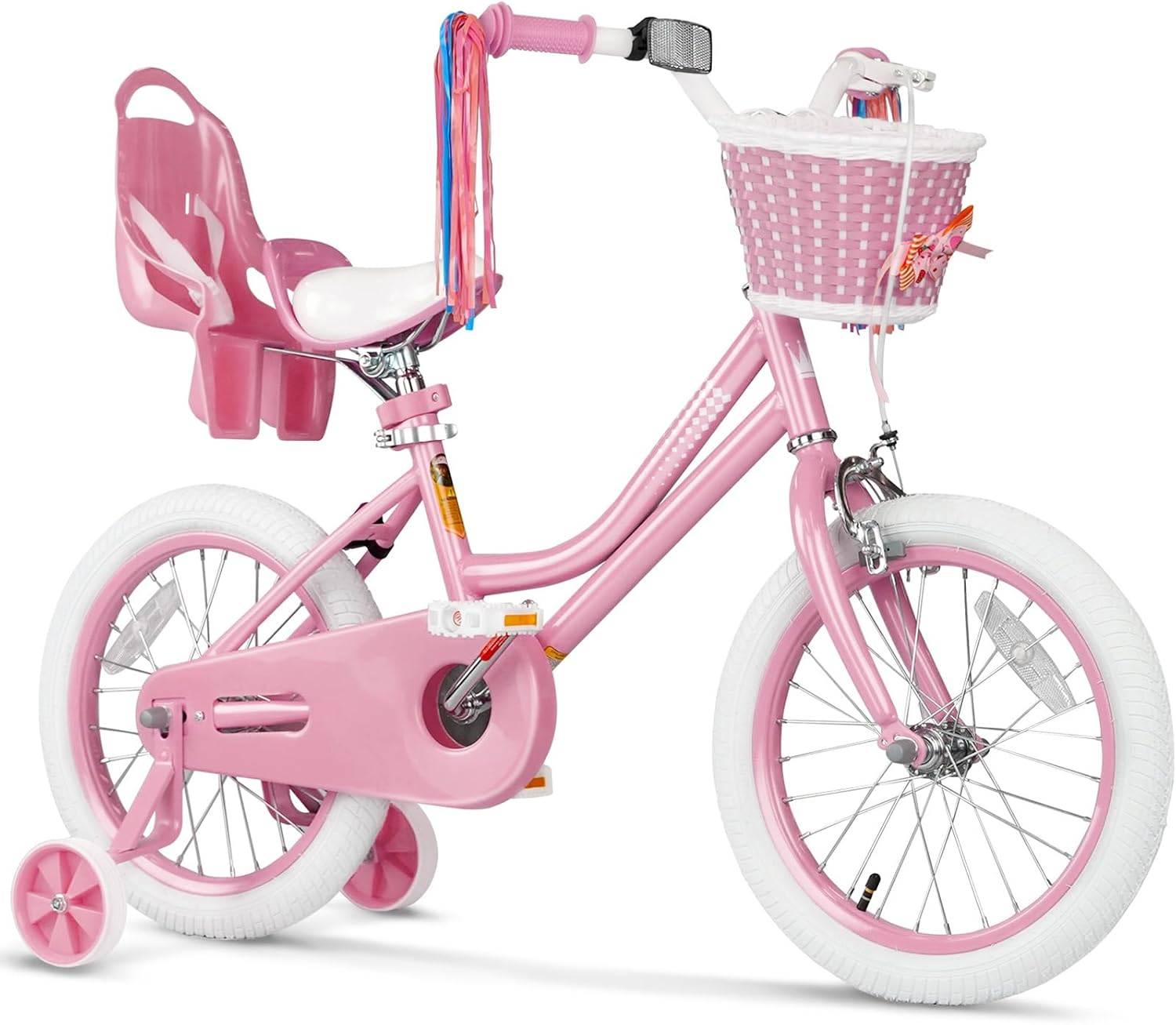 XJD Pink Girls' Bike – Kids 12/14/16 Inch Training Wheel Bicycle
A training-wheel bicycle offered in 12, 14 and 16 Inch sizes; relevant when the rider's measured height matches one of those starting ranges and training wheels suit their confidence.
XJD Kids Bike for Girls – Pink, 12/14/16/20 Inch with Training Wheels is listed in 12, 14, 16 and 20 Inch options. Its broader size selection spans several XBikes starting ranges, but the correct choice still depends on the individual child's measurements and control.
XJD Pink Girls' Bike – Kids 12/14/16 Inch Training Wheel Bicycle is listed in 12, 14 and 16 Inch options. It is relevant when the child's measured height points toward one of those starting sizes and training wheels suit the current learning stage.
These models are not relevant when the fit check indicates an 18, 24 or 26 Inch wheel, because neither supplied listing includes those sizes. They should be treated only as nearby comparison points, never as equal substitutes. Likewise, choose another approach if the child already balances confidently and does not need training wheels.
What to check during the first practice
- Fit: Confirm comfortable stand-over clearance and a relaxed reach before riding.
- Control: Ask the child to grip, steer and operate the brakes while remaining stable.
- Stopping: Practise controlled starts and stops in a flat area away from traffic.
- Confidence: Keep the session brief and reduce assistance only when the child remains composed.
- Helmet: Use a properly fitting bicycle helmet that sits level, with straps adjusted according to its manufacturer's instructions.
An adult should supervise and choose a suitable practice area. For assembly, maintenance, load limits, compatibility or torque, follow the exact product manual or ask a qualified bicycle mechanic; those details cannot be inferred from wheel size.
Make the decision by readiness, not age
If your child is interested, follows directions and can control a correctly fitted bike, begin with a short supervised practice session. If they cannot stand comfortably, reach the controls or stop reliably, pause and compare another size or wait. The right age to learn is the point when measured fit and practical readiness meet—not the birthday on the calendar.
Bikes for your next adventure
-

Black XJD Kids Bike for Boys – 12, 14 & 16 Inch Sizes
For a son between roughly 3 and 8 years old, the XJD Kids Bike in Black covers t…$169
$199 -

XJD Kids Bike for Girls – Pink, 12/14/16/20 Inch with Training Wheels
The XJD Kids Bike for Girls in Pink is a training-wheel bike built to carry your…$139
$159 -

Blue XJD Girls Bike with Training Wheels – 12/14/16 Inch
If you're shopping for a first pedal bike for a daughter roughly 3 to 8 years ol…$149
$169