

What age should kids start riding a bike
Most children can start riding a bike around age 3, but readiness and fit matter more than a birthday. Measure height and inseam, then check control.
What is the right starting age?
Age 3 is a practical starting point for many children because the XBikes starting range for a 12-inch bike is ages 3–4 and 34–40 in (86–102 cm) tall. That is a starting point, not a rule. A child should also be willing to practise, able to follow simple directions and comfortable balancing and stopping.
Some children are ready later, and waiting is reasonable. Do not move a hesitant child onto a larger bicycle simply because peers of the same age are riding. Confidence can improve with short, low-pressure sessions in a flat area away from traffic.
Measure before choosing a wheel size
Measure the child without shoes for a consistent height reading. For inseam, have the child stand straight with feet slightly apart and measure from the floor to the crotch. Compare those measurements with a bicycle in person whenever possible.
| Wheel size | Age starting point | Rider height |
|---|---|---|
| 12 Inch | 3–4 | 34–40 in / 86–102 cm |
| 14 Inch | 3–6 | 37–45 in / 94–114 cm |
| 16 Inch | 4–7 | 40–48 in / 102–122 cm |
| 18 Inch | 5–9 | 43–52 in / 109–132 cm |
| 20 Inch | 7–12 | 48–60 in / 122–152 cm |
| 24 Inch | 10–14 | 54–64 in / 137–163 cm |
| 26 Inch | Youth and adults | Over 60 in / 153 cm |
Where ranges overlap, do not decide from age or height alone. Inseam, reach, brake control and current confidence should settle the choice.
Use a hands-on fit check
Have the child try the exact bicycle rather than relying only on its wheel label. Do not buy an oversized bike for the child to grow into. A bike that is too large can make starting, stopping and steering harder.
- Check stand-over: the child should be able to straddle the bicycle securely rather than being forced onto tiptoes.
- Check reach: seated normally, the child should reach the handlebar without stretching, locking the elbows or losing a stable posture.
- Check controls: the child must be able to operate the available brakes confidently while maintaining grip and steering control.
- Watch movement: ask the child to start, steer, stop and get off in a controlled way in a safe practice area.
If you cannot confirm these points or need adjustments beyond the product manual, use a qualified bicycle mechanic.
When the supplied BMX options are relevant
The two supplied Kids' BMX Bikes are relevant comparison options when the child fits a 12-, 14- or 16-inch starting range and passes the individual fit check. Both are catalogued with training wheels, which may be useful to compare if that support matches the child’s current confidence; the catalog facts do not establish readiness or fit.
The XJD Girls BMX Bike 12/14/16 Inch with Training Wheels – Pink Blue and the XJD Boys & Girls BMX Bike with Training Wheels, 12/14/16" – Blue each have 12 Inch, 14 Inch and 16 Inch SKU labels. Their supplied facts support comparison by listed size, title and colour wording only.
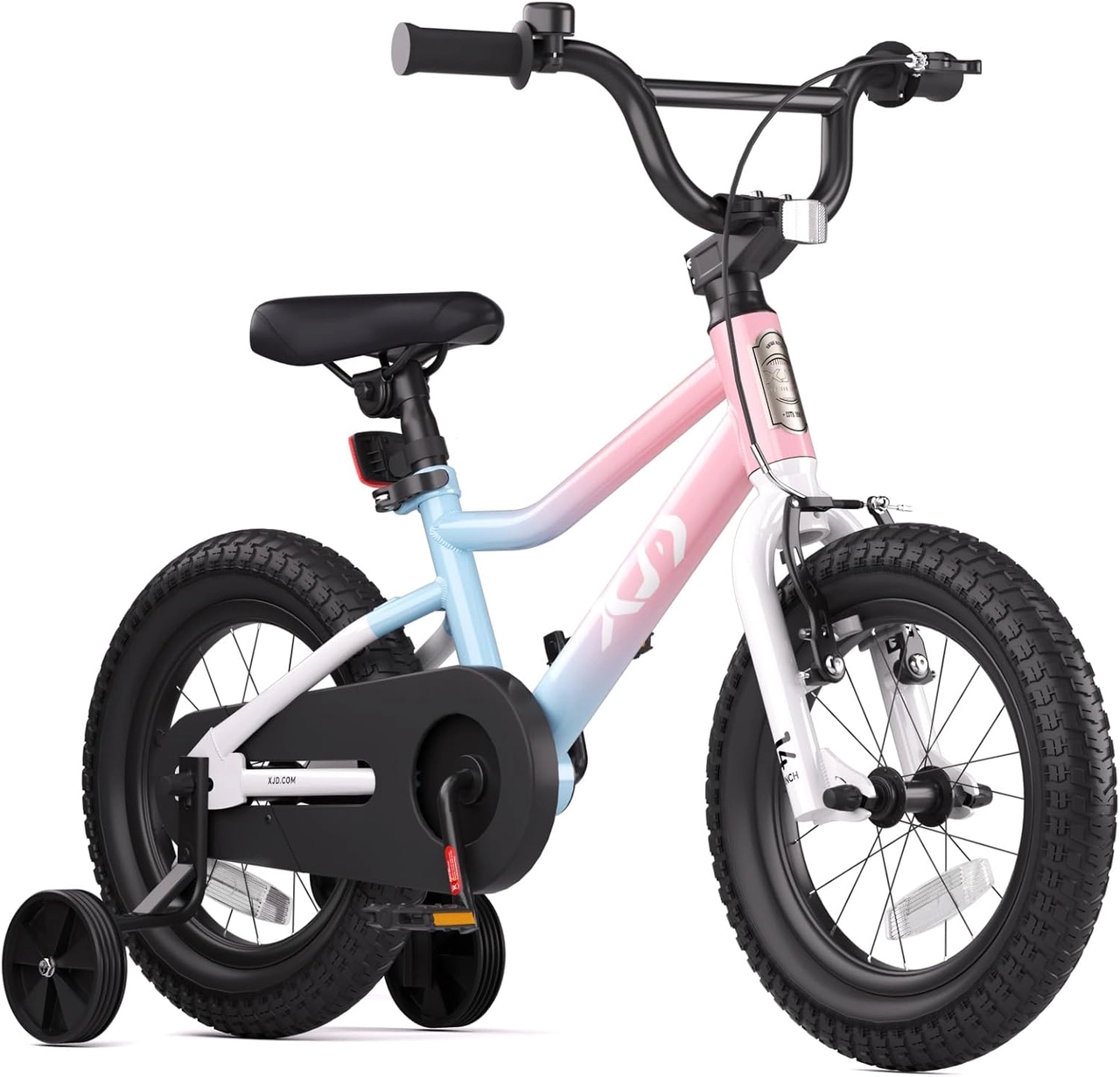 XJD Girls BMX Bike 12/14/16 Inch with Training Wheels – Pink Blue
A Kids' BMX Bike offered in 12 Inch, 14 Inch and 16 Inch SKU labels with training wheels. Compare the child’s measurements and hands-on control before selecting a size.
 XJD Boys & Girls BMX Bike with Training Wheels, 12/14/16" – Blue
A blue Kids' BMX Bike with training wheels and available 12 Inch, 14 Inch and 16 Inch SKU labels. It is relevant only when the rider fits the selected size and can control the bicycle.
These products are not relevant size substitutes for a child who measures into the 18-, 20-, 24- or 26-inch ranges. If the child needs one of those sizes, use the table to seek that exact wheel-size range and complete the same hands-on checks.
Training wheels do not decide readiness
Training wheels may change how a child begins practising, but their presence does not make an incorrectly sized bicycle suitable. Decide first whether the child can stand over the frame, reach comfortably, control the brakes and steer. Then consider whether training wheels fit the learning approach you plan to use.
Follow the exact product manual for assembly, adjustment, maintenance, compatibility and any load or torque requirements. If instructions are missing or the bicycle cannot be set up correctly, ask a qualified bicycle mechanic rather than improvising.
Prepare for the first ride
Use a bicycle helmet that fits properly, sits level and has its straps adjusted according to the helmet manufacturer’s instructions. Practise in a flat, open location away from vehicles and other hazards, with close adult supervision.
Start with brief sessions covering starting, straight-line steering and controlled stopping. Stop before fatigue or frustration undermines control. The next decision is simple: measure the child now, compare the height range, and choose only a bike on which that child can confidently stand over, reach, brake and steer.
Bikes for your next adventure
-
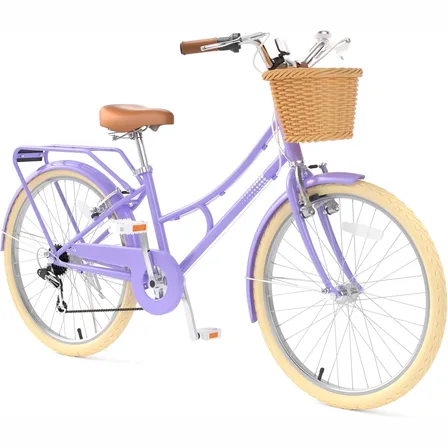
24-Inch Purple XJD Beach Cruiser Bike with U-Brake
The XJD 24-Inch Purple Beach Cruiser is built for girls and young women roughly …$159.99
-

XJD Kids Bike for Girls – Pink, 12/14/16/20 Inch with Training Wheels
The XJD Kids Bike for Girls in Pink is a training-wheel bike built to carry your…$139
$159 -
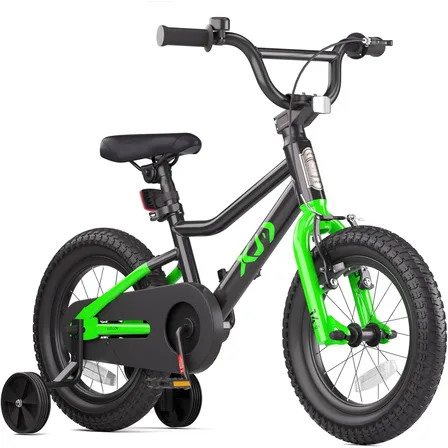
Black XJD Kids' BMX Bicycle with Training Wheels
The XJD Kids' BMX Bicycle with Training Wheels is built for children roughly 3 t…$99.99
$119.99