

What age to kids learn to ride a bike
There is no single age when kids learn to ride a bike. Start when your child can follow directions, control the bike and feels willing to practise.
Read readiness before choosing by age
Age can suggest where to begin, but it cannot tell you whether a bicycle fits or whether a child is ready to ride independently. Look for willingness to try, enough focus to respond to instructions, and the ability to steer, stop and remain in control at a walking pace.
Confidence matters too. A hesitant child may need more time with supported practice, while an eager child still needs a bicycle that fits. Avoid pressure or comparisons with siblings and friends; the useful question is whether this rider can operate this bicycle comfortably today.
Measure the child and compare wheel sizes
Measure standing height without shoes. Also measure inseam from the floor to the crotch while the child stands straight. Use height to find a starting wheel size, then check inseam, reach, brake control and confidence on the actual bicycle.
| Wheel size | Starting age | Rider height |
|---|---|---|
| 12 Inch | 3–4 | 34–40 in / 86–102 cm |
| 14 Inch | 3–6 | 37–45 in / 94–114 cm |
| 16 Inch | 4–7 | 40–48 in / 102–122 cm |
| 18 Inch | 5–9 | 43–52 in / 109–132 cm |
| 20 Inch | 7–12 | 48–60 in / 122–152 cm |
| 24 Inch | 10–14 | 54–64 in / 137–163 cm |
| 26 Inch | Youth and adults | Over 60 in / 153 cm |
These XBikes ranges are starting points, not permission to order from age alone. Where ranges overlap, compare both candidate sizes in person if possible. Do not buy an oversized bicycle merely to allow room for growth.
Perform an individual fit check
Have the child try the bicycle. When standing over it, the frame should not prevent a stable stance. Seated, the rider should reach the handlebar without stretching or becoming cramped. Ask the child to turn the handlebar both ways while staying balanced and to demonstrate that every fitted brake control is comfortably within reach and can be operated.
Reject a size if the child cannot mount and dismount with control, maintain a stable position, steer predictably or reach the controls. A wheel-size label does not override any of those problems. American Academy of Pediatrics guidance likewise emphasizes trying the bicycle, checking stand-over and controls, and avoiding an oversized purchase for future growth.
Practise the skills in a useful order
- Begin in a flat, open area: choose a space away from traffic, steep slopes and obstacles.
- Establish control first: let the child become comfortable mounting, looking ahead, steering and stopping before expecting independent riding.
- Add balance gradually: provide only the support the child needs, then reduce it as starts and straight riding become steadier.
- Keep sessions manageable: pause when concentration or confidence drops. A calm return later is more useful than forcing another attempt.
A properly fitting bicycle helmet is required for every practice session. It must sit level, fit properly and use its straps according to the helmet manufacturer's instructions, consistent with U.S. Consumer Product Safety Commission guidance.
How the supplied training-wheel bikes compare
The two catalog options are relevant when a child is learning with a training-wheel bike and their measured fit points toward one of the listed sizes. They help compare available wheel-size steps: Girls' Training Wheel Bike by XJD with Basket – Purple is offered in 14 Inch, 16 Inch and 20 Inch labels, while Flower Pink XJD Girls Bike with Doll Seat & Basket is offered in 12 Inch, 14 Inch and 16 Inch labels.
 Girls' Training Wheel Bike by XJD with Basket – Purple
A training-wheel bike offered in 14 Inch, 16 Inch and 20 Inch labels, making it relevant when the rider's measurements and individual fit check point to one of those sizes.
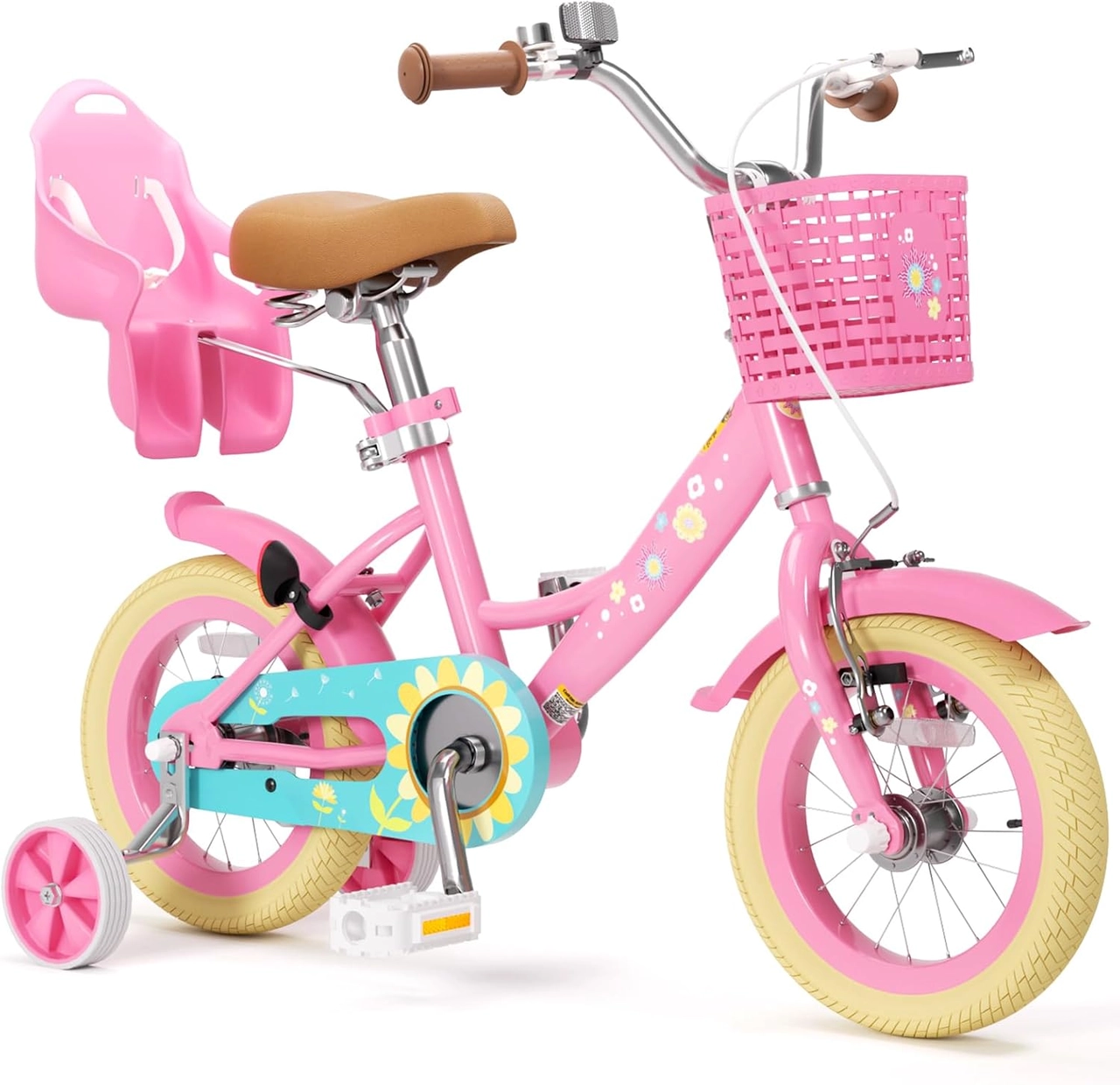 Flower Pink XJD Girls Bike with Doll Seat & Basket
A training-wheel bike offered in 12 Inch, 14 Inch and 16 Inch labels. It adds the smallest supplied comparison point but still requires checks of height, inseam, reach, control and confidence.
The second option supplies the smaller 12 Inch comparison point; the first extends the comparison to 20 Inch. Both overlap at 14 Inch and 16 Inch. That does not make them interchangeable: select only after matching the rider's measured height and checking inseam, reach, control access and confidence on the exact bicycle.
Neither supplied product offers an 18 Inch, 24 Inch or 26 Inch label. If the measurements point to one of those sizes, these products are comparison points around the range, not substitutes for the indicated size. Do not move to another size simply because it appears in this selection.
Decide what to do next
Write down the child's height and inseam, identify the starting size in the table, and arrange a fit check. Keep the candidate only if the child can stand over, reach, steer and stop with control and wants to practise. For assembly, adjustments, compatibility, maintenance, load limits or torque, follow the exact product manual or ask a qualified bicycle mechanic. The right learning time is when readiness and correct fit meet—not when a birthday says they should.
Bikes for your next adventure
-

Black XJD Kids Bike for Boys – 12, 14 & 16 Inch Sizes
For a son between roughly 3 and 8 years old, the XJD Kids Bike in Black covers t…$169
$199 -

XJD Kids Bike for Girls – Pink, 12/14/16/20 Inch with Training Wheels
The XJD Kids Bike for Girls in Pink is a training-wheel bike built to carry your…$139
$159 -

Blue XJD Girls Bike with Training Wheels – 12/14/16 Inch
If you're shopping for a first pedal bike for a daughter roughly 3 to 8 years ol…$149
$169