

What age to teach a kid to ride a bike
Most children are ready to learn to ride a bike between ages 3 and 7, but readiness and individual fit matter more than a birthday.
Use age as a starting point, not the decision
A child can begin when they can follow simple directions, stay engaged during short practice sessions, and coordinate steering, pedaling and stopping. Some children are eager at three; others need more time at six or seven. Hesitation is a reason to slow down, not evidence that anything is wrong.
Age helps narrow the search, but it cannot confirm bike size. Measure the child and have them try the bicycle. Never choose an oversized bike simply to leave room for growth: a bike that is difficult to stand over, reach across or stop can make learning harder.
Measure and check these five things
- Standing height: Measure without shoes, from the floor to the top of the head.
- Inseam: Measure from the floor to the crotch while the child stands straight. Compare this measurement with the bicycle's stand-over space and adjustment information.
- Stand-over control: With the child straddling the bicycle, confirm that they can support themselves and manage the bike without leaning precariously.
- Reach: Seated in a normal riding position, the child should reach the handlebar and steer without stretching, locking their arms or losing balance.
- Brake control: The child must be able to reach and operate the bicycle's actual braking system confidently. Follow the exact product manual for adjustment, or ask a qualified bicycle mechanic.
These checks outrank the age printed on a chart or packaging. Recheck them after any seat or handlebar adjustment.
Compare the child's measurements with wheel-size starting points
| Wheel size | Starting age | Rider height |
|---|---|---|
| 12 Inch | 3–4 | 34–40 in / 86–102 cm |
| 14 Inch | 3–6 | 37–45 in / 94–114 cm |
| 16 Inch | 4–7 | 40–48 in / 102–122 cm |
| 18 Inch | 5–9 | 43–52 in / 109–132 cm |
| 20 Inch | 7–12 | 48–60 in / 122–152 cm |
| 24 Inch | 10–14 | 54–64 in / 137–163 cm |
| 26 Inch | Youth and adults | Over 60 in / 153 cm |
Overlapping ranges are intentional: two children of the same age may need different sizes. If height points toward more than one wheel size, compare inseam, stand-over control, reach, braking and confidence on each actual bicycle. A child should not move up merely because their age appears in the larger size's range.
Decide whether training wheels fit the learning stage
Training wheels may be relevant when a child is learning pedaling and steering but is not ready to balance independently. They do not replace a fit check, and their presence does not establish an age range. A child who already balances confidently may instead need practice coordinating starts, pedals, turns and controlled stops.
The two supplied catalog options help families compare 12 Inch, 14 Inch and 16 Inch bicycles that include training wheels: Black XJD Kids' BMX Bicycle with Training Wheels is categorized as a Kids' BMX Bike, while Pink Girls' 12/14/16" Bike by XJD – Basket & Doll Seat is categorized as a Training Wheel Bike.
 Black XJD Kids' BMX Bicycle with Training Wheels
Available in 12 Inch, 14 Inch and 16 Inch labels, this Kids' BMX Bike with training wheels is relevant for comparing chart starting points with the child's individual fit.
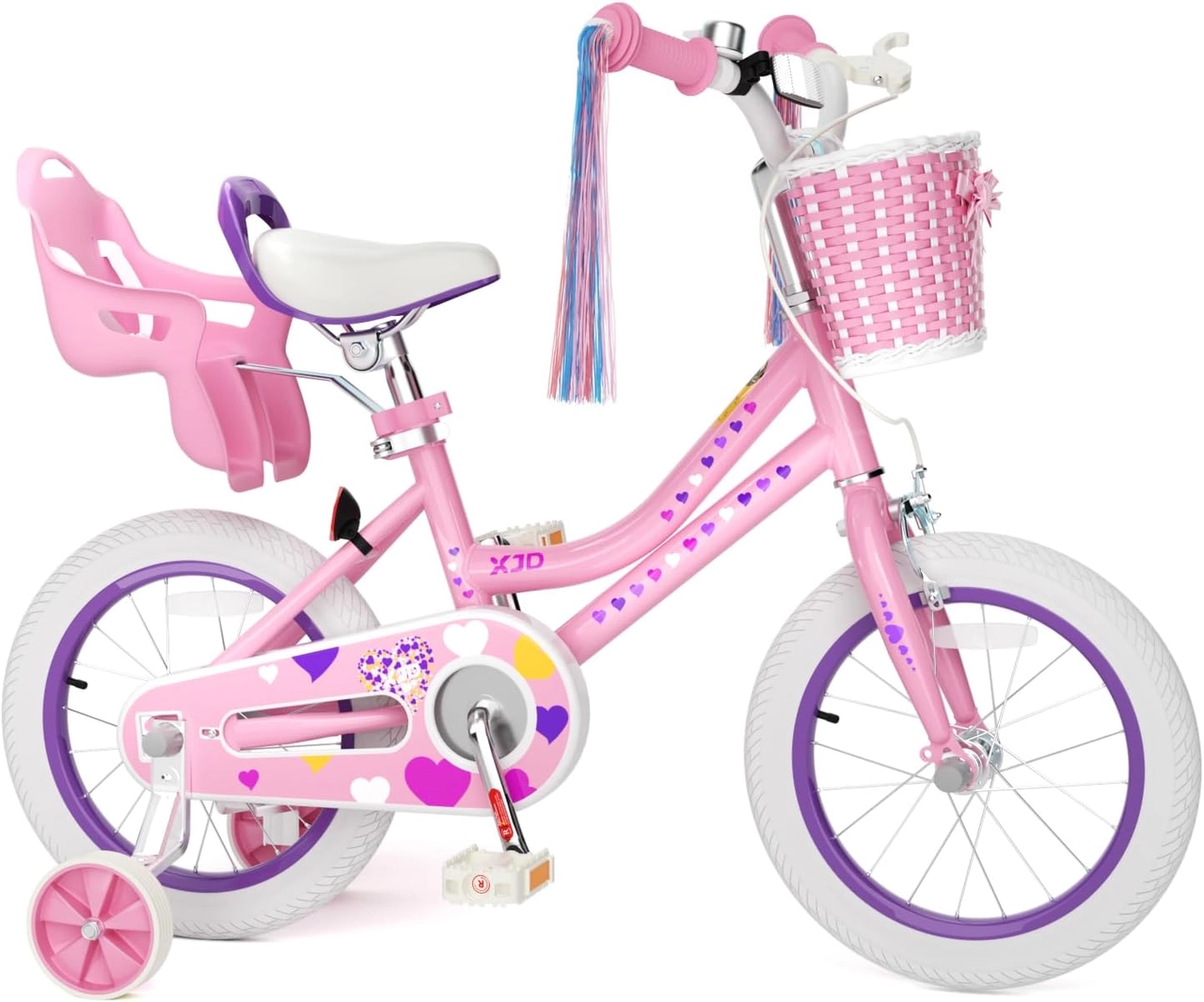 Pink Girls' 12/14/16" Bike by XJD – Basket & Doll Seat
This Training Wheel Bike offers 12 Inch, 14 Inch and 16 Inch labels. Its basket and doll seat appear in the catalog title, but size still requires an individual fit check.
Both options have 12 Inch, 14 Inch and 16 Inch SKU labels. Use the chart to identify a starting size, then select the corresponding product variant only after checking the individual child's height, inseam, reach, brake control and confidence. The basket and doll seat are identified only in the second product's catalog title; they do not affect fit.
If measurements indicate 18 Inch, 20 Inch, 24 Inch or 26 Inch, neither supplied product offers that exact wheel-size label. In that case, these products are comparison points for smaller sizes, not equal substitutes for the required size.
Make the first lessons manageable
- Choose a flat practice area away from traffic, obstacles and steep slopes.
- Begin with mounting, looking ahead, steering and stopping before expecting a complete ride.
- Keep practice brief enough that the child remains attentive and willing to try again.
- Stay close enough to assist, but avoid pushing the child faster than they can control.
A bicycle helmet must fit properly, sit level and have its straps secured according to the helmet manufacturer's instructions. Check the fit before every session. For bicycle assembly, maintenance, compatibility, load limits or torque, follow the exact product manual or use a qualified bicycle mechanic.
Choose the next step today
Measure height and inseam first, identify the chart's starting wheel size, and arrange an individual fit check. Teach now if the child is willing, attentive and able to control the correctly fitted bicycle; wait and retry later if reach, braking, balance or confidence is not yet adequate.
Bikes for your next adventure
-

Kids Bike Helmet by XJD for Boys & Girls – Black, Blue, Green, Pink, Purple
The XJD Kids Bike Helmet covers a wide 2-to-8-year age range thanks to two head-…$59.99
-

Kids Bike Helmet by XJD for Girls – Pink
The XJD Kids Bike Helmet in Pink is a lightweight multi-sport helmet for girls r…$59.99
$99 -

XJD Kids Bike for Girls – Pink, 12/14/16/20 Inch with Training Wheels
The XJD Kids Bike for Girls in Pink is a training-wheel bike built to carry your…$139
$159