

What are the best bikes for kids 6-9 years
For most children aged 6–9, start by comparing 16-, 18- and 20-inch bikes, then choose by measured height, inseam, reach, brake control and confidence—not age alone.
Which wheel size should you compare?
The best bike is the smallest suitable option that gives the child comfortable control without being cramped. Do not buy an oversized bicycle merely to allow room for growth. A child near an age boundary may need a different size from a classmate of the same age.
| Wheel size | XBikes age starting point | Rider-height starting point | Relevance at ages 6–9 |
|---|---|---|---|
| 14 Inch | 3–6 | 37–45 in / 94–114 cm | Worth checking for a shorter six-year-old |
| 16 Inch | 4–7 | 40–48 in / 102–122 cm | Common comparison for ages six to seven |
| 18 Inch | 5–9 | 43–52 in / 109–132 cm | Covers much of the requested age span |
| 20 Inch | 7–12 | 48–60 in / 122–152 cm | Common comparison for ages seven to nine |
| 24 Inch | 10–14 | 54–64 in / 137–163 cm | Consider only when the child’s measurements and control support it |
These figures are starting points, not guarantees. Height narrows the search, but the final choice depends on how the individual child fits and handles the complete bicycle.
Measure before choosing
Measure the child’s height without shoes, standing straight against a wall. Measure inseam from the floor to the crotch while the child stands naturally. Use height to identify likely wheel sizes, then take the child to try the actual bicycle.
During the trial, check four things:
- Stand-over: the child can straddle the bicycle without the frame preventing stable footing.
- Reach: the handlebars can be held without excessive stretching, locked elbows or an awkward posture.
- Brake control: the child can comfortably reach and operate the bicycle’s brakes.
- Confidence: starting, steering, slowing and stopping feel controlled rather than intimidating.
A larger wheel size is not an upgrade if it makes any of these tasks harder. If two sizes match the height chart, compare both in person and favor the one the child can control more naturally.
How the supplied catalog bike fits this decision
The supplied option, Girls' Training Wheel Bike by XJD, 12–20 Inch Wheels – Blue, is categorized as a training wheel bike and is offered with 12 Inch, 14 Inch, 16 Inch and 20 Inch SKU labels. Its 16- and 20-inch choices provide useful comparison points within the main size range for ages 6–9; the 14-inch choice may be relevant to a shorter six-year-old. It does not offer an 18-inch SKU, so it is not a substitute when an individual fit check indicates that 18 inches is the appropriate choice.

Because the catalog facts do not specify geometry, brake type, adjustability, weight or load limit, the title and wheel-size label alone cannot establish fit. Try the exact SKU and consult its product manual for assembly, adjustment, maintenance, compatibility and limits. Use a qualified bicycle mechanic when the manual does not resolve a question.
Decide whether training wheels are relevant
The supplied model belongs to the Training Wheel Bikes category. That makes it relevant when a parent is intentionally comparing that category, but category alone does not show whether training wheels suit a particular child’s current skills.
Start with the child’s present confidence: can they balance, start, steer and stop consistently, or do they still need the kind of support represented by this category? Compare the child’s control during an actual trial. Do not choose the supplied model solely because one of its wheel labels matches the chart.
Complete the safety and condition checks
Before each ride, confirm that the bicycle appears correctly assembled and that steering, braking and moving parts operate as intended. Follow the exact product manual rather than relying on a generic torque value or maintenance procedure. If assembly, damage or adjustment is uncertain, have a qualified bicycle mechanic inspect it.
A bicycle helmet must fit properly, sit level on the child’s head and use its straps according to the helmet manufacturer’s instructions. Recheck the fit instead of assuming that an existing helmet still fits.
Your next decision
- Measure height and inseam.
- Use the XBikes ranges to shortlist 16, 18 or 20 inches, adding 14 or 24 inches only when the child’s measurements justify checking them.
- Have the child try each shortlisted bicycle and compare stand-over, reach, brake operation and confident control.
- Choose the size the child controls now; do not size up merely for future growth.
For a 6–9-year-old, the answer is therefore measurement-led: shortlist the chart-matching sizes, test the complete bikes, and buy only the option the child can comfortably control today.
Bikes for your next adventure
-

Flower Pink XJD Girls Bike with Doll Seat & Basket
The XJD Flower Pink girls' bike is made for riders 71–122 cm tall (roughly ages …$69.99
-

XJD Pink Beach Cruiser for Girls – Rear Rack & V-Brake
The XJD Pink Beach Cruiser for girls is the step-up bike for riders who've outgr…$179.99
$209.99 -
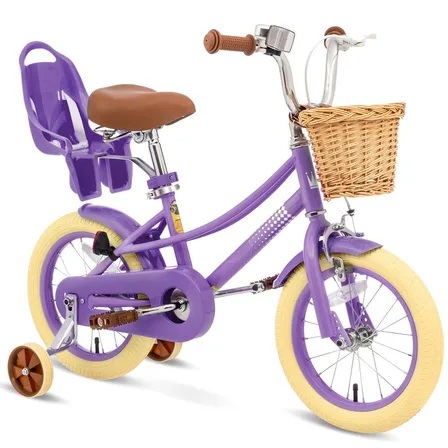
XJD Girls' Bike with Training Wheels, 12/14/16/20 Inch – Purple
The XJD girls' bike with training wheels in Purple is built to grow with your ri…$139
$159