

What are the best kid bike trailers
The best kid bike trailer is one that fits your child now, stays within its manual’s limits, connects correctly to the towing bicycle, and suits your routes.
Start with the child, not the feature list
Measure the child’s seated height and shoulder width, then check the trailer’s stated passenger-height, seating-space and load limits. Include the child, clothing and anything carried when evaluating the permitted load. A trailer that is already cramped or close to a stated limit is not a sensible choice for growth.
Confirm that the restraint can be adjusted to the child as directed by the manufacturer. Look at headroom with the child seated and wearing the clothing expected on rides. If a helmet is required by the trailer instructions or applicable rules, include it during this check.
A bicycle helmet must fit properly, sit level and have its straps adjusted according to the helmet manufacturer’s instructions. Replace guesswork with an actual fitting.
Compare trailers around the rides you will take
The best design depends on where and how it will be used. For each candidate, compare the following points rather than choosing from appearance alone:
- Passenger fit: enough usable space for the intended child or children, within every stated limit.
- Towing compatibility: explicit compatibility with the bicycle, axle and hitch arrangement you will use.
- Route suitability: wheels, enclosure and intended use that match your usual surfaces and weather.
- Everyday practicality: doorway access, storage space, folding needs and room for essential cargo.
- Inspection and upkeep: instructions that clearly explain attachment, pre-ride checks and replacement parts.
Do not assume that a hitch fits because it appears close, or improvise around an incompatible axle. Follow the exact trailer and bicycle manuals; ask a qualified bicycle mechanic when compatibility, assembly or torque is uncertain.
Check the towing bike as carefully as the trailer
A suitable trailer still needs a correctly fitted towing bicycle and a rider who can start, steer and stop with the added trailer confidently. Before carrying a child, verify the attachment exactly as the manual specifies and practise without a passenger in a controlled area.
The two catalog bicycles below help clarify an important distinction: they are child-ridden bicycles for wheel-size and fit comparison, not kid bike trailers or documented trailer-towing options. Their supplied facts do not establish hitch compatibility, load capacity or towing suitability.
 Blue XJD Freestyle BMX Bike, 20-Inch – No Pegs
A 20-inch Kids’ BMX Bike offered with the Default SKU label. It is a child-ridden bicycle and only a comparison point; supplied facts do not establish trailer or towing suitability.
 Pink 12/14/16/20" XJD Girls Bike with Training Wheels & Basket
A Training Wheel Bike offered in 12-, 14-, 16- and 20-inch labels. It can support bicycle-size comparisons, but it is not a kid bike trailer and has no supplied towing-compatibility facts.
Blue XJD Freestyle BMX Bike, 20-Inch – No Pegs is a 20-inch product in Kids’ BMX Bikes. Pink 12/14/16/20" XJD Girls Bike with Training Wheels & Basket is offered in 12-, 14-, 16- and 20-inch labels in Training Wheel Bikes. Neither supplied listing is a substitute for a kid bike trailer, and neither should be selected as a towing bicycle without confirmation from its exact manual or a qualified bicycle mechanic.
If you are comparing a trailer with a child’s own bike
A trailer carries a passenger; a child’s bicycle requires the child to balance, steer, brake and manage the route. The decision therefore depends on the trip and the child’s current ability, not merely on age.
| Wheel size | XBikes starting point |
|---|---|
| 12 Inch | Ages 3–4; 34–40 in / 86–102 cm |
| 14 Inch | Ages 3–6; 37–45 in / 94–114 cm |
| 16 Inch | Ages 4–7; 40–48 in / 102–122 cm |
| 18 Inch | Ages 5–9; 43–52 in / 109–132 cm |
| 20 Inch | Ages 7–12; 48–60 in / 122–152 cm |
| 24 Inch | Ages 10–14; 54–64 in / 137–163 cm |
| 26 Inch | Youth and adults over 60 in / 153 cm |
These ranges are starting points only. Measure the rider and have the child try the bicycle. Check stand-over clearance, reach, brake control and present confidence; do not buy an oversized bicycle simply for growth. Height and individual control matter more than age alone.
Use a short pass-or-reject check
- Measure the child and compare the results with the trailer manufacturer’s passenger-space and load requirements.
- Identify the exact towing bicycle and obtain written compatibility information for its axle and hitch arrangement.
- Check that the restraint, enclosure and seating position adjust correctly for the child.
- Confirm that the trailer’s intended surfaces, storage arrangement and passenger capacity match real family trips.
- Read the manuals for assembly, maintenance, inspection, load limits and attachment instructions; use a qualified mechanic where anything remains unclear.
Reject any candidate that fails one of those checks, even if its other features are appealing. Choose the kid bike trailer only after the child fits, the towing connection is explicitly compatible, and the adult can control the complete setup confidently.
Bikes for your next adventure
-

Kids Bike Helmet by XJD for Girls – Pink
The XJD Kids Bike Helmet in Pink is a lightweight multi-sport helmet for girls r…$59.99
$99 -

Blue XJD Kids Bike Helmet for Boys & Girls
The Blue XJD Kids Bike Helmet is a lightweight, adjustable multi-sport helmet fo…$59.99
$99 -
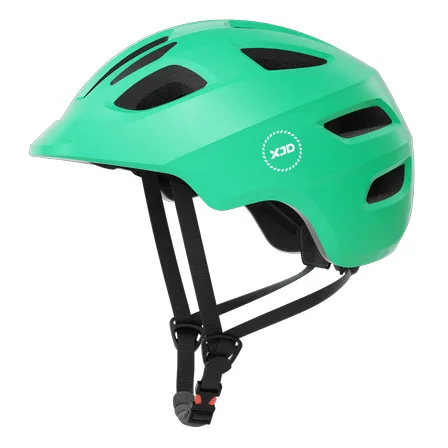
Green XJD Kids Bike Helmet for Boys & Girls
The Green XJD Kids Bike Helmet is a lightweight multi-sport helmet for toddlers …$59.99
$99