

What bike frame for 10 years old
For most 10-year-olds, start by comparing 20-inch and 24-inch bikes. Choose by measured height and fit: 20 Inch covers 48–60 in (122–152 cm), while 24 Inch covers 54–64 in (137–163 cm). Do not buy a larger frame merely to allow room for growth.
Which size should you check first?
Age points you toward a comparison, but it does not settle the choice. Under the XBikes starting points, a 20 Inch bike covers ages 7–12, while a 24 Inch bike covers ages 10–14. Their height ranges overlap between 54 and 60 in (137 and 152 cm), so many 10-year-olds need to try both.
| Wheel size | Age starting point | Rider-height starting point | How to use it |
|---|---|---|---|
| 20 Inch | 7–12 | 48–60 in / 122–152 cm | Compare when the rider is within this range, especially if reach or control is easier than on a 24 Inch. |
| 24 Inch | 10–14 | 54–64 in / 137–163 cm | Compare when height is at least 54 in / 137 cm and the rider can comfortably control the complete bike. |
| 26 Inch | Youth and adults | Over 60 in / 153 cm | Consider only when the rider exceeds this height starting point and passes an individual fit check. |
If the child is below 48 in (122 cm), neither 20 Inch nor 24 Inch falls within the supplied height starting points. Recheck the measurement and compare the smaller wheel-size standards rather than forcing the child onto an oversized bicycle.
Measure height and inseam before shopping
Measure the child without shoes on a level floor. For height, have them stand upright against a wall and measure from the floor to the top of the head. Use that number to select the wheel sizes worth trying.
For inseam, have the child stand naturally and measure from the floor to the crotch. There is no universal conversion from inseam to a frame size because bicycle shapes can differ. Instead, take the measurement with you and use it during the stand-over check.
Make the child try the complete bicycle
Have the rider straddle the bicycle while it is upright. They should be able to stand securely without the frame pressing into them. Then check the riding position: the child should reach the handlebar without an awkward stretch, turn it confidently, and remain balanced while looking ahead.
Next, check brake control. The rider must be able to reach and operate the brake controls with their normal hand position. A bike is too large if the child must strain, shift their hands unsafely, or cannot confidently start, steer, stop and dismount. A smaller suitable bike is preferable to an oversized one bought for future growth.
How the supplied catalog option helps
The XJD Pink Beach Cruiser for Girls – Rear Rack & V-Brake is offered with 20 Inch, 24 Inch and 26 Inch SKU labels. That makes its 20 Inch and 24 Inch versions relevant comparison points for the usual 10-year-old overlap, while the 26 Inch label is relevant only above the supplied height threshold. These labels narrow the options to try; they do not prove an individual fit.

Compare the 20 Inch and 24 Inch versions as different sizes, not interchangeable choices. Select the version on which the child passes the stand-over, reach, brake-control and confidence checks. Do not infer dimensions, adjustment range, component compatibility, assembly requirements or load limits from the wheel-size label; consult the exact product manual or a qualified bicycle mechanic for those details.
Resolve an overlap without guessing
If the rider measures 54–60 in (137–152 cm), both 20 Inch and 24 Inch are starting points. Use a side-by-side tryout and compare:
- Whether the child can stand over each bicycle securely.
- Whether the handlebar is reachable without overextending.
- Whether every brake control can be reached and operated reliably.
- Whether starts, turns, stops and dismounts remain calm and controlled.
- Whether the child is currently confident, rather than merely able to touch the pedals.
If only one bike passes every check, choose that size. If neither does, keep looking. If both do, compare the complete riding positions and favor the one the child controls more naturally; do not automatically choose the larger option.
Complete the fit with a helmet
A properly fitting bicycle helmet is part of the decision. It should sit level and its straps should be adjusted according to the helmet manufacturer’s instructions. A helmet cannot compensate for a bicycle that is too large or difficult to control.
For a 10-year-old, measure height now, shortlist 20 Inch or 24 Inch from the table, and arrange an individual tryout. Choose only after the child can stand over, reach, brake and ride with present-day confidence.
Bikes for your next adventure
-
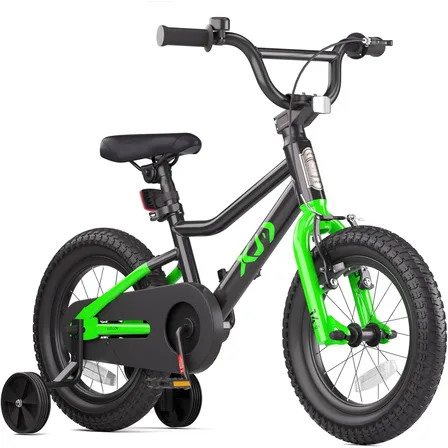
Black XJD Kids' BMX Bicycle with Training Wheels
The XJD Kids' BMX Bicycle with Training Wheels is built for children roughly 3 t…$99.99
$119.99 -

Black XJD Kids Bike for Boys – 12, 14 & 16 Inch Sizes
For a son between roughly 3 and 8 years old, the XJD Kids Bike in Black covers t…$169
$199 -
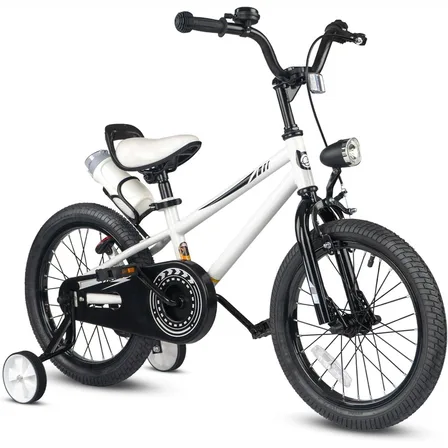
XJD Kids' Training Wheel Bike for Boys & Girls, 12/14/16 Inch – White
The XJD kids' training wheel bike in White is made for riders ages 3–8 (roughly …$169
$199