

What child bike seat is best
The best child bike seat is one made for the job, compatible with the exact bicycle and correctly sized for the child. If you mean a passenger seat mounted on an adult bicycle, neither supplied XBikes product is suitable: each is a child’s bicycle with a doll seat, not a seat for carrying a child.
First decide which “bike seat” you need
For a child-passenger seat, begin with the seat manufacturer’s compatibility and load instructions and the bicycle manufacturer’s manual. Check the intended mounting position, permitted bicycle or rack configuration, child-size limits and required hardware. Those facts are not supplied for the catalog products here, so do not infer them from appearance or improvise a mounting method. A qualified bicycle mechanic can confirm compatibility and installation.
If you are choosing a bicycle the child will ride, the “best seat” is the saddle position that supports a properly sized bicycle and confident control. Wheel size is only a starting point; the child should try the complete bicycle before purchase.
Measure the rider before comparing bicycles
Measure the child’s height without shoes and measure inseam from the floor to the crotch. Then assess the actual bicycle, because two models with the same wheel label can still feel different.
- Stand-over: The child must be able to straddle the bicycle comfortably rather than being forced onto tiptoes.
- Reach: Seated in a normal riding position, the child should reach the handlebar without stretching or losing balance.
- Brake control: The child must be able to reach and operate the fitted controls reliably.
- Confidence: Starting, stopping, steering and getting off should feel controlled at the child’s present skill level.
Do not choose an oversized bicycle merely to allow room for growth. Age can narrow the search, but measured height, inseam, reach, brake control and current confidence decide whether the fit works.
Use wheel size as a starting point
| Wheel size | Starting age | Rider height |
|---|---|---|
| 12 Inch | 3–4 | 34–40 in / 86–102 cm |
| 14 Inch | 3–6 | 37–45 in / 94–114 cm |
| 16 Inch | 4–7 | 40–48 in / 102–122 cm |
| 18 Inch | 5–9 | 43–52 in / 109–132 cm |
| 20 Inch | 7–12 | 48–60 in / 122–152 cm |
| 24 Inch | 10–14 | 54–64 in / 137–163 cm |
| 26 Inch | Youth and adults | Over 60 in / 153 cm |
Overlapping ranges are normal. When a child falls within two rows, compare both sizes in person and favor controllable fit over the larger label.
How the supplied XBikes options help
Purple XJD Girls' Bike with Doll Seat & Basket and Pink Girls' 12/14/16" Bike by XJD – Basket & Doll Seat are both Training Wheel Bikes offered in 12 Inch, 14 Inch and 16 Inch labels. They provide relevant comparison points for children whose measurements fall within those starting ranges. Their doll seats are accessories for dolls; they do not answer a search for a child-passenger seat.
 Purple XJD Girls' Bike with Doll Seat & Basket
A Training Wheel Bike offered in 12 Inch, 14 Inch and 16 Inch sizes. Its doll seat is not a child-passenger seat; use it only as a bicycle fit comparison after measuring the rider.
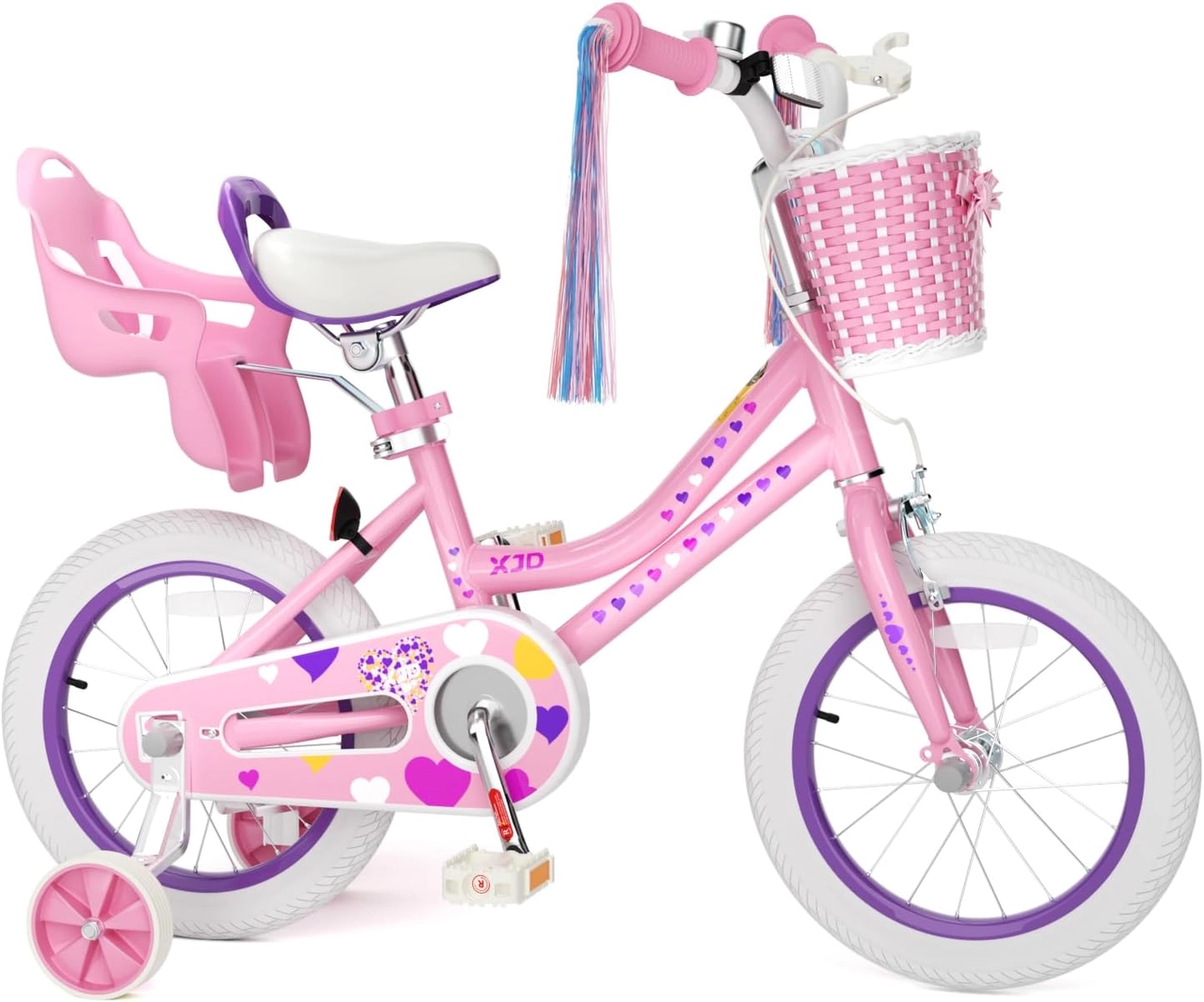 Pink Girls' 12/14/16" Bike by XJD – Basket & Doll Seat
This Training Wheel Bike comes in 12 Inch, 14 Inch and 16 Inch options with a basket and doll seat. The doll seat does not establish suitability for carrying a child.
Between these two products, the supplied facts establish differences in title and color wording, but no verified difference in fit geometry, brakes, materials, weight or performance. Accordingly, neither can be declared better from the available information. Select the wheel-size candidates from the table, then compare the child’s real fit and control on each bicycle.
Check the seat position on the actual bicycle
Follow the exact product manual when adjusting saddle height or position. The supplied catalog facts do not provide adjustment limits, torque values or assembly procedures. Keep every seat post and fastener within its marked or documented limits, and have a qualified bicycle mechanic complete or inspect the work if anything is unclear.
After adjustment, repeat the stand-over, reach and brake-control checks. A saddle adjustment cannot make an oversized frame appropriate, and a child who cannot start or stop confidently needs a different fit or more support rather than a taller setup.
Complete the safety check
Before riding, inspect assembly and maintenance items according to the bicycle’s manual. A bicycle helmet must fit properly, sit level and have its straps adjusted according to the helmet manufacturer’s instructions. The helmet does not correct poor bicycle fit, so check both independently.
If your goal is carrying a child on an adult bicycle, stop here and choose a purpose-built passenger seat only after confirming manual-based compatibility and limits. If the child will ride, measure height and inseam now, shortlist the matching wheel sizes, and have the child try them before choosing.
Bikes for your next adventure
-
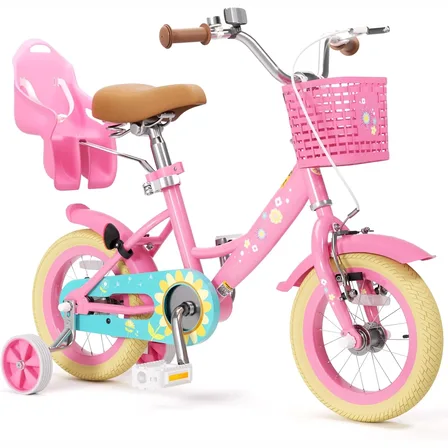
Flower Pink XJD Girls Bike with Doll Seat & Basket
The XJD Flower Pink girls' bike is made for riders 71–122 cm tall (roughly ages …$69.99
-

Pink Girls' 12/14/16" Bike by XJD – Basket & Doll Seat
The XJD Pink Girls' Bike with Basket & Doll Seat is made for riders 71–122 cm ta…$75.99
$99.99 -
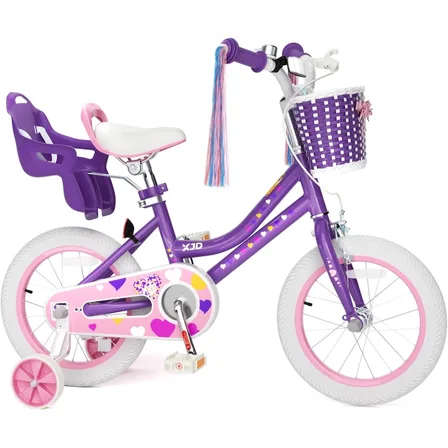
Purple XJD Girls' Bike with Doll Seat & Basket
For girls 71–122 cm tall (about ages 3–7), this XJD girls' bike in Purple pairs …$75.99
$99.99