

What does a 12 inch bicycle mean
A 12 inch bicycle is a children’s bike built around wheels described as 12 inches in size. It does not mean the frame is 12 inches or that every child of one age will fit it.
What the 12 inch measurement describes
The label refers to the bicycle’s nominal wheel-size category. It is a useful starting point for comparing children’s bicycles, but it is not a complete body measurement or a guarantee of fit. Frame shape, saddle adjustment, handlebar position and the child’s proportions can make two bicycles with the same wheel label feel different.
Do not measure the frame and expect to find 12 inches. When checking a bicycle already at home, read the size marked on the tyre or consult the exact bicycle manual. Tyre markings can contain several numbers, so use the manufacturer’s stated wheel size when confirming the category.
Who should start with a 12 inch bicycle
XBikes uses ages 3–4 and a rider height of 34–40 inches (86–102 cm) as starting points for a 12 inch bicycle. Height is more useful than age because children of the same age can have very different proportions, reach and confidence.
| Wheel label | Age starting point | Rider-height starting point |
|---|---|---|
| 12 Inch | 3–4 | 34–40 in / 86–102 cm |
| 14 Inch | 3–6 | 37–45 in / 94–114 cm |
| 16 Inch | 4–7 | 40–48 in / 102–122 cm |
The overlapping ranges are intentional starting points, not proof that adjacent sizes are interchangeable. Measure the child and test the actual bicycle before deciding.
What to measure before comparing bikes
- Standing height: Have the child stand straight without shoes against a wall. Measure from the floor to the top of the head.
- Inseam: With feet slightly apart, measure from the floor to the crotch. Use this to assess clearance over the bicycle rather than trying to convert it automatically into a wheel size.
- Reach and control: On the actual bicycle, check whether the child can hold the handlebars comfortably, steer without stretching and operate the brakes they are expected to use.
- Confidence: Notice whether the child can mount, stop and remain in control without looking frightened or unstable.
A proper trial matters. The child should have suitable stand-over clearance and should not need to lean or stretch excessively to control the bicycle. Do not select an oversized bicycle merely to leave room for growth.
How the supplied XBikes options relate
Both supplied catalog options offer a 12 Inch SKU, so they are directly relevant to this question. They also offer 14 Inch, 16 Inch and 20 Inch SKUs, which makes careful size-label comparison important; those larger labels are separate sizes, not equivalent alternatives to a 12 inch bicycle.
 Pink 12/14/16/20" XJD Girls Bike with Training Wheels & Basket
Available in a 12 Inch SKU that directly matches the article topic; its separate 14 Inch, 16 Inch and 20 Inch options require their own individual fit checks.
 Light Pink XJD Girls' Bicycle with Basket & Training Wheels
This Training Wheel Bikes product includes a relevant 12 Inch SKU, plus distinct 14 Inch, 16 Inch and 20 Inch labels that should not be treated as equivalent sizes.
The Pink 12/14/16/20" XJD Girls Bike with Training Wheels & Basket is listed in Training Wheel Bikes and has 12 Inch, 14 Inch, 16 Inch and 20 Inch size labels. For this page, only its 12 Inch SKU matches the wheel size in the title.
The Light Pink XJD Girls' Bicycle with Basket & Training Wheels is also listed in Training Wheel Bikes with the same four available size labels. Its 12 Inch SKU is relevant when the child’s measurements and in-person control check support that size.
These catalog facts do not establish frame geometry, weight, brake type, stock, load limits or assembly details. Compare the exact selected SKU and follow its product manual; use a qualified bicycle mechanic when assembly, adjustment or compatibility is uncertain.
Perform the final fit check
- Confirm that the order or box says 12 Inch, rather than relying on a product photo or a multi-size title.
- Have the child straddle the bicycle and verify comfortable stand-over clearance.
- Adjust the saddle only within the limits specified in the exact product manual.
- Check that the child can reach the handlebars and brakes comfortably, steer, start and stop under control.
- Repeat the check with the shoes and clothing normally used for riding.
A properly fitting bicycle helmet is also essential. It should sit level, fit securely and use its straps according to the helmet manufacturer’s instructions.
Make the 12 inch decision
Choose a 12 inch bicycle only when the child’s measured height is near the 34–40 inch (86–102 cm) starting range and the actual bike passes the inseam, stand-over, reach, brake-control and confidence checks. If it does not, compare a different wheel label and repeat the fit test rather than forcing the 12 inch choice or buying larger solely for future growth.
Bikes for your next adventure
-

XJD 24-Inch Green Beach Cruiser Bike with U-Brake
This XJD 24-inch beach cruiser in green is made for riders about 4'8" to 5'4" ta…$159.99
$199.99 -

Kids Bike Helmet by XJD for Girls – Pink
The XJD Kids Bike Helmet in Pink is a lightweight multi-sport helmet for girls r…$59.99
$99 -
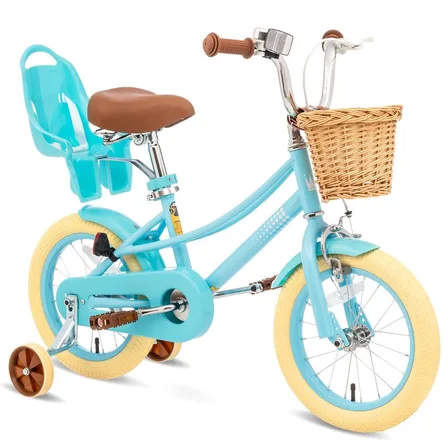
Girls' Training Wheel Bike by XJD, 12–20 Inch Wheels – Blue
This XJD girls' training wheel bike in Blue covers one of the widest fit ranges …$139
$159