

What height bike for 6 year old
For most 6-year-olds, start by comparing 16-inch and 18-inch bikes—but choose from measured height and an individual fit check, not age alone.
Match measured height to wheel size
Measure your child without shoes, standing straight against a wall. Record total height from the floor to the top of the head. Then compare that measurement with the XBikes starting points below. Wheel size describes the wheels, not the complete height of the bicycle, so two bikes with the same wheel size can still fit differently.
| Wheel size | Starting age | Rider height |
|---|---|---|
| 14 Inch | 3–6 | 37–45 in / 94–114 cm |
| 16 Inch | 4–7 | 40–48 in / 102–122 cm |
| 18 Inch | 5–9 | 43–52 in / 109–132 cm |
| 20 Inch | 7–12 | 48–60 in / 122–152 cm |
A 6-year-old measuring 40–48 inches is within the 16-inch starting range. At 43–48 inches, the 16-inch and 18-inch ranges overlap, so a physical comparison is necessary. A rider above 48 inches may enter the 20-inch height range, while a shorter child could still fall within the 14-inch range. Height narrows the choice; it does not complete it.
Measure inseam before trying a bike
Have the child stand in socks with feet slightly apart. Place a hardback book between the legs, raise it gently to simulate a saddle, and measure from the floor to the book’s top edge. Keep this inseam measurement available when checking the bicycle’s stand-over space and saddle adjustment instructions.
On the actual bike, the child must be able to stand over the frame without being forced onto tiptoes or pressed against the bicycle. Check the exact product manual for its adjustment range and setup requirements. If the correct setup is unclear, use a qualified bicycle mechanic rather than inventing an adjustment or torque value.
Do a five-part fit check
- Stand-over: Ask the child to straddle the bike with both feet planted and confirm that the frame does not obstruct a comfortable stance.
- Starting and stopping: The rider should get on, begin moving and put a foot down without struggling against the bike’s size.
- Reach: With hands on the controls, the child should sit naturally rather than stretching, locking the elbows or leaning excessively.
- Brake control: Confirm that the child can reach and operate the provided braking controls confidently. Follow the product manual for the particular system.
- Steering: At walking speed in a traffic-free area, check that the rider can turn, look ahead and stop while remaining in control.
HealthyChildren guidance from the American Academy of Pediatrics supports having the child try the bicycle, checking stand-over, control and brake reach, and avoiding an oversized bike bought merely for future growth.
How the supplied bikes help with comparison
The supplied catalog choices cover 14-, 16- and 20-inch labels, making them useful physical comparison points for shorter, middle-range and taller riders. They do not include an 18-inch option, so if measurement and a fit check point to 18 inches, these products are not equal substitutes for that size.
XJD Girls BMX Bike 12/14/16 Inch with Training Wheels – Pink Blue and XJD Boys & Girls BMX Bike with Training Wheels, 12/14/16" – Blue are both cataloged as Kids' BMX Bikes with 12-, 14- and 16-inch SKU labels. For this question, their 14- and 16-inch versions are the relevant comparisons; the 12-inch starting range is 34–40 inches and ages 3–4, so it will generally be too small for a measured 6-year-old outside that height range.
Girls' Training Wheel Bike by XJD with Basket – Purple is cataloged as a Training Wheel Bike with 14-, 16- and 20-inch SKU labels. It allows comparison at both ends of the likely range, but its 20-inch label should be considered only when the rider’s measured height and actual control support that larger option.
These particular catalog options help answer the title because they let parents compare available 14-, 16- and 20-inch versions while recognizing the missing 18-inch step.
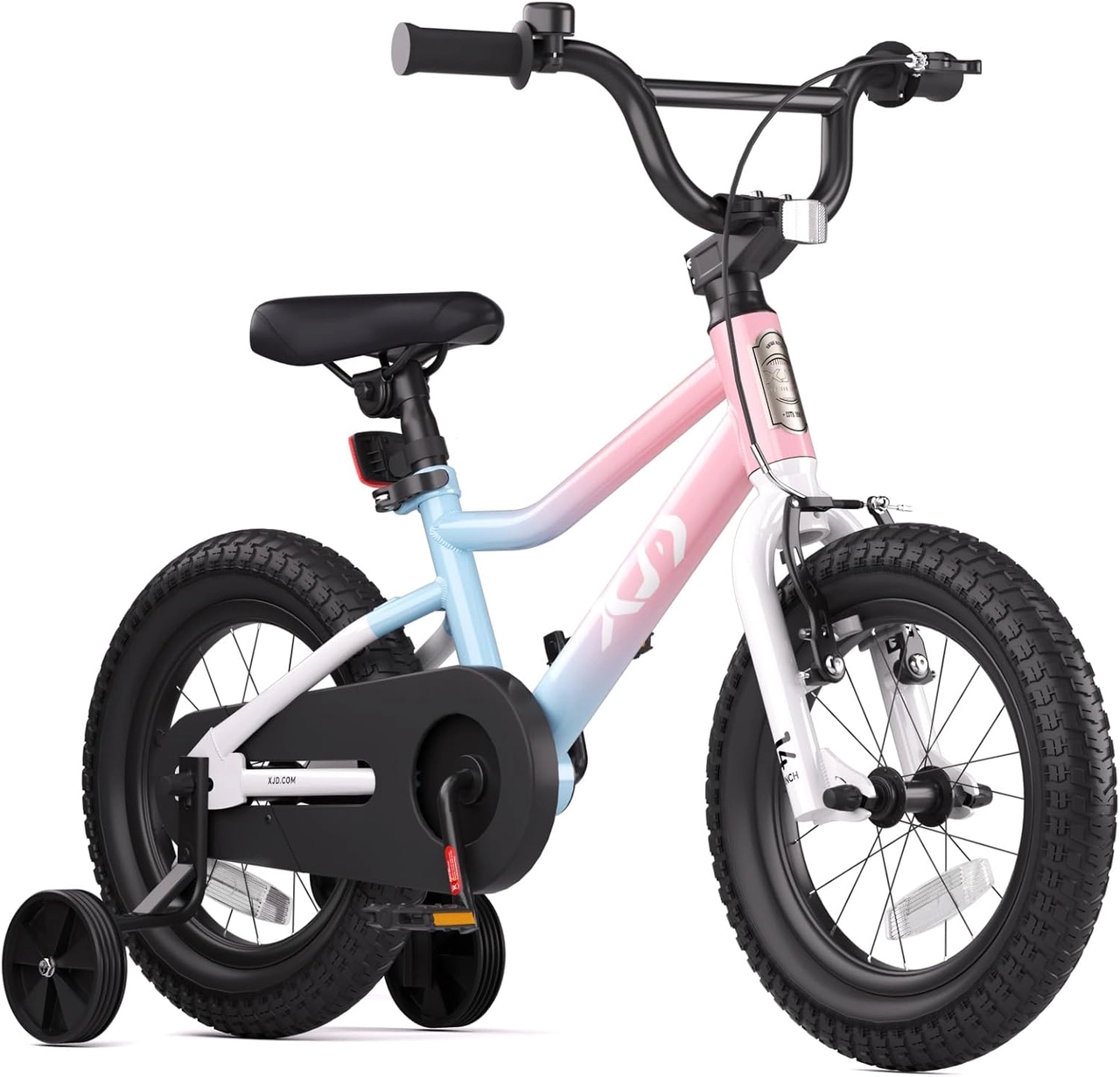 XJD Girls BMX Bike 12/14/16 Inch with Training Wheels – Pink Blue
Available in 12-, 14- and 16-inch labels. For a 6-year-old, compare its 14- or 16-inch version only when measured height and an individual control check support that size.
 XJD Boys & Girls BMX Bike with Training Wheels, 12/14/16" – Blue
This Kids' BMX Bike has 12-, 14- and 16-inch SKU labels. Its 14- and 16-inch options can serve as fit comparisons based on height, inseam, reach and control.
 Girls' Training Wheel Bike by XJD with Basket – Purple
Its 14-, 16- and 20-inch labels span several relevant comparison points. The 20-inch version is relevant only when measured height and a hands-on fit check support the larger size.
Let confidence influence the final choice
Wheel size and training wheels answer different questions. Wheel size concerns physical fit; training wheels relate to how the child currently balances and rides. Do not move to a larger wheel merely because training wheels are present, and do not assume a confident rider can control a frame that is too large.
Use a quiet, level, traffic-free area for the final check. A properly fitting bicycle helmet is also essential: U.S. Consumer Product Safety Commission guidance says it should fit properly, sit level and have its straps used according to the helmet manufacturer’s instructions.
Make the decision
Measure height and inseam first, shortlist the matching range, then have the child compare stand-over, reach, braking and low-speed control. Choose 16 inches when that bike fits those checks; compare 18 inches where the overlapping measurements favor it; consider 14 or 20 inches only when the child’s measured height and individual fit support them. Never size up solely for growth.
Bikes for your next adventure
-

XJD Girls Bike for Kids Ages 3-8, 12/14/16 Inch with Training Wheels – Purple
The XJD Girls Bike in Purple is a training-wheel bicycle for kids ages 3 to 8, f…$149
$169 -

Pink Girls' 12/14/16" Bike by XJD – Basket & Doll Seat
The XJD Pink Girls' Bike with Basket & Doll Seat is made for riders 71–122 cm ta…$75.99
$99.99 -

XJD Pink Beach Cruiser for Girls – Rear Rack & V-Brake
The XJD Pink Beach Cruiser for girls is the step-up bike for riders who've outgr…$179.99
$209.99