

What height is 24 inch bike for
A 24-inch bike is a starting match for a rider about 54–64 inches (137–163 cm) tall, usually ages 10–14. Measure the child and check the actual bike before deciding.
Height matters more than age
The 10–14 age range is only a starting point. Children of the same age can differ substantially in leg length, arm length, coordination and confidence. A shorter 13-year-old may not yet control a 24-inch bike comfortably, while a tall 9-year-old may be ready to try one.
Do not choose a larger bicycle simply to leave growing room. The American Academy of Pediatrics advises having the child try the bicycle and checking stand-over clearance, control and brake reach. A bike that is too large now can make starting, stopping and steering harder.
What to measure before shopping
- Standing height: Have the child stand barefoot against a wall, looking straight ahead. Measure from the floor to the top of the head. Compare that result with the 54–64-inch (137–163 cm) starting range.
- Inseam: With feet slightly apart, measure from the floor to the crotch. Use this measurement when checking the specific bicycle’s stand-over space and saddle adjustment information in its manual.
- Reach: On the actual bicycle, the rider should be able to hold the handlebar without stretching excessively or locking the elbows.
- Brake access: The child must be able to reach and operate the fitted brake controls reliably while maintaining a secure grip.
Wheel size alone does not reveal frame shape, stand-over height or reach. Those details can vary between bicycles carrying the same 24-inch label, so compare the measurements with the exact model and its manual.
How 24 inches compares with nearby wheel sizes
| Wheel size | XBikes height starting point | Age starting point |
|---|---|---|
| 20 Inch | 48–60 in / 122–152 cm | 7–12 |
| 24 Inch | 54–64 in / 137–163 cm | 10–14 |
| 26 Inch | Over 60 in / 153 cm | Youth and adults |
The ranges overlap, so height does not make the decision by itself. A rider near 54 inches might compare a 20-inch and 24-inch bicycle, while someone over 60 inches might compare 24-inch and 26-inch options. Choose according to present stand-over space, reach, brake control and confidence—not the size the child may grow into later.
What the rider should demonstrate
Have the child try the assembled bicycle in a controlled area. First check whether the rider can stand over it comfortably. Then confirm that mounting and dismounting are controlled rather than awkward.
While seated in an appropriate riding position, the child should be able to steer without overreaching, look ahead comfortably and use the brake controls confidently. Ask the rider to start, ride a straight line, turn and stop under control. Hesitation caused by unfamiliarity may improve with practice; inability to reach the controls or manage the bicycle’s dimensions indicates a fit problem.
For assembly, adjustment, maintenance and torque requirements, follow the exact product manual or use a qualified bicycle mechanic. Do not improvise settings that the manufacturer has not specified.
How the supplied 24-inch options are relevant
The supplied catalog choices are useful because both include a 24-inch option: one lets a family compare labeled wheel sizes within a single product listing, while the other is specifically titled as a 24-inch bicycle. They help narrow the catalog search, but neither replaces an individual fit check.
 XJD Pink Beach Cruiser for Girls – Rear Rack & V-Brake
This Beach Cruiser Bikes listing offers 20 Inch, 24 Inch and 26 Inch SKU labels, making its 24 Inch option relevant while also allowing nearby wheel-size comparison.
 24-Inch Purple XJD Beach Cruiser Bike with U-Brake
This Beach Cruiser Bikes product is identified as 24-inch in its exact title. Its Default SKU label adds no fit detail, so the rider still needs an individual fit check.
XJD Pink Beach Cruiser for Girls – Rear Rack & V-Brake is listed in Beach Cruiser Bikes with 20 Inch, 24 Inch and 26 Inch SKU labels. Select the 24 Inch SKU when evaluating it for this question; the other labels represent different wheel sizes and should not be treated as equivalent fits.
24-Inch Purple XJD Beach Cruiser Bike with U-Brake is also listed in Beach Cruiser Bikes and has a Default SKU label. Its exact title identifies it as 24-inch, but the Default label supplies no additional fit measurement. Confirm the bicycle’s dimensions and adjustments through its exact product information or manual.
Make the final 24-inch decision
If the child measures 54–64 inches (137–163 cm), a 24-inch bicycle is appropriate to try. Proceed only if the rider can stand over it, reach the handlebar and brake controls, mount and dismount, and start, steer and stop with current confidence.
If any of those checks fail, compare the adjacent wheel-size starting points rather than buying for future growth. Finish by fitting a bicycle helmet: U.S. Consumer Product Safety Commission guidance says it should fit properly, sit level and have its straps used according to the helmet manufacturer’s instructions.
Bikes for your next adventure
-

26-Inch XJD Beach Cruiser Bike for Girls – Purple, V-Brake
This XJD 26-inch purple beach cruiser is sized for big kids and teens — suggeste…$218.49
$229.99 -
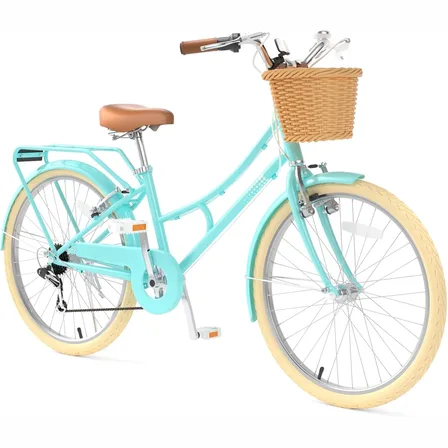
XJD 24-Inch Green Beach Cruiser Bike with U-Brake
This XJD 24-inch beach cruiser in green is made for riders about 4'8" to 5'4" ta…$159.99
$199.99 -
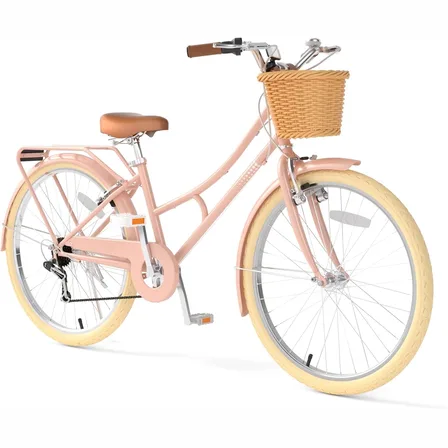
Pink XJD Beach Cruiser Bike, 24"/26", U-Brake
The XJD Pink Beach Cruiser Bike is a single-speed cruiser built for older kids a…$159.99