

What height is good for a 24 inch bike
A 24-inch bike is a starting match for a rider who is 54–64 inches (137–163 cm) tall, usually around ages 10–14. Height alone does not confirm fit: measure the rider, check inseam clearance and reach, and have the child try the exact bicycle before buying.
Start with the rider’s measured height
Measure the child without shoes, standing straight against a wall. Mark the top of the head and measure from the floor. Compare that result with the XBikes 24-inch starting range of 54–64 inches (137–163 cm).
Age is only a secondary clue. A tall or short 10-year-old may need a different size, while two children of the same height can have different leg and arm proportions. The adjacent XBikes starting points help identify a borderline case:
| Wheel size | Rider-height starting point | Age starting point |
|---|---|---|
| 20 Inch | 48–60 in / 122–152 cm | 7–12 |
| 24 Inch | 54–64 in / 137–163 cm | 10–14 |
| 26 Inch | Over 60 in / 153 cm | Youth and adults |
The ranges overlap intentionally. If the rider is near 54 inches, compare the exact 20-inch and 24-inch bicycles. If the rider is over 60 inches, compare the exact 24-inch and 26-inch bicycles. Wheel size is not the same as frame fit, so the trial still decides.
Measure inseam and check stand-over clearance
Measure inseam with shoes off. Have the child stand with feet slightly apart, place a firm book between the legs as though it were a saddle, and measure from the floor to the book’s top edge.
Then have the rider straddle the exact bike with both feet flat on the ground. There should be usable clearance between the rider and the top tube rather than contact or an awkward tiptoe stance. Because frame shapes differ, do not infer clearance from the 24-inch wheel label or from height alone. The American Academy of Pediatrics advises having the child try the bicycle and checking stand-over instead of buying an oversized bike for future growth.
Confirm reach, steering and brake control
Seat the rider in a normal riding position while an adult stabilizes the bicycle. The child should be able to hold the grips without locking the elbows, leaning excessively forward or stretching to steer. Ask the rider to turn the handlebar both ways and operate each brake control comfortably.
A suitable fit lets the child start, stop, steer and dismount with current confidence. Reject the bike if its size makes the rider hesitant, prevents reliable brake operation or requires an unstable body position. Do not assume the child will quickly grow into difficult controls.
How the supplied 24-inch options help
Both supplied catalog choices include the wheel size named in the question. The XJD Pink Beach Cruiser for Girls – Rear Rack & V-Brake offers 20 Inch, 24 Inch and 26 Inch SKU labels, so it can help families comparing adjacent starting sizes. The 24-Inch Purple XJD Beach Cruiser Bike with U-Brake is specifically titled as a 24-inch model. These are relevant candidates, but their catalog labels do not replace an individual stand-over, reach and control check.
 XJD Pink Beach Cruiser for Girls – Rear Rack & V-Brake
Available with 20 Inch, 24 Inch and 26 Inch SKU labels, this beach cruiser provides useful adjacent-size comparison options when the rider is near a height-range boundary.
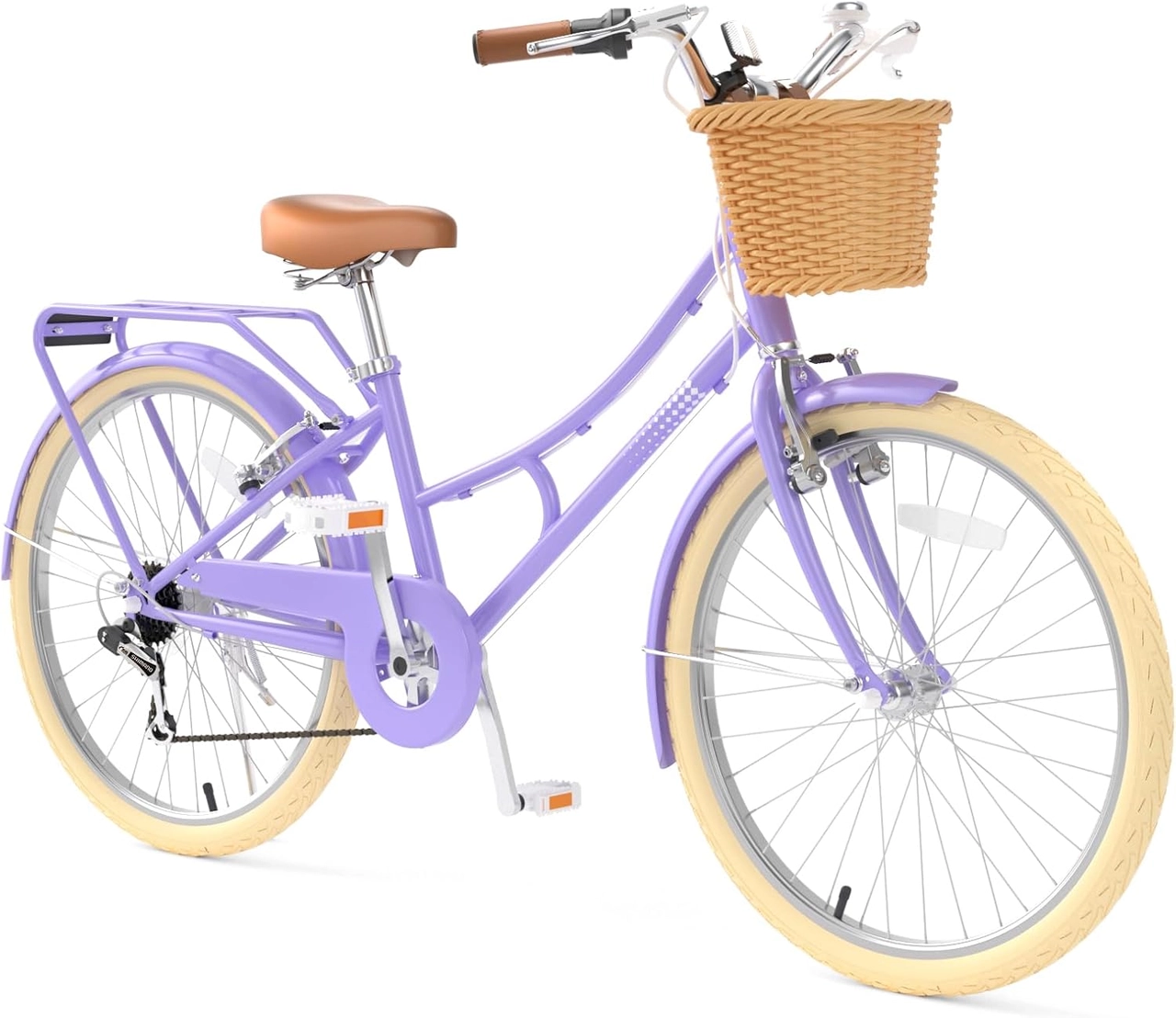 24-Inch Purple XJD Beach Cruiser Bike with U-Brake
Its exact catalog title identifies it as a 24-inch beach cruiser, making it relevant to the requested size while still requiring individual stand-over, reach and brake-control checks.
Use only the exact size variant being considered when trying a bicycle. Do not transfer a successful fit from one model or SKU label to another, because the supplied facts do not establish identical frame dimensions or riding positions.
Make the decision at an in-person fit check
- Confirm that the measured height falls within, or close enough to compare with, the 54–64 inch (137–163 cm) starting range.
- Use the inseam measurement to screen for plausible stand-over clearance, then verify that clearance on the assembled bicycle.
- Check that the rider reaches the grips naturally, steers without strain and can operate the brakes reliably.
- Have the child demonstrate a controlled start, stop, turn and dismount in a safe practice area.
- If any adjustment, assembly detail or compatibility question is uncertain, follow the exact product manual or ask a qualified bicycle mechanic.
Also fit a bicycle helmet for every ride. U.S. Consumer Product Safety Commission guidance says it should fit properly, sit level and use its straps according to the helmet manufacturer’s instructions.
When a 24-inch bike is not the right choice
Do not choose 24 inches merely because the child is 10–14, because a friend rides that size or because extra room seems economical. Compare a 20-inch bicycle when a rider near the lower boundary cannot clear, reach or control the 24-inch model. Compare a 26-inch bicycle for a rider over 60 inches when the exact 24-inch model feels cramped, while still checking the larger bike individually.
The practical answer is simple: begin with 24 inches at 54–64 inches tall, but buy it only when the child can comfortably straddle, reach, brake and control that exact bicycle today.
Bikes for your next adventure
-

Light Pink XJD Girls' Bicycle with Basket & Training Wheels
The Light Pink XJD Girls' Bicycle with Basket & Training Wheels is a retro-style…$109.99
$129.99 -

Blue XJD Kids Bike Helmet for Boys & Girls
The Blue XJD Kids Bike Helmet is a lightweight, adjustable multi-sport helmet fo…$59.99
$99 -

Kids Bike Helmet by XJD for Girls – Pink
The XJD Kids Bike Helmet in Pink is a lightweight multi-sport helmet for girls r…$59.99
$99