

What inch bike for 8 year old
Most 8-year-olds should start by trying a 20-inch bike, especially if they are 48–60 inches (122–152 cm) tall. Measure the child first: an 18-inch bike may fit a shorter rider, while age alone cannot confirm the right size.
Which wheel size should an 8-year-old try?
Use measured height to choose the first bike to test. The XBikes starting points place both 18-inch and 20-inch wheels within the possible age range for an 8-year-old, but they cover different rider heights.
| Wheel size | Starting age range | Rider height | Relevance at age 8 |
|---|---|---|---|
| 18 Inch | 5–9 | 43–52 in / 109–132 cm | Consider for a shorter rider who can control it comfortably. |
| 20 Inch | 7–12 | 48–60 in / 122–152 cm | The usual first size to try for this age. |
| 24 Inch | 10–14 | 54–64 in / 137–163 cm | Do not choose it from height alone; reach and control must also work. |
The ranges overlap because wheel diameter does not describe the complete bicycle geometry. Two bikes with the same wheel size can feel different when the child stands over them, reaches the handlebar or operates the brakes.
Measure before comparing bikes
Measure the child without shoes, standing straight against a wall, to get current height. Then measure inseam from the floor to the crotch. Keep both measurements available when checking the bicycle and its exact size information.
Height identifies a sensible starting category; inseam helps evaluate stand-over room. Neither replaces an actual trial. A child may fall within the 20-inch height range yet struggle with the reach or controls on a particular frame.
Check the fit on the actual bicycle
Have the child try the bike instead of buying a larger one merely to allow growth. During the fit check, look for all of the following:
- The child can stand over the bicycle with stable footing and suitable clearance.
- The seated riding position does not require an uncomfortable stretch to the handlebar.
- The child can steer, start and stop while remaining in control.
- Both brake controls, where fitted, are within comfortable reach and can be operated reliably.
- The bicycle matches the rider’s current confidence rather than demanding skills they do not yet have.
If the child cannot manage these checks, reject that particular bike even when its wheel-size label matches the height chart. Move to a different model or size and repeat the trial.
How the supplied 20-inch options are relevant
The supplied catalog choices are useful because each is offered with a 20 Inch SKU label, the main starting point for an 8-year-old measuring 48–60 inches (122–152 cm). They also offer smaller labeled sizes, allowing you to see that a product family’s size menu is not itself proof of individual fit.
 XJD Girls' Bike with Training Wheels, 12/14/16/20 Inch – Purple
Offered with 12, 14, 16 and 20 Inch SKU labels. Its 20 Inch option is relevant as a starting comparison for an 8-year-old within the supplied height range, subject to an individual fit check.
 XJD Kids Bike for Girls – Pink, 12/14/16/20 Inch with Training Wheels
A Training Wheel Bikes option offered in 12, 14, 16 and 20 Inch SKU labels. The 20 Inch variant may be relevant for the title query, but measurements, control and confidence must confirm fit.
XJD Girls' Bike with Training Wheels, 12/14/16/20 Inch – Purple is listed in the Training Wheel Bikes category and has 12 Inch, 14 Inch, 16 Inch and 20 Inch SKU labels. For this question, only its 20 Inch option aligns with the usual age-eight starting range; the child must still try it.
XJD Kids Bike for Girls – Pink, 12/14/16/20 Inch with Training Wheels is also a Training Wheel Bikes product with 12 Inch, 14 Inch, 16 Inch and 20 Inch SKU labels. Its supplied facts establish the available labels, but not frame dimensions, brake type, weight, load limit or suitability for a particular rider.
These products are most relevant when a 20-inch training-wheel bike suits the child’s present fit and confidence. Their 12-, 14- and 16-inch options should not be treated as equivalent to 18 inches, and neither supplied product offers an 18 Inch or 24 Inch SKU label. If the fit check points to either of those sizes, these catalog products are comparison points, not substitutes.
Complete the safety and setup checks
Use a properly fitting bicycle helmet. It should sit level, with its straps adjusted according to the helmet manufacturer’s instructions. Recheck the fit whenever the helmet is adjusted or shared.
Before riding, follow the exact bicycle manual for assembly, adjustments, maintenance, compatibility and load limits. When instructions are missing or the setup is uncertain, use a qualified bicycle mechanic rather than guessing at a procedure or torque.
The decision to make now
Measure the rider’s height and inseam, then begin with a 20-inch trial if the child is 48–60 inches tall. Compare an 18-inch bike if the rider is shorter or cannot confidently control the 20-inch model. Consider 24 inches only when the child’s measurements, reach, brake control and confidence all support it—never simply because a larger bike leaves room to grow.
Bikes for your next adventure
-

XJD Girls Bike for Kids Ages 3-8, 12/14/16 Inch with Training Wheels – Purple
The XJD Girls Bike in Purple is a training-wheel bicycle for kids ages 3 to 8, f…$149
$169 -

Pink Girls' 12/14/16" Bike by XJD – Basket & Doll Seat
The XJD Pink Girls' Bike with Basket & Doll Seat is made for riders 71–122 cm ta…$75.99
$99.99 -
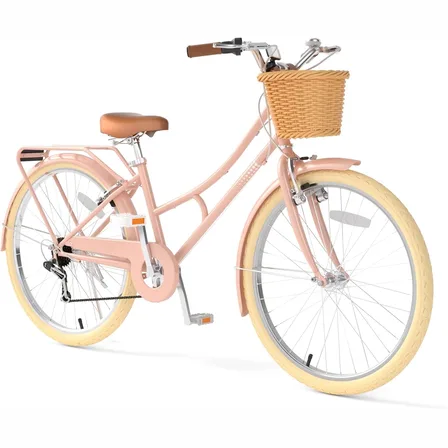
Pink XJD Beach Cruiser Bike, 24"/26", U-Brake
The XJD Pink Beach Cruiser Bike is a single-speed cruiser built for older kids a…$159.99