

What inch bike for 9 year old
Most 9-year-olds should start by trying an 18-inch or 20-inch bike. Use measured height—not age alone: 18-inch suits 43–52 in (109–132 cm), while 20-inch suits 48–60 in (122–152 cm).
Choose the starting size from height
Measure your child standing upright without shoes, then compare the result with the XBikes starting points below. Where the ranges overlap, test both sizes rather than automatically choosing the larger bike.
| Wheel size | XBikes age starting point | Rider-height starting point |
|---|---|---|
| 18 Inch | Ages 5–9 | 43–52 in / 109–132 cm |
| 20 Inch | Ages 7–12 | 48–60 in / 122–152 cm |
| 24 Inch | Ages 10–14 | 54–64 in / 137–163 cm |
A 9-year-old measuring below 48 inches may begin with an 18-inch bike. At 48–52 inches, both 18-inch and 20-inch ranges apply, so actual control decides. From 52–60 inches, start with a 20-inch bike. A particularly tall child approaching or exceeding 54 inches may also compare a 24-inch model, but only if its stand-over clearance, reach and controls fit now.
Measure more than standing height
Height narrows the options, but inseam helps reveal whether the frame itself is manageable. Measure from the floor to the crotch while the child stands straight without shoes. Compare that measurement with the bicycle maker’s stand-over information and have the child straddle the actual bike.
The child needs comfortable clearance over the frame, an easy reach to the handlebar and the ability to operate the brakes confidently. The American Academy of Pediatrics advises having the child try the bicycle and avoiding an oversized bike bought merely for future growth.
Use a short ride to break a tie
If 18-inch and 20-inch bikes both match the height range, let the rider try each in a controlled area. Watch the child, rather than judging only by how the bike looks.
- Can the rider start and stop without being pulled off balance?
- Can the child steer and turn without stretching or locking the arms?
- Can each brake control be reached and used reliably?
- Does the rider remain composed at slow speed?
- Can the child mount, dismount and stand over the frame comfortably?
Choose the size on which these actions are controlled now. Current confidence matters: a technically plausible larger wheel is not the right choice if the child hesitates, cannot reach properly or loses control.
How the supplied XBikes option relates
The supplied product, XJD Light Purple Girls Bike with Basket, Training Wheels, 12/14/16/20 Inch, is categorized as a training-wheel bike. Although its exact catalog title mentions 12/14/16/20 Inch, the supplied available SKU labels are only 12 Inch, 14 Inch and 16 Inch. Those sizes are comparison points, not substitutes for an 18-inch or 20-inch bike.
These particular catalog options help show why the child’s measurement matters: 12-inch starts at ages 3–4 and 34–40 in (86–102 cm), 14-inch at ages 3–6 and 37–45 in (94–114 cm), and 16-inch at ages 4–7 and 40–48 in (102–122 cm). For most 9-year-olds, they will be smaller than the relevant starting range.

The product may be relevant only if the rider’s measured height falls within one of those supplied ranges and an individual fit check confirms comfortable control. Do not choose a listed smaller size merely because training wheels seem reassuring, and do not assume the 20-inch wording in the title means that SKU is available.
Check setup and helmet fit
Before riding, follow the exact product manual for assembly, adjustment, maintenance, compatibility, load limits and torque requirements. If anything is unclear or the controls cannot be positioned comfortably, use a qualified bicycle mechanic rather than improvising.
A bicycle helmet also needs an individual fit. U.S. Consumer Product Safety Commission guidance says it should fit properly, sit level on the head and have its straps used according to the helmet manufacturer’s instructions.
What to do next
- Measure the child’s standing height and inseam without shoes.
- Start with 18-inch below 48 inches, compare 18-inch and 20-inch within their overlap, or start with 20-inch from 52–60 inches.
- Have the child straddle and ride the actual candidate bike.
- Reject any size that compromises stand-over clearance, reach, braking or confidence.
For a 9-year-old, make 18-inch versus 20-inch the main comparison, then buy only the size the child can comfortably control today—not one chosen for age alone or future growth.
Bikes for your next adventure
-

Pink Girls' 12/14/16" Bike by XJD – Basket & Doll Seat
The XJD Pink Girls' Bike with Basket & Doll Seat is made for riders 71–122 cm ta…$75.99
$99.99 -

XJD Girls Bike for Kids Ages 3-8, 12/14/16 Inch with Training Wheels – Purple
The XJD Girls Bike in Purple is a training-wheel bicycle for kids ages 3 to 8, f…$149
$169 -
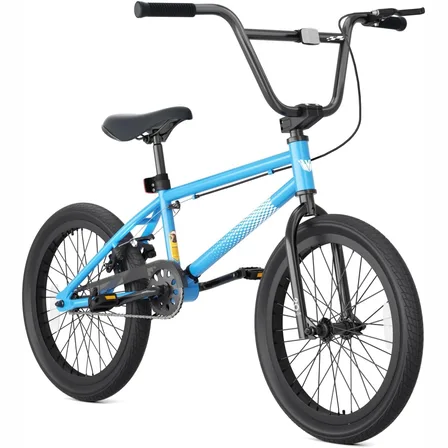
Blue XJD Freestyle BMX Bike, 20-Inch – No Pegs
The XJD 20-Inch Blue Freestyle BMX is an entry-level BMX bike for boys and girls…$189.99