

What inch bike for a 8 year old
For most 8-year-olds, start by comparing an 18-inch and a 20-inch bike. Choose by measured height and hands-on fit: 18 Inch covers 43–52 in (109–132 cm), while 20 Inch covers 48–60 in (122–152 cm).
Use height before age
Age narrows the search, but it cannot confirm the right wheel size. The XBikes starting points place an 18-inch bike at ages 5–9 and a 20-inch bike at ages 7–12, so both ranges include an 8-year-old. Their height ranges overlap, which is why a test fit matters.
| Wheel size | XBikes age starting point | Rider height | Relevance at age 8 |
|---|---|---|---|
| 16 Inch | Ages 4–7 | 40–48 in / 102–122 cm | Check only when the child's measured height and actual fit point smaller. |
| 18 Inch | Ages 5–9 | 43–52 in / 109–132 cm | A primary size to compare. |
| 20 Inch | Ages 7–12 | 48–60 in / 122–152 cm | A primary size to compare. |
| 24 Inch | Ages 10–14 | 54–64 in / 137–163 cm | Consider only if height and a complete fit check support it. |
Do not move up to a 24-inch bike merely to leave growing room. Likewise, do not assume a 20-inch bike fits every 8-year-old. A correctly fitting smaller wheel size is more useful than an oversized bike the child cannot control confidently.
Measure the child before comparing bikes
- Measure standing height: Have the child stand upright without shoes against a wall, then compare the result with the XBikes height ranges.
- Measure inseam: With feet naturally apart, measure from the floor to the crotch. Use this measurement when checking the actual frame's stand-over position; wheel diameter alone does not reveal frame clearance.
- Note current confidence: Record whether the rider starts, stops, turns and balances independently. Confidence affects which otherwise plausible fit feels manageable.
Height selects the likely wheel-size range. Inseam, reach and controls decide whether a particular bicycle within that range actually fits.
Perform the fit check
Have the child try the exact bicycle rather than relying on its wheel label. When straddling the frame, the child should have usable stand-over clearance instead of the frame pressing into the body. On the saddle, the riding position should feel stable and allow controlled pedaling.
Next, check reach. The child should be able to hold the handlebars and steer without stretching, locking the arms or shifting into an unstable posture. Ask the child to operate the brakes while maintaining a secure grip. If the controls cannot be reached or used confidently, that bicycle is not a suitable fit even when its nominal size matches the chart.
Watch a start, a straight ride, a turn and a controlled stop in a suitable practice area. Difficulty controlling the bicycle is a reason to compare another frame or wheel size, not a reason to expect the child to grow into it.
How the supplied XBikes options relate
The supplied catalog options help because each offers a 20 Inch SKU, one of the two main starting sizes for an 8-year-old. They also offer 12 Inch, 14 Inch and 16 Inch labels for comparison. None offers an 18 Inch SKU, so these are not substitutes when an individual fit check points to 18 Inch.
 Girls' Training Wheel Bike by XJD, 12–20 Inch Wheels – Blue
Offers 12, 14, 16 and 20 Inch SKUs. The 20 Inch option is relevant for an 8-year-old only when measured height and an individual fit check support it; no 18 Inch SKU is supplied.
 XJD Girls' Bike with Training Wheels, 12/14/16/20 Inch – Purple
This Training Wheel Bike has 12, 14, 16 and 20 Inch SKU labels. Its 20 Inch version is a comparison option, while riders whose fit points to 18 Inch need another bicycle.
 XJD Kids Bike for Girls – Pink, 12/14/16/20 Inch with Training Wheels
Available in 12, 14, 16 and 20 Inch labels with training wheels. Consider the 20 Inch SKU only after checking height, inseam, reach, brake control and confidence on the exact bike.
Girls' Training Wheel Bike by XJD, 12–20 Inch Wheels – Blue is listed in Training Wheel Bikes with 12 Inch, 14 Inch, 16 Inch and 20 Inch SKU labels. Its 20 Inch version is relevant when the rider measures within 48–60 in (122–152 cm) and passes the complete fit check.
XJD Girls' Bike with Training Wheels, 12/14/16/20 Inch – Purple has the same four supplied wheel-size labels and is also categorized as a Training Wheel Bike. Compare its 20 Inch option only on actual fit and control; the title itself does not establish suitability.
XJD Kids Bike for Girls – Pink, 12/14/16/20 Inch with Training Wheels likewise offers 12 Inch, 14 Inch, 16 Inch and 20 Inch labels in the Training Wheel Bikes category. Its smaller labels may provide size comparison points, but they are not evidence that a smaller size fits this particular child.
These products may be relevant when training wheels suit the child's present confidence and the chosen SKU fits. If the rider needs an 18-inch bike, or if a training-wheel model is not appropriate for their current skills, continue comparing other bicycles rather than treating the listed 20 Inch versions as equivalent.
Make the final decision
Before riding, use a properly fitting bicycle helmet that sits level, with its straps adjusted according to the helmet manufacturer's instructions. Follow the exact bicycle manual for assembly, maintenance, load limits, compatibility and torque; when instructions are missing or uncertain, use a qualified bicycle mechanic.
For an 8-year-old, measure height and inseam now, shortlist 18 Inch and 20 Inch accordingly, and buy only after the child demonstrates comfortable stand-over, reach, brake operation and control on that exact bike.
Bikes for your next adventure
-

XJD Girls Bike for Kids Ages 3-8, 12/14/16 Inch with Training Wheels – Purple
The XJD Girls Bike in Purple is a training-wheel bicycle for kids ages 3 to 8, f…$149
$169 -

Pink Girls' 12/14/16" Bike by XJD – Basket & Doll Seat
The XJD Pink Girls' Bike with Basket & Doll Seat is made for riders 71–122 cm ta…$75.99
$99.99 -
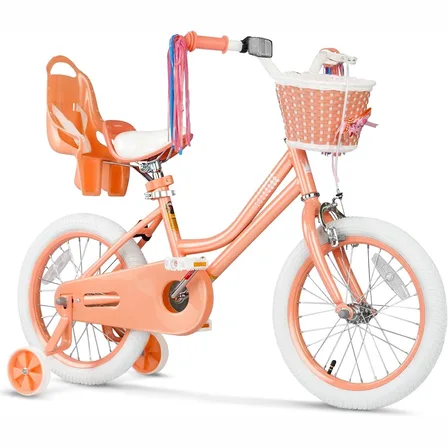
Girls 12/14/16 Inch Kids Bike by XJD with Training Wheels – Peach
The XJD Girls Bike in Peach is a training-wheel bike built for girls roughly 3 t…$149
$169