

What inch bike should a 6 year old need
Most 6-year-olds need a 16-inch bike, but measured height and an individual fit check decide. Start with 16 inches at 40–48 in (102–122 cm); compare 14 or 18 inches if the child falls outside that range.
Choose the wheel size from measured height
Measure the child barefoot, standing straight against a wall. Use total rider height to select the first bike to try, then confirm inseam clearance, reach, braking and control. Age is only a starting point.
| Wheel size | XBikes starting range | What it means for a 6-year-old |
|---|---|---|
| 14 Inch | Ages 3–6; 37–45 in / 94–114 cm | Compare when the rider is below 40 in or finds a 16-inch bike difficult to control. |
| 16 Inch | Ages 4–7; 40–48 in / 102–122 cm | The usual first size to try for this age. |
| 18 Inch | Ages 5–9; 43–52 in / 109–132 cm | Worth trying for a taller rider, provided every fit and control check is passed. |
| 20 Inch | Ages 7–12; 48–60 in / 122–152 cm | Consider only when measured height supports it and the child can control the bike confidently. |
A 6-year-old under 37 in (94 cm) falls below the listed 14-inch starting range, while a child at or above 48 in (122 cm) reaches the listed 20-inch height range. At overlapping measurements, try the plausible sizes rather than choosing solely from the chart.
Measure inseam and check stand-over clearance
Measure inseam with the child barefoot. Have them stand with feet slightly apart and measure from the floor to the crotch. Compare that measurement with the bicycle’s actual stand-over height or the manufacturer’s fit information.
When trying the bike, the child should be able to straddle it with stable footing and appropriate clearance. The American Academy of Pediatrics advises having the child try the bicycle and checking stand-over rather than buying an oversized bike for future growth. If the child cannot stand securely or must lean the bike sharply, reject that size.
Confirm reach, brakes and real control
Seated in a normal riding position, the child should reach the handlebar without stretching, locking the elbows or losing a balanced posture. They must also be able to operate the fitted brakes reliably. Brake reach cannot be inferred from wheel diameter or age.
Ask for a supervised test in a clear, low-risk area. Check whether the child can:
- start and stop without being pulled off balance;
- steer smoothly and make controlled turns;
- look ahead while maintaining a comfortable grip;
- place a foot down promptly when stopping;
- use the brakes confidently and consistently.
If an 18- or 20-inch bike technically matches the height chart but makes these tasks harder, it is too large for the child now. Do not treat extra growing room as a substitute for control.
How the supplied bikes help with comparison
The catalog options below are relevant because all three offer 14-inch and 16-inch labels, the two most likely comparison sizes for many 6-year-olds. Two also offer a 20-inch label for a sufficiently tall rider. None offers an 18-inch version, so these products cannot substitute when an individual fit check points specifically to 18 inches.
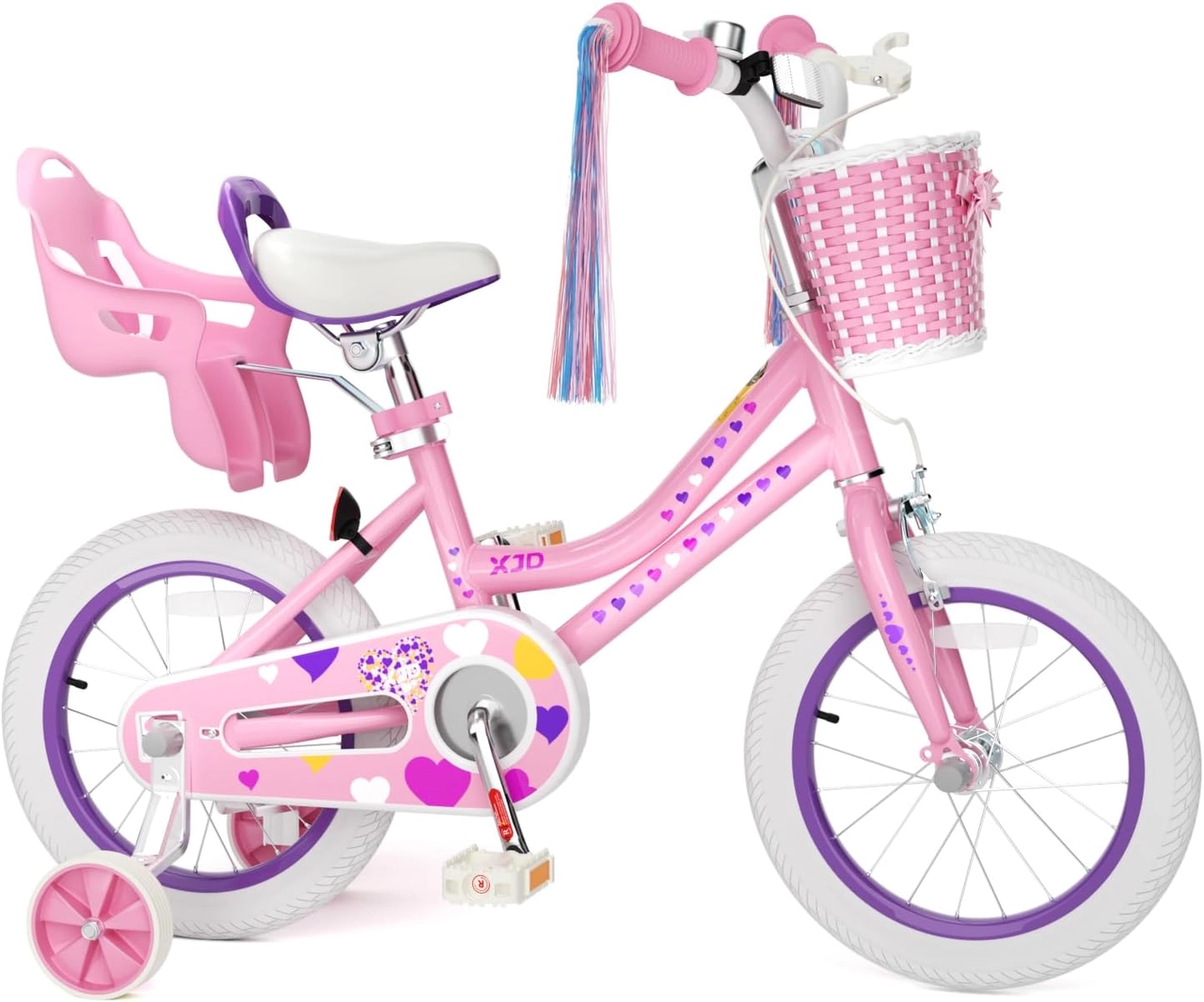 Pink Girls' 12/14/16" Bike by XJD – Basket & Doll Seat
Available in 12-, 14- and 16-inch labels. Its 14- and 16-inch versions are relevant comparison points for a 6-year-old after measured height and an individual fit check.
 Pink 12/14/16/20" XJD Girls Bike with Training Wheels & Basket
Available in 12-, 14-, 16- and 20-inch labels. Compare the height-appropriate version; the 20-inch option is relevant only from the supplied 48-inch rider-height starting point and after a complete fit check.
 Light Pink XJD Girls' Bicycle with Basket & Training Wheels
This training-wheel bike has 12-, 14-, 16- and 20-inch labels. Its labeled sizes provide comparison options, but measured height, inseam, reach, brake control and confidence must determine fit.
Pink Girls' 12/14/16" Bike by XJD – Basket & Doll Seat is listed in 12-, 14- and 16-inch versions. For this question, its 14- and 16-inch labels allow comparison around the usual 6-year-old range.
Pink 12/14/16/20" XJD Girls Bike with Training Wheels & Basket is offered with 12-, 14-, 16- and 20-inch labels. Its 20-inch option is relevant only if the child measures at least 48 in (122 cm) and passes the complete fit check.
Light Pink XJD Girls' Bicycle with Basket & Training Wheels likewise has 12-, 14-, 16- and 20-inch labels. Compare the applicable labeled versions using the same measured-height and control checks; the catalog title itself does not establish fit.
All three are categorized as training-wheel bikes. Training wheels may relate to current confidence, but they do not make an oversized frame suitable. For assembly, adjustment, compatibility, load limits, maintenance or torque requirements, follow the exact product manual or consult a qualified bicycle mechanic.
Do this before choosing
- Measure standing height and inseam rather than relying on age.
- Use 16 inches as the first trial at 40–48 in (102–122 cm).
- Compare 14 inches for a smaller or less-confident rider; try 18 inches for a taller rider within its range, even though no supplied product offers it.
- Consider 20 inches only from 48 in (122 cm), with comfortable stand-over, reach, braking and control.
- Fit a bicycle helmet that sits level and uses its straps according to the helmet manufacturer’s instructions, as advised by the U.S. Consumer Product Safety Commission.
The decision for a 6-year-old is therefore not “buy by birthday”: measure first, begin with the matching range—usually 16 inches—and choose only the size the child can straddle, reach, brake and ride confidently today.
Bikes for your next adventure
-

XJD Girls Bike for Kids Ages 3-8, 12/14/16 Inch with Training Wheels – Purple
The XJD Girls Bike in Purple is a training-wheel bicycle for kids ages 3 to 8, f…$149
$169 -

Pink Girls' 12/14/16" Bike by XJD – Basket & Doll Seat
The XJD Pink Girls' Bike with Basket & Doll Seat is made for riders 71–122 cm ta…$75.99
$99.99 -

XJD Pink Beach Cruiser for Girls – Rear Rack & V-Brake
The XJD Pink Beach Cruiser for girls is the step-up bike for riders who've outgr…$179.99
$209.99