

What is a good bike for a 7 year old
A good bike for a 7 year old is usually a correctly fitted 16-, 18-, or 20-inch bike, chosen by measured height and a hands-on fit check—not age alone.
Start with height, then narrow the wheel size
Measure the child’s height without shoes, standing straight against a wall. Use that measurement to identify a starting range:
| Wheel size | XBikes starting range | What it means at age seven |
|---|---|---|
| 16 Inch | Ages 4–7; 40–48 in / 102–122 cm | Worth checking for a smaller seven-year-old. |
| 18 Inch | Ages 5–9; 43–52 in / 109–132 cm | A possible middle option when the child falls within this height range. |
| 20 Inch | Ages 7–12; 48–60 in / 122–152 cm | A common starting point for a taller seven-year-old, subject to fit and control. |
The ranges overlap deliberately. They help you choose which sizes to try, but they do not prove that a particular bike fits. A child near a boundary may control the smaller size more confidently, while another child of the same age may be ready for the larger one.
Measure inseam and check stand-over clearance
Next, measure the child’s inseam: with shoes on, have the child stand upright with feet slightly apart, then measure from the floor to the crotch. Compare that measurement with the actual stand-over height of the assembled bicycle.
Have the child straddle the bike with both feet flat on the ground. There should be comfortable clearance rather than contact with the top of the frame. Because no universal clearance number is supplied here, assess the exact bicycle in person and follow its manual. Do not buy an oversized bike merely to leave room for growth; the American Academy of Pediatrics advises trying the bicycle and checking stand-over, control, and brake reach.
Test reach, steering, and brake control
Ask the child to sit in a normal riding position while an adult securely supports the bike. The child should be able to hold the grips without stretching, turn the handlebar smoothly, look ahead comfortably, and operate the brakes with control. Check that knees, arms, and handlebar do not interfere during steering.
Confidence matters alongside dimensions. A suitable bike should let the rider start, stop, steer, and dismount without panic or excessive effort. If the child cannot reliably reach or operate the controls, try a different size or design even when the height chart suggests the bike should work.
How the supplied XBikes options compare
These catalog options help answer the question because they cover 16- and 20-inch choices relevant to many seven-year-olds, plus smaller sizes that show why selecting from age alone can be misleading. Their categories also distinguish training-wheel bikes from a kids’ BMX bike.
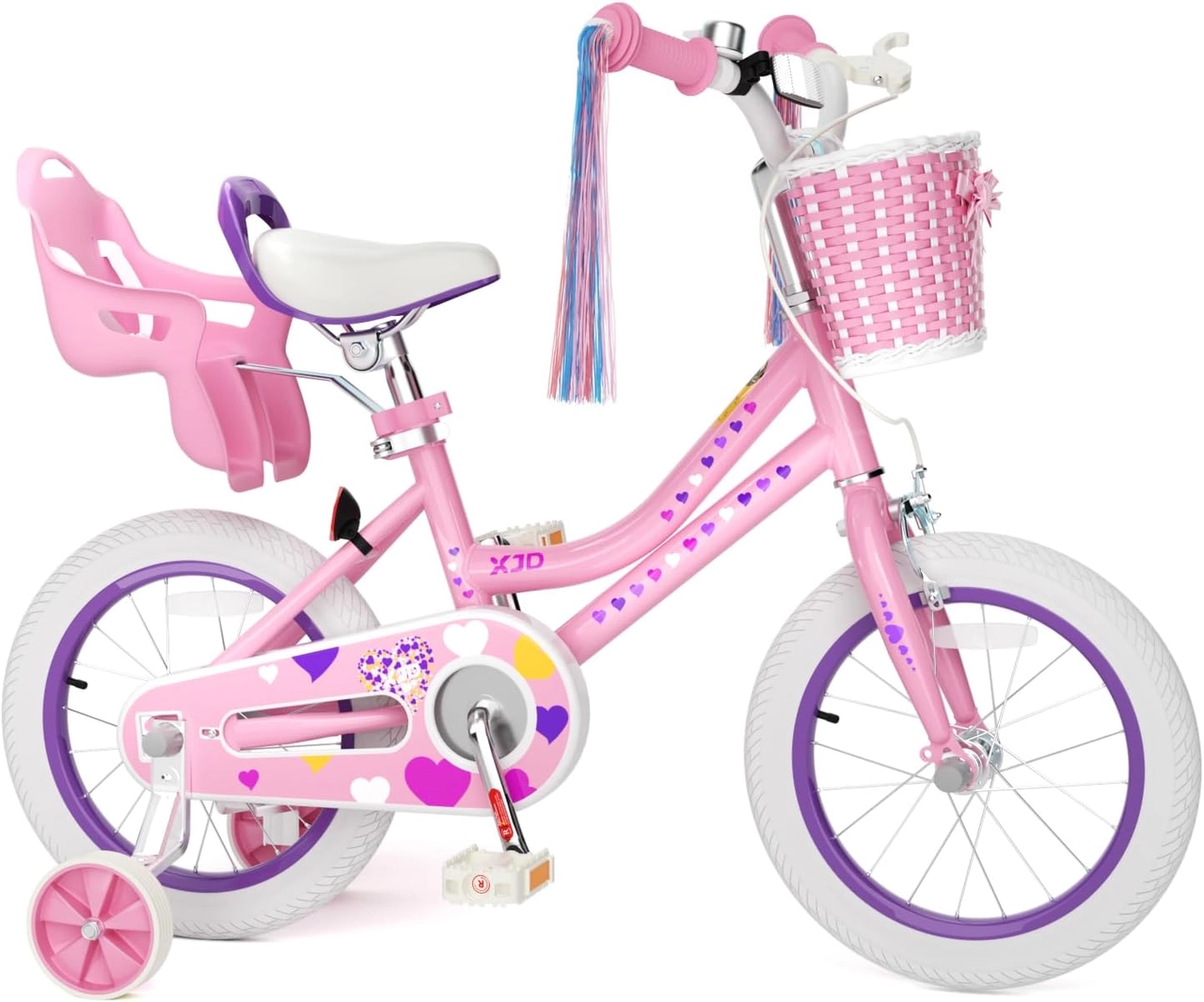 Pink Girls' 12/14/16" Bike by XJD – Basket & Doll Seat
A Training Wheel Bike offered in 12-, 14-, and 16-inch SKU labels. Its 16-inch option may be relevant for a seven-year-old measuring 40–48 inches / 102–122 cm, subject to an individual fit check.
 Blue XJD Freestyle BMX Bike, 20-Inch – No Pegs
This Kids' BMX Bike is identified as a 20-inch model without pegs. Consider it for a seven-year-old within the 48–60 inch / 122–152 cm starting range only after checking stand-over, reach, braking, and confidence.
 Pink 12/14/16/20" XJD Girls Bike with Training Wheels & Basket
A Training Wheel Bike with 12-, 14-, 16-, and 20-inch SKU labels. The 16- and 20-inch choices enable comparison across likely seven-year-old starting ranges, although each requires an individual fit and control check.
Pink Girls' 12/14/16" Bike by XJD – Basket & Doll Seat is listed as a Training Wheel Bike with 12-, 14-, and 16-inch SKU labels. For a seven-year-old, only the 16-inch option falls within the supplied age starting point, covering ages 4–7 and heights 40–48 in / 102–122 cm. The smaller options correspond to younger starting ranges and should not be selected simply because they appear in the same listing.
Pink 12/14/16/20" XJD Girls Bike with Training Wheels & Basket is also in the Training Wheel Bikes category, but it offers both 16- and 20-inch SKU labels as well as 12 and 14 Inch. This makes it relevant when comparing the lower and upper ends of likely sizing for a seven-year-old. There is no 18-inch SKU in the supplied listing.
Blue XJD Freestyle BMX Bike, 20-Inch – No Pegs is categorized as a Kids' BMX Bike and has a Default SKU label. Its exact title identifies it as a 20-inch model without pegs, so it is a candidate only when the child falls within the 20-inch starting range and passes the individual fit and control checks. Do not infer unspecified components or sizing details from the BMX category.
Match the design to current confidence
Training-wheel listings may be relevant when that format matches the child’s present riding stage. A kids’ BMX listing represents a different category, but the category alone does not establish fit, skill suitability, or component details. Compare the child’s ability to balance, start, steer, brake, and stop with the exact assembled bike rather than choosing by appearance or title.
For assembly, training-wheel setup, adjustments, compatibility, maintenance, load limits, or torque, follow the exact product manual or use a qualified bicycle mechanic. Do not improvise specifications that are not provided.
Complete the fit check before choosing
- Measure height and inseam.
- Use 16, 18, or 20 Inch as the initial shortlist according to the supplied height ranges.
- Have the child straddle and sit on each candidate bike.
- Confirm comfortable reach, steering, brake operation, starting, stopping, and dismounting.
- Reject a bike that is oversized or difficult to control, even if it offers more growing room.
Add a properly fitting bicycle helmet. The U.S. Consumer Product Safety Commission advises that it sit level and that its straps be used according to the helmet manufacturer’s instructions. For this seven-year-old, choose the smallest candidate size that provides proper stand-over clearance and confident control now, then verify the exact model against its manual before riding.
Bikes for your next adventure
-

Light Purple XJD Toddler Bike Helmet, Adjustable, Size XS (46–51 cm)
This Light Purple XJD toddler bike helmet is made for the smallest riders — the …$20.39
-

Kids Bike Helmet by XJD for Girls – Pink
The XJD Kids Bike Helmet in Pink is a lightweight multi-sport helmet for girls r…$59.99
$99 -

Blue XJD Kids Bike Helmet for Boys & Girls
The Blue XJD Kids Bike Helmet is a lightweight, adjustable multi-sport helmet fo…$59.99
$99