

What is safer a child bike seat or trailer
For most families, a properly fitted bike trailer is generally the safer choice than a child bike seat because it keeps the child lower and does not raise the bicycle’s center of gravity. Neither option is safe unless it fits the child, bicycle and route, and is used exactly as its manual directs.
Why a trailer usually has the advantage
A child seat places the passenger on the bicycle. The extra weight can change steering, braking and balance, especially while starting, stopping or loading the child. If the bicycle falls, the seat and child fall with it.
A trailer carries the child close to the ground and usually remains separate from an ordinary bicycle tip-over. That lower position is the main reason it is often the safer default. However, a trailer is wider, tracks behind the bicycle and can be less visible to drivers. Curbs, narrow gaps, intersections and passing traffic therefore require deliberate route choices.
A seat may be more practical where a trailer cannot fit, but convenience does not establish safety. The deciding questions are whether the adult can control the loaded bicycle and whether the route safely accommodates the complete setup.
What to measure and compare
Do not choose from the child’s age alone. Before buying either system, record the child’s current height and weight, then check the exact manufacturer’s minimums and limits. Also inspect the bicycle named in the manual rather than assuming every model is compatible.
- For a child seat: confirm bicycle and rack or frame compatibility, permitted child size, secure foot containment, harness adjustment, and adequate clearance from wheels and moving parts.
- For a trailer: measure its full width, check hitch compatibility, verify passenger limits, and compare that width with gates, paths and storage areas.
- For both: check the child’s posture, harness fit, helmet clearance and ability to keep the head supported during the ride.
Use only the exact product manual for assembly, maintenance, load limits, compatibility and torque. If any instruction or attachment point is unclear, have a qualified bicycle mechanic inspect the setup.
Test control before carrying a child
- Install the seat or trailer exactly as directed and perform every required pre-ride check.
- Practise first without the child in a traffic-free area, using a permitted test load if the manual allows one.
- Check starts, straight-line control, turns, braking and dismounting. With a trailer, learn its wider path and turning clearance.
- Load or unload only where the bicycle and attachment cannot roll or topple.
- Choose a low-speed route with enough width and the least practical interaction with motor traffic.
A child should wear a properly fitting bicycle helmet that sits level, with straps adjusted according to the helmet manufacturer’s instructions. A helmet does not correct an incompatible attachment, excessive load or poor route choice.
When neither option is appropriate
Do not use a seat or trailer when the child falls outside its stated limits, cannot maintain the posture required by its manual, or cannot be secured correctly. Stop if the hitch, mounting system, harness or bicycle is damaged, loose or incompatible.
A rear seat is a poor choice when the adult cannot confidently balance and brake the loaded bicycle. A trailer is a poor choice when the route is too narrow for its measured width or routinely exposes its low profile to unsafe traffic conditions. Walking, changing the route or postponing the trip is the safer decision when these problems cannot be resolved.
How the supplied kids’ bikes are relevant
The supplied XBikes products are training-wheel bicycles, not child seats or trailers, so they do not answer the passenger-carrying choice and should not be treated as substitutes. They become relevant only when comparing a later transition to independent riding. The catalog options help by showing available 12, 14, 16 and 20 Inch wheel-size starting points that still require an individual fit check.
 Girls' Training Wheel Bike by XJD, 12–20 Inch Wheels – Blue
A blue training-wheel bicycle offered in 12, 14, 16 and 20 Inch labels. It is relevant only as a future independent-riding comparison, not as a child seat or trailer.
 XJD Girls' Bike with Training Wheels, 12/14/16/20 Inch – Purple
This purple training-wheel bike has 12, 14, 16 and 20 Inch catalog options. Use it as a later riding-fit comparison; supplied facts do not establish passenger-carrying suitability or superior safety.
 XJD Kids Bike for Girls – Pink, 12/14/16/20 Inch with Training Wheels
A pink kids’ training-wheel bike available in 12, 14, 16 and 20 Inch labels. It may inform a later transition to independent riding but does not replace a seat or trailer.
The comparison options are Girls' Training Wheel Bike by XJD, 12–20 Inch Wheels – Blue; XJD Girls' Bike with Training Wheels, 12/14/16/20 Inch – Purple; and XJD Kids Bike for Girls – Pink, 12/14/16/20 Inch with Training Wheels. Each is offered in 12, 14, 16 and 20 Inch labels. The supplied facts do not establish differences in safety, brakes, materials or certification.
| Wheel label | XBikes starting point |
|---|---|
| 12 Inch | Ages 3–4; 34–40 in / 86–102 cm |
| 14 Inch | Ages 3–6; 37–45 in / 94–114 cm |
| 16 Inch | Ages 4–7; 40–48 in / 102–122 cm |
| 20 Inch | Ages 7–12; 48–60 in / 122–152 cm |
These ranges are starting points only. Have the child try the bicycle; never buy oversized solely for growth. Prioritize measured height, inseam, stand-over clearance, reach, brake control and current confidence over age.
Make the decision
Choose a trailer when its limits and hitch match, the route accommodates its measured width, and its lower carrying position is preferable. Choose a seat only when it is fully compatible and the adult can confidently manage the altered balance. If either test fails, use neither until the setup or route changes.
Bikes for your next adventure
-

Kids Bike Helmet by XJD for Girls – Pink
The XJD Kids Bike Helmet in Pink is a lightweight multi-sport helmet for girls r…$59.99
$99 -

Blue XJD Kids Bike Helmet for Boys & Girls
The Blue XJD Kids Bike Helmet is a lightweight, adjustable multi-sport helmet fo…$59.99
$99 -
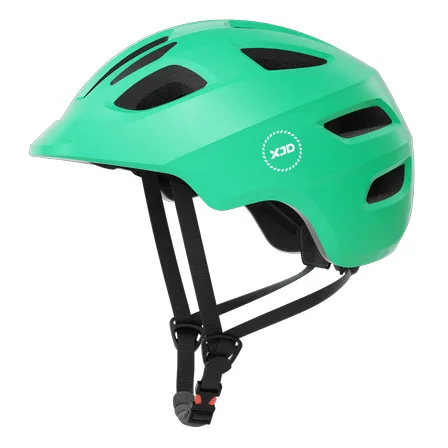
Green XJD Kids Bike Helmet for Boys & Girls
The Green XJD Kids Bike Helmet is a lightweight multi-sport helmet for toddlers …$59.99
$99