

What is safer bike trailer or child seat
A bike trailer is generally the safer choice than a child seat because it is lower and less likely to tip with the adult bicycle. Correct fit, installation, route choice and riding skill still determine real-world safety.
Why a trailer usually has the safety advantage
A trailer carries the child close to the ground and supports itself on separate wheels. If the towing bicycle falls while stopped or at low speed, the trailer may remain upright. Its wider structure can also provide more space around the passenger than a mounted seat.
The tradeoff is visibility and width. A low trailer can be harder for drivers to notice, and its wheels track farther out than the bicycle. Curbs, posts, potholes and narrow gaps therefore require extra clearance. Use the visibility equipment specified by the manufacturer and choose quiet routes with enough room.
A child seat is compact and follows the bicycle’s line, but it places the passenger higher. That added mass changes steering, braking, mounting and balance. A tip while loading the child or stopping can produce a higher fall. Never leave a child in a mounted seat unless the bicycle is being securely controlled as directed by the seat and bicycle manufacturers.
What to measure and compare
Do not decide from the child’s age alone. Before buying either system, record the child’s current height and weight, then compare those measurements with the exact carrier manual. Also check the adult bicycle rather than assuming that any rack, frame or axle will accept any carrier.
- Child limits: Confirm that the measured child and any carried items remain within every stated minimum or maximum in the manual.
- Bicycle compatibility: Verify the required frame, rack, axle or hitch connection with the bicycle and carrier manufacturers.
- Adult control: With the system unloaded first, check mounting, steering, turning radius, braking and stopping balance.
- Route clearance: Measure gates and storage spaces, and consider narrow paths, curbs, traffic and surface quality.
- Child position: Confirm that the restraint fits as the manual illustrates and that clothing cannot reach moving parts.
For assembly, maintenance, load limits, compatibility and tightening requirements, follow the exact product manuals. If the instructions are missing, conflict, or do not clearly cover the bicycle, use a qualified bicycle mechanic.
When a child seat may still make sense
A child seat may be relevant when storage space or narrow access makes a trailer impractical and the adult can confidently manage the altered balance. Its smaller road footprint can be useful on routes where trailer width would create frequent clearance problems.
That convenience does not remove the higher-position risk. Practice loading and unloading with another adult stabilizing the bicycle, then rehearse starts, stops and turns without the child. If the bicycle feels unstable, braking control is uncertain, or compatibility cannot be verified, do not carry the child in that setup.
Safety checks before every ride
- Inspect the attachment, restraint and wheels exactly as the carrier manual requires.
- Check that the child’s bicycle helmet fits properly, sits level and has straps adjusted according to its manufacturer’s instructions.
- Secure loose clothing, straps and belongings away from wheels and other moving parts.
- Test steering and braking in a traffic-free area before entering the planned route.
- Choose a calm route, reduce speed and allow more stopping and turning room than when riding alone.
A helmet is essential protection, but it does not make an incompatible carrier or poorly controlled bicycle safe. Postpone the ride if anything is loose, damaged, unclear or beyond a stated limit.
How the supplied bike relates to this decision
The XJD Girls' Bike with Training Wheels, 12/14/16/20 Inch – Purple is not a trailer or child seat. Its supplied options are 12 Inch, 14 Inch, 16 Inch and 20 Inch, so it is relevant only when the child is ready to move from being a passenger toward riding a separately fitted training-wheel bicycle. It does not establish which passenger carrier is safer.
These catalog options help answer the title by showing the separate, later choice of an independently ridden bike; they should not be treated as carrier components or substitutes for a trailer or child seat.

As starting points, XBikes associates 12 Inch with 34–40 in / 86–102 cm, 14 Inch with 37–45 in / 94–114 cm, 16 Inch with 40–48 in / 102–122 cm, and 20 Inch with 48–60 in / 122–152 cm. Measure height and inseam, then have the child try the bicycle. Check stand-over clearance, reach, brake control and current confidence; never buy an oversized bicycle merely for growth.
Make the safer choice for your ride
Choose a trailer when both systems fit correctly and its extra width can be managed on your route; its lower, independently supported position generally gives it the safety edge. Choose a child seat only when compatibility is explicitly confirmed and the adult can control the higher load without hesitation. If either condition is uncertain, stop and have the complete bicycle-and-carrier combination checked by a qualified mechanic before carrying the child.
Bikes for your next adventure
-

Kids Bike Helmet by XJD for Girls – Pink
The XJD Kids Bike Helmet in Pink is a lightweight multi-sport helmet for girls r…$59.99
$99 -

Blue XJD Kids Bike Helmet for Boys & Girls
The Blue XJD Kids Bike Helmet is a lightweight, adjustable multi-sport helmet fo…$59.99
$99 -
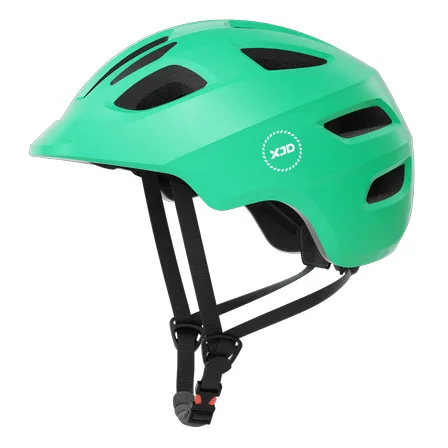
Green XJD Kids Bike Helmet for Boys & Girls
The Green XJD Kids Bike Helmet is a lightweight multi-sport helmet for toddlers …$59.99
$99