

What is the height range for a 20 inch bike
A 20-inch bike generally fits riders 48–60 inches (122–152 cm) tall, usually ages 7–12. Height is only a starting point: confirm inseam clearance, reach, brake control and confidence on the exact bicycle before buying.
Measure the rider before comparing bikes
Measure the child without shoes, standing straight against a wall. Record total height from the floor to the top of the head. This is the measurement to compare with the XBikes 20-inch starting range of 48–60 inches (122–152 cm).
Next, measure inseam. Have the child stand with feet slightly apart and place a firm, thin book between the legs, level and raised gently to represent the saddle contact point. Measure from the floor to the top edge of the book. Keep this measurement available when checking the geometry or sizing instructions for a specific bicycle.
Do not choose from age alone. Children of the same age can have different leg lengths, arm lengths and riding abilities. The stated age range of 7–12 is a broad reference, while measured height and an individual fit check are the more useful evidence.
What to check on the exact 20-inch bike
Have the child try the assembled bicycle whenever possible. With the child standing over the frame, there should be usable clearance rather than contact with the top tube. Follow the exact product manual for the intended stand-over and adjustment method because frame shapes differ.
Then check the riding position. The child should be able to reach the handlebars without an exaggerated stretch, steer through turns while remaining balanced, and operate the brake controls reliably. Controls that are difficult to reach or squeeze are a sign that the bike is not yet a workable fit, even when the height chart appears to match.
Confidence matters as well. A rider near the lower end of the range may still need a smaller bicycle if starting, stopping or turning feels uncertain. Do not buy an oversized bike merely to leave growing room; a bicycle that compromises present control is not a suitable fit.
How the neighboring wheel sizes compare
| Wheel size | XBikes rider-height starting point | Typical age |
|---|---|---|
| 16 Inch | 40–48 in / 102–122 cm | 4–7 |
| 18 Inch | 43–52 in / 109–132 cm | 5–9 |
| 20 Inch | 48–60 in / 122–152 cm | 7–12 |
| 24 Inch | 54–64 in / 137–163 cm | 10–14 |
These ranges overlap because wheel diameter does not describe every part of a bicycle’s fit. If the child falls in an overlap, compare the exact frames in person and favor the option on which the rider can stand over, reach, brake and maneuver confidently.
Relevant XBikes catalog comparisons
The supplied catalog includes two options with an available 20-inch label and one smaller-size comparison. They help narrow the catalog search, but their wheel labels do not replace the measurements and control checks above.
 XJD Kids Bike for Girls – Pink, 12/14/16/20 Inch with Training Wheels
Offers an available 20-inch label, alongside 12-, 14- and 16-inch options. Its 20-inch version is relevant only after the rider’s height and individual control fit are checked.
 XJD Light Purple Girls Bike with Basket, Training Wheels, 12/14/16/20 Inch
Although “20 Inch” appears in the exact catalog title, the supplied available labels are 12, 14 and 16 Inch. Treat this product as a smaller-size comparison, not an available 20-inch option.
 XJD Kids Beach Cruiser Bicycle, Rear Rack & V-Brakes, Mint Green
Lists available 20-, 24- and 26-inch options, making its 20-inch version relevant to the requested range and its other sizes useful comparison points. Confirm reach and V-brake control on the exact bicycle.
XJD Kids Bike for Girls – Pink, 12/14/16/20 Inch with Training Wheels lists available 12-, 14-, 16- and 20-inch size labels. Its 20-inch option is relevant when the rider measures within the starting range and passes an individual fit check.
XJD Kids Beach Cruiser Bicycle, Rear Rack & V-Brakes, Mint Green lists 20-, 24- and 26-inch options. That makes it useful for comparing a 20-inch selection with the next listed wheel sizes, but the rider must still be able to reach and control its V-brakes on the exact bike.
XJD Light Purple Girls Bike with Basket, Training Wheels, 12/14/16/20 Inch includes “20 Inch” in its catalog title, but the supplied available SKU labels are only 12, 14 and 16 Inch. Based on the provided catalog facts, it should be treated as a smaller-size comparison rather than an available 20-inch choice.
When a 20-inch bike is not the right choice
- The rider is below 48 inches (122 cm) and cannot comfortably manage the exact frame.
- The rider is within the stated range but lacks stand-over clearance, comfortable reach or dependable brake control.
- The rider is above 60 inches (152 cm), feels cramped, or cannot use a normal steering position.
- The child can sit on the bike but cannot start, stop, turn and dismount with current confidence.
A smaller or larger wheel-size range is only a new comparison point, not an automatic answer. Recheck the same fit factors on every candidate. For assembly, adjustments, compatibility, load limits, maintenance and torque requirements, follow the exact product manual or ask a qualified bicycle mechanic.
Make the final decision
Choose a 20-inch bike only if the child’s measured height is around 48–60 inches (122–152 cm) and the exact bicycle provides suitable stand-over clearance, natural reach, usable brakes and confident control. Before riding, add a properly fitting bicycle helmet: it should sit level and have its straps adjusted according to the helmet manufacturer’s instructions.
If those checks do not all pass, do not size up for growth or rely on the age label. Compare the adjacent wheel-size starting points, try the exact bicycle again, and select the size the child can control now.
Bikes for your next adventure
-
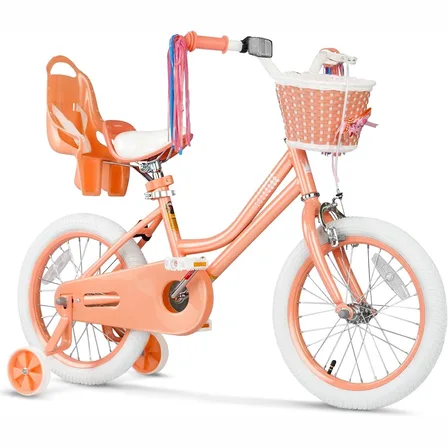
Girls 12/14/16 Inch Kids Bike by XJD with Training Wheels – Peach
The XJD Girls Bike in Peach is a training-wheel bike built for girls roughly 3 t…$149
$169 -

26-Inch XJD Beach Cruiser Bike for Girls – Purple, V-Brake
This XJD 26-inch purple beach cruiser is sized for big kids and teens — suggeste…$218.49
$229.99 -
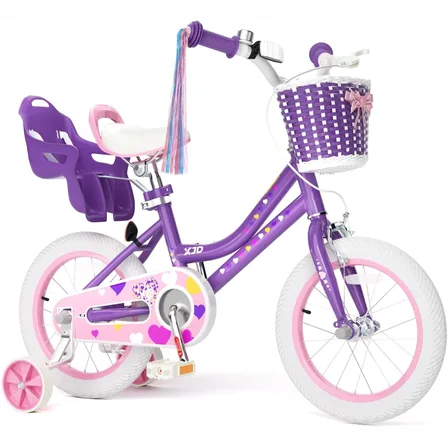
XJD Light Purple Girls Bike with Basket, Training Wheels, 12/14/16/20 Inch
The XJD Girls Bike with Basket in Light Purple is a single-speed training-wheel …$99.99
$119.99