

What safest for bike with child
The safest bike for a child is one that fits now, gives them confident control, and is paired with a properly fitted helmet—not an oversized bike chosen for growth.
Measure the child before comparing bikes
Start with the child’s standing height and inseam, measured while they wear the shoes they will ride in. Height narrows the wheel-size range; inseam helps you judge whether the child can stand over the bicycle without being trapped against the frame.
Age is only a starting point. Use the child’s measured height first, then confirm stand-over space, reach, brake control and confidence on the actual bicycle.
| Wheel size | Starting age | Rider height |
|---|---|---|
| 12 Inch | 3–4 | 34–40 in / 86–102 cm |
| 14 Inch | 3–6 | 37–45 in / 94–114 cm |
| 16 Inch | 4–7 | 40–48 in / 102–122 cm |
| 18 Inch | 5–9 | 43–52 in / 109–132 cm |
| 20 Inch | 7–12 | 48–60 in / 122–152 cm |
| 24 Inch | 10–14 | 54–64 in / 137–163 cm |
| 26 Inch | Youth and adults | Over 60 in / 153 cm |
Overlapping ranges are intentional starting points, not proof that either size fits. A child near a boundary should try the relevant sizes rather than automatically moving up.
Check control on the actual bike
Have the child try the bicycle in a safe, level area with adult supervision. The American Academy of Pediatrics advises against buying an oversized bicycle for a child to grow into. A larger wheel label does not make a bike safer if the rider cannot manage it.
- Stand-over: The child should be able to straddle the bike without the frame preventing a stable stance.
- Reach: They should reach the handlebar without stretching, locking their arms or losing a balanced posture.
- Brake control: They must be able to reach and operate the bicycle’s brakes reliably. Do not assume brake details that are not stated; inspect the specific bike.
- Starts and stops: The rider should start, steer, slow and stop without panic or repeated loss of balance.
- Confidence: Choose the size the child can control today, even when age and height charts suggest more than one possibility.
When training wheels are relevant
Training wheels may help a child who is not ready to balance independently, but they do not correct a poor fit. The child still needs suitable stand-over clearance, comfortable reach and dependable stopping control.
The supplied catalog option, Light Pink XJD Girls' Bicycle with Basket & Training Wheels, is categorized as a Training Wheel Bike and is offered with 12 Inch, 14 Inch, 16 Inch and 20 Inch SKU labels. Those choices help compare several XBikes height starting points for a rider who may benefit from training wheels. The catalog facts do not establish the bike’s brake type, weight, load limit, materials or certification, so verify those details in the exact product manual or with a qualified bicycle mechanic.

This product is relevant only if one of its listed wheel sizes matches the child’s measured range and the individual fit check succeeds. It has no 18 Inch, 24 Inch or 26 Inch label in the supplied facts; if the child needs one of those sizes, it is not an equal substitute and should only serve as a nearby comparison point.
Fit the helmet every time
A bicycle helmet is part of the safety decision, regardless of wheel size or training wheels. The U.S. Consumer Product Safety Commission advises that the helmet must fit properly, sit level on the head and use its straps according to the helmet manufacturer’s instructions.
Replace guesswork with a fit check: confirm that the helmet remains level and secure when fastened, and follow the manufacturer’s instructions for adjustment, replacement and care. A loose, tilted or incorrectly strapped helmet should be corrected before the ride begins.
Verify assembly and condition
Before riding, an adult should check that the bicycle is correctly assembled and in sound condition. Because the supplied catalog facts do not provide assembly steps, torque settings, maintenance intervals, compatibility rules or load limits, follow the exact bicycle manual. If anything is unclear, loose, damaged or difficult to operate, use a qualified bicycle mechanic.
Recheck fit as the child grows or gains skill. A bike that fitted previously can become cramped, while a newly selected larger bike may still be too difficult to control.
Make the safest choice now
- Measure standing height and inseam.
- Use the XBikes table to identify candidate wheel sizes.
- Have the child try each candidate and check stand-over, reach, braking, starts, stops and confidence.
- Select a bike they can control now; do not size up solely for future growth.
- Fit the helmet correctly and verify assembly before the first ride.
For this decision, choose the correctly fitted wheel size the child can confidently control today. Consider the supplied training-wheel bicycle only when its available size, the child’s present ability and the hands-on fit check all agree.
Bikes for your next adventure
-

Blue XJD Girls Bike with Training Wheels – 12/14/16 Inch
If you're shopping for a first pedal bike for a daughter roughly 3 to 8 years ol…$149
$169 -

XJD Girls BMX Bike 12/14/16 Inch with Training Wheels – Pink Blue
The XJD Girls BMX Bike in Pink/Blue is built as a first pedal bike for kids roug…$99.99
$119.99 -
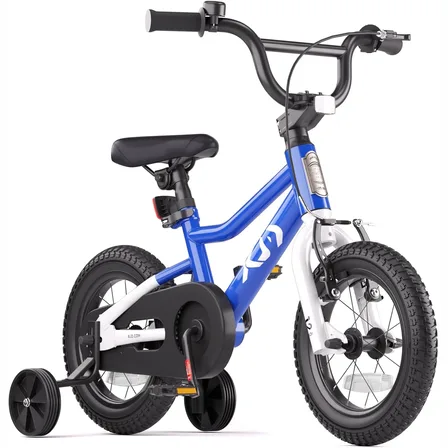
XJD Boys & Girls BMX Bike with Training Wheels, 12/14/16" – Blue
The XJD Boys & Girls BMX Bike in Blue is a first pedal bike for kids roughly age…$99.99
$119.99