

What size bicycle does a 6 year old need
Most 6-year-olds need a 16-inch bicycle, but height and fit decide: start there if your child is 40–48 in (102–122 cm) tall.
Choose the wheel size from measured height
Measure your child without shoes, standing straight against a wall. Record total height, then compare it with the XBikes starting points below. Age is only a rough filter; children of the same age can differ considerably in height, leg length, reach and riding confidence.
| Wheel size | XBikes age starting point | Rider height | Meaning for a 6-year-old |
|---|---|---|---|
| 14 Inch | Ages 3–6 | 37–45 in / 94–114 cm | Check for a shorter child, especially below 40 in. |
| 16 Inch | Ages 4–7 | 40–48 in / 102–122 cm | The usual starting size at age six. |
| 18 Inch | Ages 5–9 | 43–52 in / 109–132 cm | Compare when the child is taller or between ranges. |
| 20 Inch | Ages 7–12 | 48–60 in / 122–152 cm | Consider only if measured height and an individual fit check support it. |
The ranges overlap, so height cannot settle every case. If your child is 43–45 in (109–114 cm), for example, 14-, 16- and 18-inch starting ranges overlap. A real fit check should break the tie.
Measure inseam before the fit check
For inseam, have the child stand in socks with feet slightly apart. Place a firm book upright between the legs, gently raising it to simulate the bicycle saddle, and measure from the floor to the book’s top edge. Keep this measurement with the child’s height when comparing bicycles.
No inseam-to-wheel-size conversion is supplied here because frame shapes and stand-over clearance can differ even when wheel labels match. Instead, use the inseam during an actual try-on: the child must be able to straddle the bicycle with practical clearance and get on and off without struggling.
Run a hands-on fit test
Do not buy a bicycle that is deliberately oversized for future growth. Have your child try the exact bicycle and check these points:
- Stand-over: the child can straddle the frame comfortably rather than being pressed against it.
- Reach: seated in a normal riding position, the child can hold the handlebar without excessive stretching, locked elbows or leaning awkwardly.
- Brake control: the child can reach and operate the bicycle’s braking controls confidently. Check the exact model rather than assuming all children’s bicycles are alike.
- Starting and stopping: the child can mount, begin riding, stop and dismount while remaining in control.
- Confidence: the bicycle feels manageable at low speed and while turning. Fear or loss of control is a reason to compare another fit.
If two sizes appear plausible, choose according to controlled handling and the better current fit—not the larger label. For assembly, adjustment, compatibility, maintenance or torque instructions, follow the exact product manual or use a qualified bicycle mechanic.
How the supplied XBikes options compare
These catalog options are useful because all three include 14- and 16-inch choices, the two most likely comparison points for many 6-year-olds. Two also offer 20-inch choices for a child whose measured height and hands-on fit justify that larger wheel size. None offers an 18-inch SKU, so they cannot substitute for an 18-inch bicycle when that is the size the fit check supports.
 XJD Kids' Training Wheel Bike for Boys & Girls, 12/14/16 Inch – White
Offers 12-, 14- and 16-inch SKUs. Its 14- and 16-inch versions are relevant comparison options for a 6-year-old, subject to measured height and an individual fit check.
 Girls' Training Wheel Bike by XJD, 12–20 Inch Wheels – Blue
Offers 12-, 14-, 16- and 20-inch SKUs. Compare the 14- and 16-inch versions first for many 6-year-olds; the 20-inch version requires supporting height and fit. No 18-inch SKU is supplied.
 XJD Girls' Bike with Training Wheels, 12/14/16/20 Inch – Purple
This Training Wheel Bikes model offers 12-, 14-, 16- and 20-inch SKUs. The 14- and 16-inch options may be relevant after measuring; its 20-inch option needs a successful individual fit check. No 18-inch SKU is supplied.
XJD Kids' Training Wheel Bike for Boys & Girls, 12/14/16 Inch – White is listed in Training Wheel Bikes and has 12-, 14- and 16-inch SKU labels. For this question, compare its 14- and 16-inch versions against the child’s measurement and actual control.
Girls' Training Wheel Bike by XJD, 12–20 Inch Wheels – Blue is also a Training Wheel Bikes model. Its supplied SKU labels are 12, 14, 16 and 20 Inch, allowing comparison across the likely 14- or 16-inch choices and a possible 20-inch fit. It has no supplied 18-inch option.
XJD Girls' Bike with Training Wheels, 12/14/16/20 Inch – Purple has the same supplied size labels: 12, 14, 16 and 20 Inch. Treat those labels as comparison choices, not proof of fit; this model likewise does not include a supplied 18-inch SKU.
Training wheels may be relevant when a child needs that type of bicycle, but their presence does not make an incorrectly sized frame suitable. Select wheel size and confirm reach, stand-over, braking control and confidence on the exact version.
Complete the decision safely
Begin with a 16-inch bicycle for a 6-year-old measuring 40–48 in (102–122 cm). Compare 14 inches for a shorter rider, 18 inches for a child whose measurements and trial favor it, or 20 inches only when the child is at least around the supplied 48-inch starting point and the full fit check succeeds.
Once the bicycle fits, add a properly fitting bicycle helmet. It should sit level, with its straps used according to the helmet manufacturer’s instructions. Your next step is simple: measure height and inseam, shortlist the matching wheel sizes, and let the child try the exact bicycle before choosing.
Bikes for your next adventure
-

Light Purple XJD Toddler Bike Helmet, Adjustable, Size XS (46–51 cm)
This Light Purple XJD toddler bike helmet is made for the smallest riders — the …$20.39
-
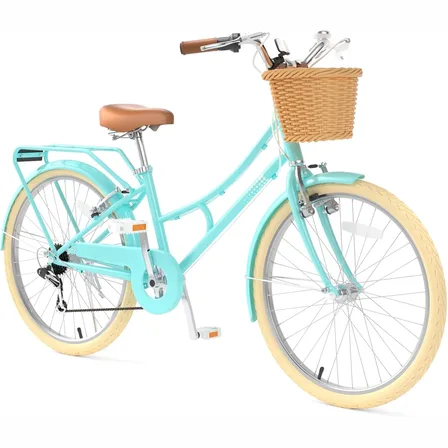
XJD 24-Inch Green Beach Cruiser Bike with U-Brake
This XJD 24-inch beach cruiser in green is made for riders about 4'8" to 5'4" ta…$159.99
$199.99 -

XJD Boys 12/14/16" Training Wheel Bike – Blue
The XJD Boys Bike in Blue is a training wheel bike for riders 71–122 cm tall—rou…$169
$199