

What size bicycle is best for a 6 year old
For most 6-year-olds, start by comparing 14-, 16-, and 18-inch bicycles. Choose by measured height and an in-person fit check, not age alone.
Which wheel size should you check first?
Measure your child’s height without shoes, then use the XBikes ranges below as starting points. A 6-year-old may fit more than one range, so age cannot settle the decision.
| Wheel size | XBikes age starting point | Rider height starting point |
|---|---|---|
| 14 Inch | Ages 3–6 | 37–45 in / 94–114 cm |
| 16 Inch | Ages 4–7 | 40–48 in / 102–122 cm |
| 18 Inch | Ages 5–9 | 43–52 in / 109–132 cm |
If your child is 40–45 inches tall, both the 14- and 16-inch ranges overlap. At 43–48 inches, the 16- and 18-inch ranges overlap. In either case, compare the actual bicycles and choose the one the child can control confidently. Do not automatically select the larger option for extra growing room.
Measure height and inseam before shopping
For height, have the child stand straight against a wall without shoes. Keep their feet flat and mark the top of the head, then measure from the floor to the mark.
For inseam, have the child stand with feet slightly apart. Place a firm, thin book between the legs and raise it gently to imitate the bicycle saddle. Measure from the floor to the top edge of the book. Keep this measurement available when checking the bicycle’s stand-over clearance and saddle adjustment instructions.
Do not turn the inseam measurement into a wheel size by itself. Bicycle frames can differ even when their wheels share the same label. Height narrows the options; inseam, reach, brake access, and confidence determine whether a particular bicycle fits.
Do the fit check on the actual bicycle
Have the child try the bicycle rather than relying only on a box label or age recommendation. The American Academy of Pediatrics advises against buying an oversized bicycle merely for growth and emphasizes stand-over, control, and brake reach.
- Check stand-over: With the child straddling the frame and both feet on the ground, confirm that they can stand comfortably rather than being forced onto tiptoes or against the frame.
- Check starting and stopping: The child should be able to get into riding position, begin moving, and stop without the bicycle pulling them off balance.
- Check reach: Seated normally, they should reach the handlebar without stretching, locking their elbows, or losing a stable posture.
- Check brake control: They must be able to reach and operate the bicycle’s brakes as designed while keeping control of the handlebar.
- Watch confidence: Hesitation caused by excessive height, reach, or weight of handling is a fit warning, even if the age and height chart appears suitable.
How the supplied catalog option helps
The XJD Pink Girls' Bike – Kids 12/14/16 Inch Training Wheel Bicycle is offered in 12 Inch, 14 Inch, and 16 Inch labels. For this question, its 14- and 16-inch versions provide relevant comparison points for many 6-year-olds under the XBikes starting ranges. Its 12-inch version starts at ages 3–4 and heights 34–40 inches, so it will generally be a comparison only for a particularly short rider whose individual fit still needs checking. This product is categorized as a training wheel bike; the supplied catalog facts do not include an 18-inch version.
These particular catalog choices are useful because a parent can compare two commonly overlapping starting sizes—14 and 16 inches—within one listed model, while recognizing that a taller 6-year-old may need an 18-inch fit check elsewhere.

The wheel-size label does not prove fit, and the age wording in the product title is only a catalog label. The supplied facts do not establish brake type, bicycle weight, load limit, assembly details, or whether its training-wheel setup suits a particular child. Consult the exact product manual for those details, and use a qualified bicycle mechanic when assembly or adjustment is uncertain.
When 14, 16, or 18 inches is the better starting point
- Begin with 14 Inch when the measured height falls within 37–45 inches / 94–114 cm, especially if the child is less confident or the 16-inch bicycle compromises stand-over, reach, or control.
- Begin with 16 Inch when height falls within 40–48 inches / 102–122 cm and the child can comfortably stand over, steer, reach the controls, start, and stop.
- Begin with 18 Inch when height falls within 43–52 inches / 109–132 cm, but only keep it in consideration if the actual fit remains manageable. The supplied product is not an 18-inch substitute.
If the child falls near a boundary, try both adjacent sizes. Prefer present control over speculative growth. A bicycle that is difficult to mount, balance, steer, or stop is too demanding now, regardless of the size suggested by age.
Make the final decision
Measure height and inseam, shortlist the matching 14-, 16-, or 18-inch range, and have your 6-year-old try each plausible bicycle. Select the smallest option that provides a comfortable, properly adjustable fit without crowding the rider—not the largest bicycle they can barely manage. Finish by fitting a bicycle helmet so it sits level and secure, with straps adjusted according to the helmet manufacturer’s instructions.
Bikes for your next adventure
-
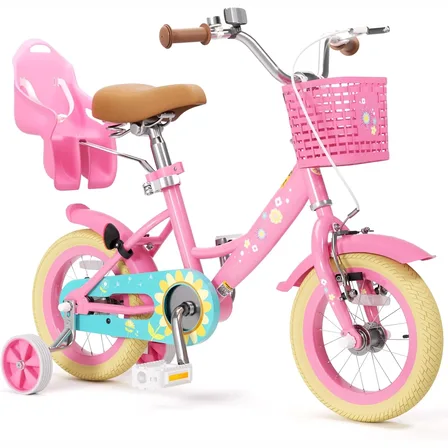
Flower Pink XJD Girls Bike with Doll Seat & Basket
The XJD Flower Pink girls' bike is made for riders 71–122 cm tall (roughly ages …$69.99
-

XJD Girls Bike for Kids Ages 3-8, 12/14/16 Inch with Training Wheels – Purple
The XJD Girls Bike in Purple is a training-wheel bicycle for kids ages 3 to 8, f…$149
$169 -

Pink Girls' 12/14/16" Bike by XJD – Basket & Doll Seat
The XJD Pink Girls' Bike with Basket & Doll Seat is made for riders 71–122 cm ta…$75.99
$99.99