

What size bicycle shud a 6 year old ride
Most 6-year-olds should start by trying a 16-inch or 18-inch bicycle, but measured height and actual fit—not age alone—must decide.
Start with height, then check the bicycle
Measure your child without shoes, standing straight against a wall. Compare that height with the XBikes starting points: a 16-inch bicycle covers 40–48 in (102–122 cm), while an 18-inch bicycle covers 43–52 in (109–132 cm). Both ranges include age 6, so there is no single wheel size that fits every 6-year-old.
Also measure inseam from the floor to the crotch. The supplied sizing standard does not assign numerical inseam ranges, so use that measurement when checking the bicycle’s stand-over clearance and saddle adjustment rather than converting it into a wheel size.
Use this size comparison
| Wheel size | XBikes age starting point | XBikes rider-height starting point | Relevance at age 6 |
|---|---|---|---|
| 14 Inch | Ages 3–6 | 37–45 in / 94–114 cm | Possible for a shorter rider who fits and controls it comfortably |
| 16 Inch | Ages 4–7 | 40–48 in / 102–122 cm | A common starting size to try |
| 18 Inch | Ages 5–9 | 43–52 in / 109–132 cm | Worth trying for a taller child within this range |
| 20 Inch | Ages 7–12 | 48–60 in / 122–152 cm | Consider only if height and the complete fit check support it |
Where height ranges overlap, do not automatically choose the larger wheel. Current confidence, reach, stand-over clearance, and the ability to operate the brakes matter more than leaving extra room for growth.
Perform a hands-on fit check
Have the child try the exact bicycle before deciding. The correct candidate lets the rider mount, start, steer, stop, and get a foot down without struggling or appearing stretched.
- Stand-over: With the child straddling the bicycle, confirm there is comfortable clearance rather than contact with the frame.
- Reach: The child should reach the handlebar while remaining balanced, without locking the arms or leaning excessively forward.
- Brake control: Confirm the child can comfortably reach and operate the bicycle’s brakes. Brake details vary, so follow the exact product manual for adjustment.
- Confidence: Watch for controlled starts, turns, and stops. If the larger candidate makes these harder, it is oversized even if the age label appears suitable.
Do not buy an oversized bicycle merely for the child to grow into. If adjustment, assembly, compatibility, or maintenance is uncertain, consult the exact manual or a qualified bicycle mechanic.
How the supplied 12-, 14-, and 16-inch options help
The catalog options can help families compare a 16-inch fit with smaller 14- and 12-inch configurations. XJD Girls Bike for Kids Ages 3-8, 12/14/16 Inch with Training Wheels – Purple and Girls 12/14/16 Inch Kids Bike by XJD with Training Wheels – Peach are both training-wheel bicycles offered in 12 Inch, 14 Inch, and 16 Inch SKU labels.
For a typical 6-year-old decision, their 16-inch configurations are the most directly relevant supplied options; a 14-inch configuration may remain relevant for a shorter rider whose measured height and hands-on fit support it. The 12-inch starting range is ages 3–4 and 34–40 in (86–102 cm), so it is generally outside the age starting point for a 6-year-old and should be considered only on individual fit evidence.
These exact product titles contain age wording, but that wording is only a catalog label and does not prove fit. Neither supplied product offers an 18-inch or 20-inch SKU, so if the child fits either of those sizes, these products are comparison points—not equivalent substitutes.
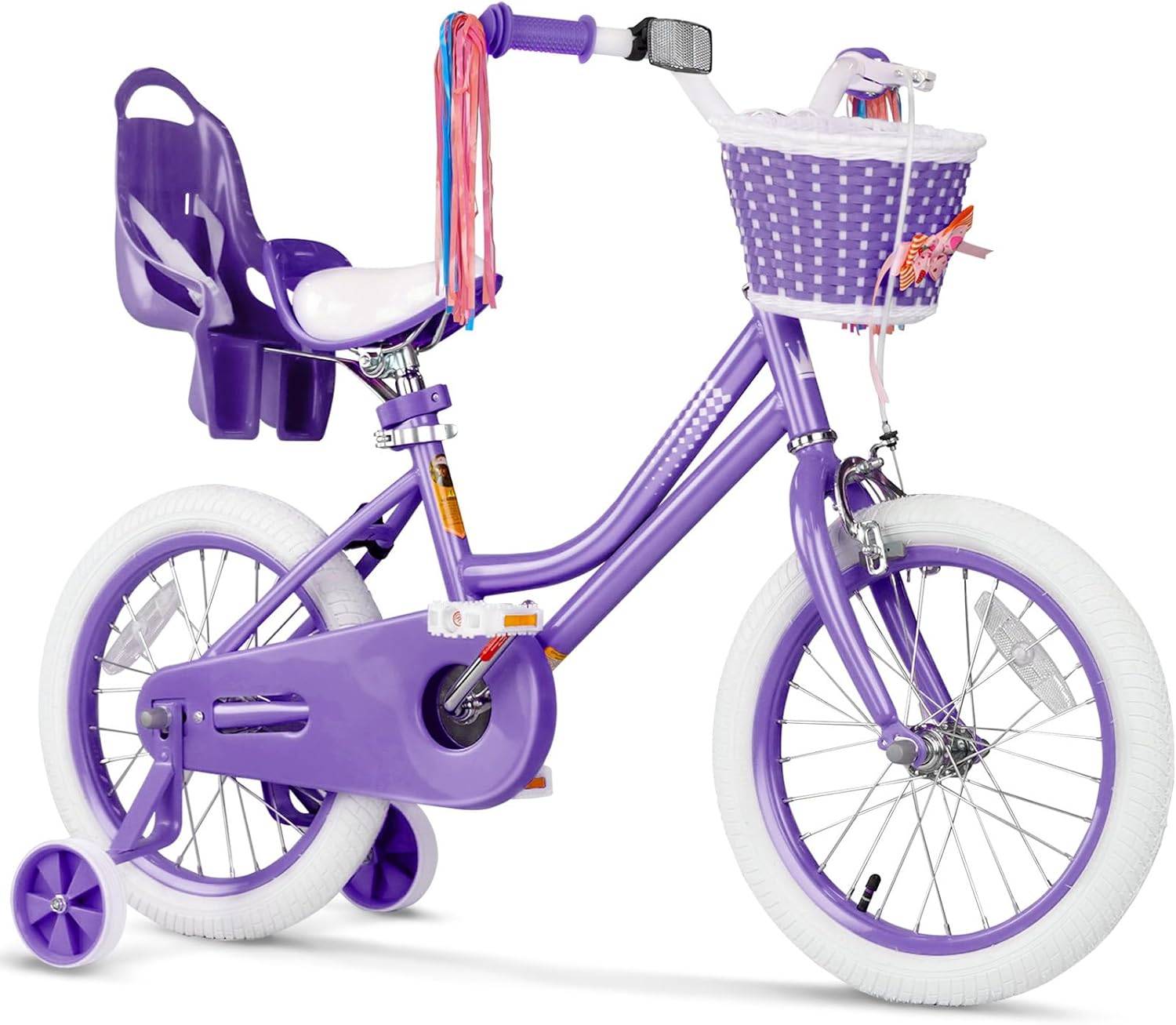 XJD Girls Bike for Kids Ages 3-8, 12/14/16 Inch with Training Wheels – Purple
Available in 12 Inch, 14 Inch, and 16 Inch configurations with training wheels. Its 16-inch option is directly relevant to many age-6 fit checks, while measured height and hands-on control must decide.
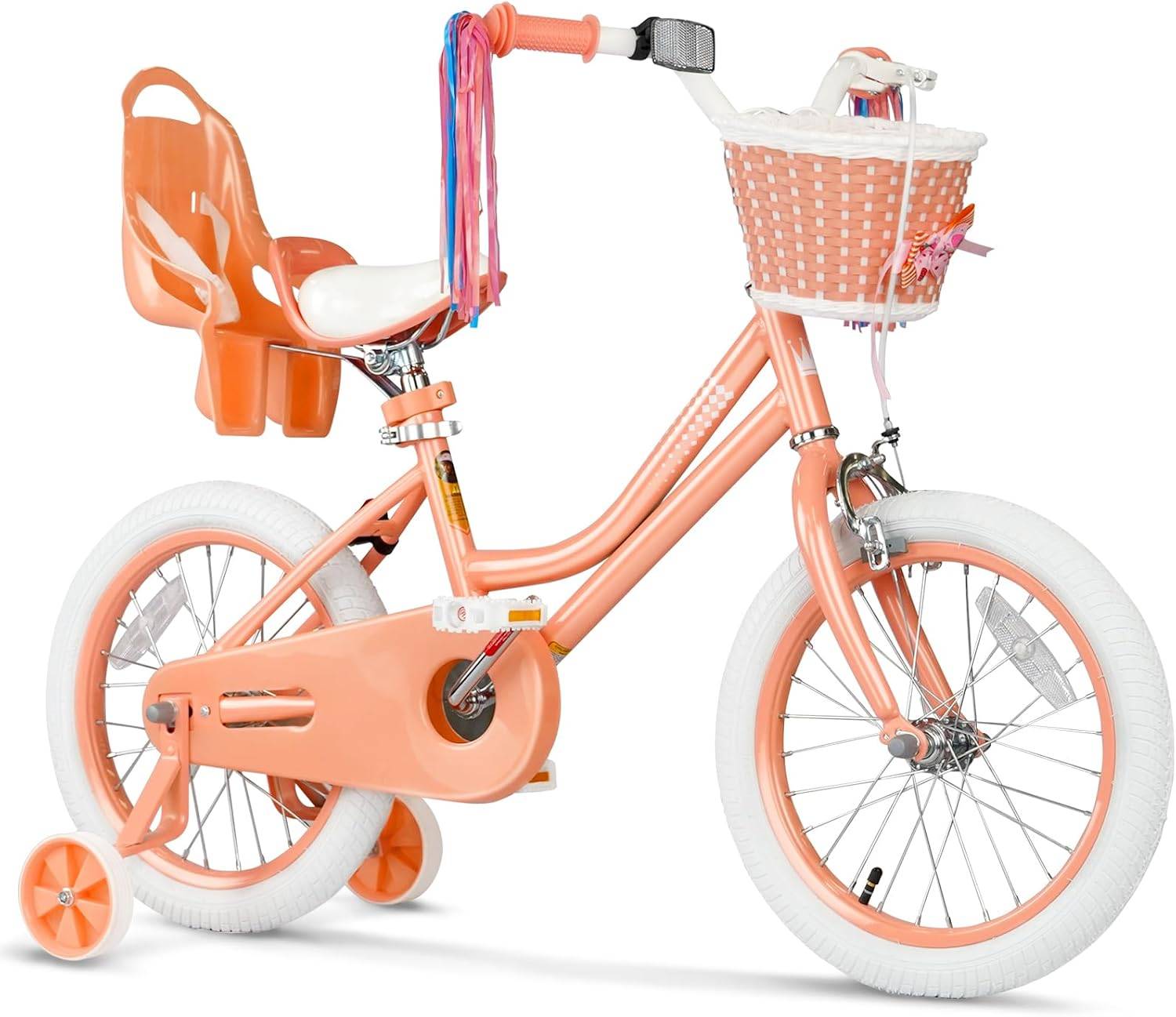 Girls 12/14/16 Inch Kids Bike by XJD with Training Wheels – Peach
A peach training-wheel bicycle with 12 Inch, 14 Inch, and 16 Inch SKU labels. Compare its 16-inch configuration for an age-6 rider, or 14 Inch when the child’s measured height and individual fit support it.
Check safety equipment before riding
Choose a bicycle helmet that fits the child properly. It should sit level and its straps should be used according to the helmet manufacturer’s instructions. Recheck helmet fit whenever it is adjusted or worn over different clothing.
Complete the bicycle’s required assembly and pre-ride checks exactly as its manual directs. When instructions are missing or the bicycle cannot be adjusted so the child controls it confidently, use a qualified bicycle mechanic rather than improvising settings or procedures.
Make the decision
Measure height and inseam first. Try a 16-inch bicycle if the child is 40–48 in (102–122 cm), and compare an 18-inch bicycle if the child is 43–52 in (109–132 cm). In an overlap, choose only the size on which your 6-year-old has comfortable stand-over clearance, natural reach, reliable brake control, and confident starts and stops.
Bikes for your next adventure
-

XJD Girls Bike for Kids Ages 3-8, 12/14/16 Inch with Training Wheels – Purple
The XJD Girls Bike in Purple is a training-wheel bicycle for kids ages 3 to 8, f…$149
$169 -

Pink Girls' 12/14/16" Bike by XJD – Basket & Doll Seat
The XJD Pink Girls' Bike with Basket & Doll Seat is made for riders 71–122 cm ta…$75.99
$99.99 -

Light Pink XJD Girls' Bicycle with Basket & Training Wheels
The Light Pink XJD Girls' Bicycle with Basket & Training Wheels is a retro-style…$109.99
$129.99