

What size bike do i need for 10 year old
For a 10-year-old, start by comparing a 20 Inch and 24 Inch bike. Choose by measured height and actual control: 20 Inch suits 48–60 in (122–152 cm), while 24 Inch suits 54–64 in (137–163 cm).
Use height before age
Age narrows the search, but it cannot confirm fit. XBikes lists 20 Inch bikes as a starting point for ages 7–12 and 24 Inch bikes for ages 10–14. Because those ranges overlap at age 10, the child’s height is the more useful first measurement.
| Wheel size | XBikes age starting point | Rider height | Relevance at age 10 |
|---|---|---|---|
| 20 Inch | Ages 7–12 | 48–60 in / 122–152 cm | Consider when the measured height falls in this range |
| 24 Inch | Ages 10–14 | 54–64 in / 137–163 cm | Compare directly when the child is at least 54 in / 137 cm |
| 26 Inch | Youth and adults | Over 60 in / 153 cm | Consider only above the stated height and after a fit check |
A child between 54 and 60 in (137–152 cm) falls within both the 20 Inch and 24 Inch height bands. Do not resolve that overlap by automatically choosing the larger bike. The better size is the one the child can stand over, reach, steer and stop confidently.
Measure the child correctly
Measure without shoes, using a wall and a level floor. For height, have the child stand straight with heels against the wall and mark the top of the head. Measure from the floor to that mark.
For inseam, have the child stand with feet slightly apart. Place a firm, thin book between the legs and raise it gently to simulate the bicycle saddle, then measure vertically from the floor to the top edge of the book. Record both measurements in inches or centimetres.
Height selects the likely wheel-size range. Inseam then helps you assess stand-over room and whether the child can mount and dismount without the frame obstructing them. Frame shapes differ, so an inseam measurement cannot replace checking the actual bicycle.
Check the bike in person
Have the child try the bicycle in the clothing and closed-toe shoes normally worn for riding. The American Academy of Pediatrics advises against buying an oversized bicycle merely to allow room for growth. During the fit check, confirm that the child can:
- stand over the frame without being forced onto tiptoe or against the frame;
- mount and dismount in a controlled way;
- sit in a stable riding position without an uncomfortable stretch;
- turn the handlebar while keeping control of the bicycle;
- reach and operate the brakes reliably, where hand controls are fitted;
- start, ride slowly, turn and stop without fear or obvious strain.
If the child looks stretched, cannot operate the controls, or loses confidence on the 24 Inch bike, compare the 20 Inch option even when both height bands apply. If the 20 Inch bike feels cramped or restricts comfortable control, try the 24 Inch. Follow the exact product manual for permitted adjustments, assembly and maintenance, or ask a qualified bicycle mechanic.
How the supplied 20 Inch products help
The supplied XBikes products each offer 12 Inch, 14 Inch, 16 Inch and 20 Inch SKU labels and belong to the Training Wheel Bikes category. Their 20 Inch versions are relevant comparison points for a 10-year-old measuring 48–60 in (122–152 cm), especially when that category matches the child’s current confidence. They are not 24 Inch or 26 Inch substitutes.
The three catalog choices let you inspect a relevant 20 Inch size: Light Pink XJD Girls' Bicycle with Basket & Training Wheels; Girls' Training Wheel Bike by XJD, 12–20 Inch Wheels – Blue; and XJD Girls' Bike with Training Wheels, 12/14/16/20 Inch – Purple. Select the exact 20 Inch SKU for this comparison, then verify individual fit rather than relying on the title or color.
 Light Pink XJD Girls' Bicycle with Basket & Training Wheels
Available in a 20 Inch SKU, this Training Wheel Bikes option is relevant when the child measures 48–60 in (122–152 cm) and passes an individual control and fit check.
 Girls' Training Wheel Bike by XJD, 12–20 Inch Wheels – Blue
This Training Wheel Bikes model includes a 20 Inch SKU for comparison within the 48–60 in (122–152 cm) height range; it is not a substitute for a 24 Inch bike.
 XJD Girls' Bike with Training Wheels, 12/14/16/20 Inch – Purple
Its available sizes include 20 Inch, making it a possible comparison for a 10-year-old in the stated height band when the training-wheel category and hands-on fit are appropriate.
When these products are not relevant
These catalog options stop at a 20 Inch SKU. If the child fits and controls a 24 Inch bike better, none of the supplied products provides that exact wheel size; they should be treated only as nearest-size comparison points, not equivalent alternatives. The same limitation applies if a child over 60 in (153 cm) needs to compare a 26 Inch bike.
A training-wheel category may also be unsuitable when the rider’s current skills or goals call for a different setup. Do not infer compatibility, removal procedures or adjustment limits from a title. Check the exact product manual or consult a qualified bicycle mechanic.
Make the final decision
Measure height and inseam today, shortlist 20 Inch or 24 Inch from the table, and have the child try the exact bicycle. Choose only when stand-over, reach, steering, braking and confidence all work together. Finally, use a properly fitting bicycle helmet that sits level, with straps adjusted according to the helmet manufacturer’s instructions, as directed by the U.S. Consumer Product Safety Commission.
Bikes for your next adventure
-
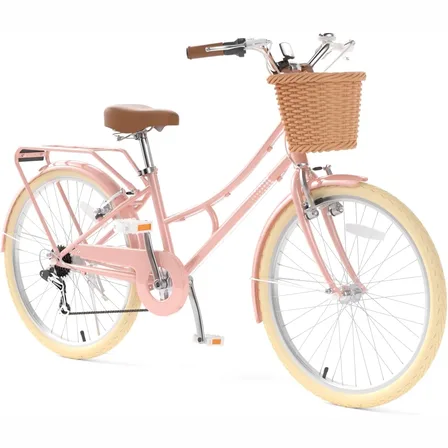
XJD Pink Beach Cruiser for Girls – Rear Rack & V-Brake
The XJD Pink Beach Cruiser for girls is the step-up bike for riders who've outgr…$179.99
$209.99 -

XJD Girls Bike for Kids Ages 3-8, 12/14/16 Inch with Training Wheels – Purple
The XJD Girls Bike in Purple is a training-wheel bicycle for kids ages 3 to 8, f…$149
$169 -

XJD Girls BMX Bike 12/14/16 Inch with Training Wheels – Pink Blue
The XJD Girls BMX Bike in Pink/Blue is built as a first pedal bike for kids roug…$99.99
$119.99